Law and regulationGuide
Nitrates programme 2020: the 170 kg N/ha limit, fertilising dates and tanks, and digestate
The 2020 nitrates programme applies nationwide: a limit of 170 kg N/ha from natural fertilisers, application dates, tanks for 6 and 5 months, and documentation. What does this mean for digestate?
Other language versions: polski.
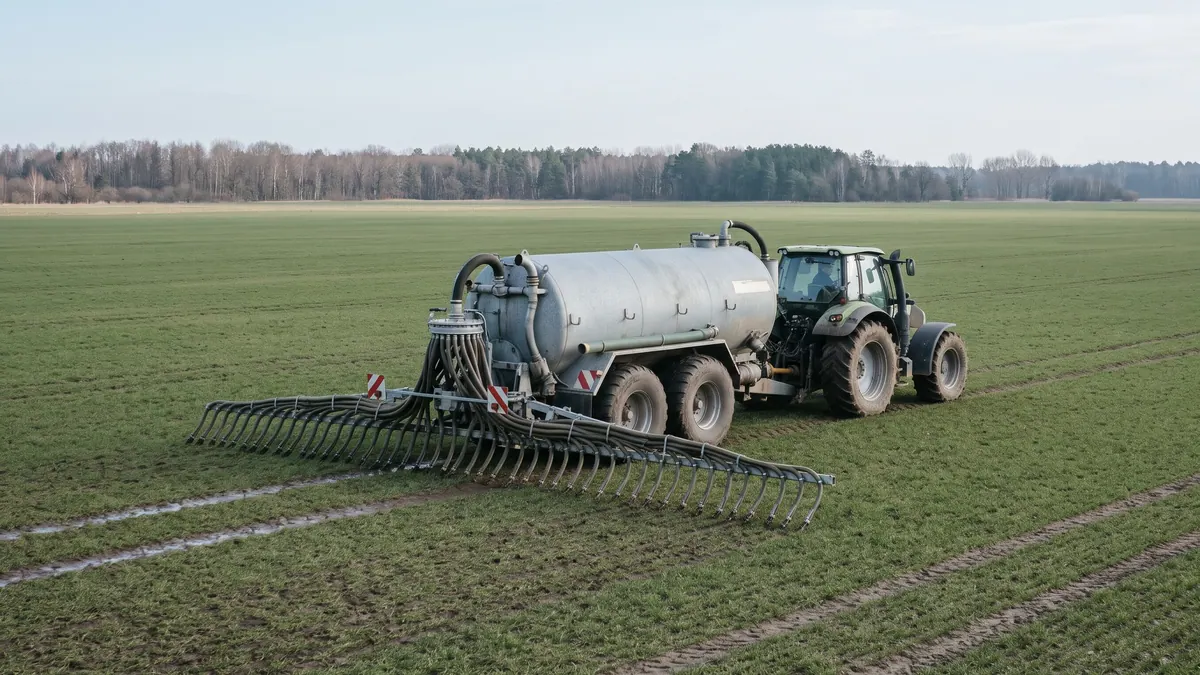
The nitrates programme of February 2020 applies nationwide and introduces three rigid requirements that also affect biogas plants and the recipients of their digestate: a limit of 170 kg N/ha per year from natural fertilisers, fertiliser application dates, and requirements for storage facilities. The document is the Council of Ministers regulation of 12 February 2020 (Dz.U. 2020 item 243), issued under the Water Law and implementing the Nitrates Directive 91/676/EEC. It entered into force the day after publication and replaced the 2018 programme.
The 170 kg N/ha limit
The annual nitrogen dose from natural fertilisers (slurry, liquid manure, solid manure) may not exceed 170 kg N per 1 ha of agricultural land. The permissible fertiliser dose is calculated using the formula: 170 kg N/ha ÷ N content in kg/t or kg/m³. N values are taken from the annex to the programme or from documented testing of the fertiliser. An illustrative example: at 4 kg N/m³ of slurry, the maximum dose is 42.5 m³/ha per year.
For agricultural biogas plants, the programme requires the production of digestate product to be calculated on the basis of the technological documentation of the whole installation, and the annex gives reference values for it. The act on fertilisers and fertilisation defines "natural fertilisers" narrowly (manure, liquid manure, slurry and certain excrement and guano), so when planning digestate doses it is best to rely on your own analysis and agree the method of calculation with an agri-environmental adviser.
Fertiliser application dates
As a rule, fertilisers are applied from 1 March. In the first year of the programme, a start from 15 February was permitted on fields with winter crops, permanent and perennial crops and permanent grassland.
| Type of land | Mineral nitrogen fertilisers and liquid natural fertilisers | Solid natural fertilisers |
|---|---|---|
| Arable land | until 20 October | until 31 October |
| Arable land in municipalities listed in annexes 2 and 3 | shorter dates depending on the list (in autumn 15 or 25 October) | in accordance with the programme table |
| Permanent and perennial crops, permanent grassland | until the end of October | until the end of November |
Check the exact dates for your municipality in the programme table and its annexes. Exceptions also apply: where a crop is established in autumn after late-harvested forecrops, the nitrogen dose from multi-component fertilisers may not exceed 30 kg N/ha and the date of harvest, application and sowing must be documented. In adverse weather (especially excessively wet soil) the final date is 30 November.
Fertilisers are not applied to frozen, flooded, water-saturated or snow-covered soil (this is regulated by the act on fertilisers and fertilisation); soil that thaws during the day at least at the surface is not regarded as frozen.
Distances from water and slopes
- Fertilisers are not applied within a 5 m strip from the bank of lakes (up to 50 ha), watercourses and ditches; for slurry 10 m; 20 m from lakes over 50 ha and water intakes.
- The distances can be halved when the fertiliser is applied directly into the soil or when the dose is split into at least 3 equal parts at intervals of at least 14 days.
- On steeply sloping land the distances are increased by 5 m, and natural fertilisers must be ploughed in or mixed in within 4 hours, at the latest the next day.
Storage
Tanks for liquid fertilisers must hold 6 months of production, and areas for solid fertilisers 5 months; tanks should have a leak-tight base and walls and be covered. Adaptation deadlines: 31 December 2021 for farms above 210 LU (and large poultry and pig farms) and 31 December 2024 for the others. Until adaptation, liquid fertilisers must be stored in leak-tight tanks for at least 4 months of production. Manure may be stored temporarily in the field for up to 6 months, on land with a slope of up to 3% and at a distance of more than 25 m from water; the same place may be used again after 3 years.
Documentation
Farms of at least 10 ha of agricultural land or keeping at least 10 LU must have a nitrogen fertilisation plan (or calculated maximum doses) and keep records of treatments: date, crop and area, type and dose of fertiliser and, on slopes, the date of ploughing in. Documents are kept for 3 years. Agreements for the disposal of natural fertilisers for agricultural use are concluded in writing under pain of nullity (Article 3(3) of the act on fertilisers and fertilisation).
A worked example for a biogas plant and its recipients
An illustrative example (conventional values): if a biogas plant has 10,000 m³ of liquid digestate per year with a content of 4 kg N/m³, the digestate contains 40,000 kg of nitrogen. With a limit of 170 kg N/ha, you need at least 40,000 ÷ 170 ≈ 235 ha of agricultural land on which the digestate will be spread (taking into account that nitrogen from other natural fertilisers applied on those farms also counts towards the limit). The result makes sense only if the actual N content from testing is known, because the composition of digestate depends on the feedstock recipe.
Typical mistakes
- Calculating the dose on the total area instead of on agricultural land. The limit refers to agricultural land.
- No records of treatments. Inspections often begin with the documents: dates, doses, fertiliser and crop.
- Tanks calculated "by eye". The capacity should result from herd turnover and the calculations in the programme annexes, not from an estimate.
- No agreements for the disposal of natural fertilisers. A written agreement is required under pain of nullity.
- Applying too late in autumn. The final dates do not move, unless the exceptions in the programme apply.
What to do first
- Calculate the annual production of fertiliser and the area on which you will use it, with a margin against the 170 kg N/ha limit.
- Check whether the municipality is on the lists in annexes 2 or 3.
- Assess the tank capacity in months of production.
- Order a test of the nitrogen content of the digestate.
- Prepare a template for records and agreements with recipients.
This text is for information purposes only and does not constitute legal advice; before an investment or formal decision, check the current wording of the provisions and consult a lawyer or the competent authority.
Sources
Questions and answers
Does the nitrates programme apply only in vulnerable zones?
No. The programme adopted in February 2020 applies throughout the country. Earlier programmes applied only to areas particularly vulnerable to nitrate pollution.
How do you calculate the maximum slurry dose per hectare?
By dividing 170 kg N/ha by the nitrogen content of the slurry. Example: at 4 kg N/m³ it comes to 42.5 m³/ha a year. The N content is taken from the annex to the programme or from a laboratory test.
Related articles