Technology and operationAnalysis
Dry and wet fermentation: technological differences and applications
Wet fermentation operates at a dry matter content below about 15%, dry fermentation at about 20–40%. A comparison of technologies, substrates, energy consumption and typical problems.
Other language versions: polski.
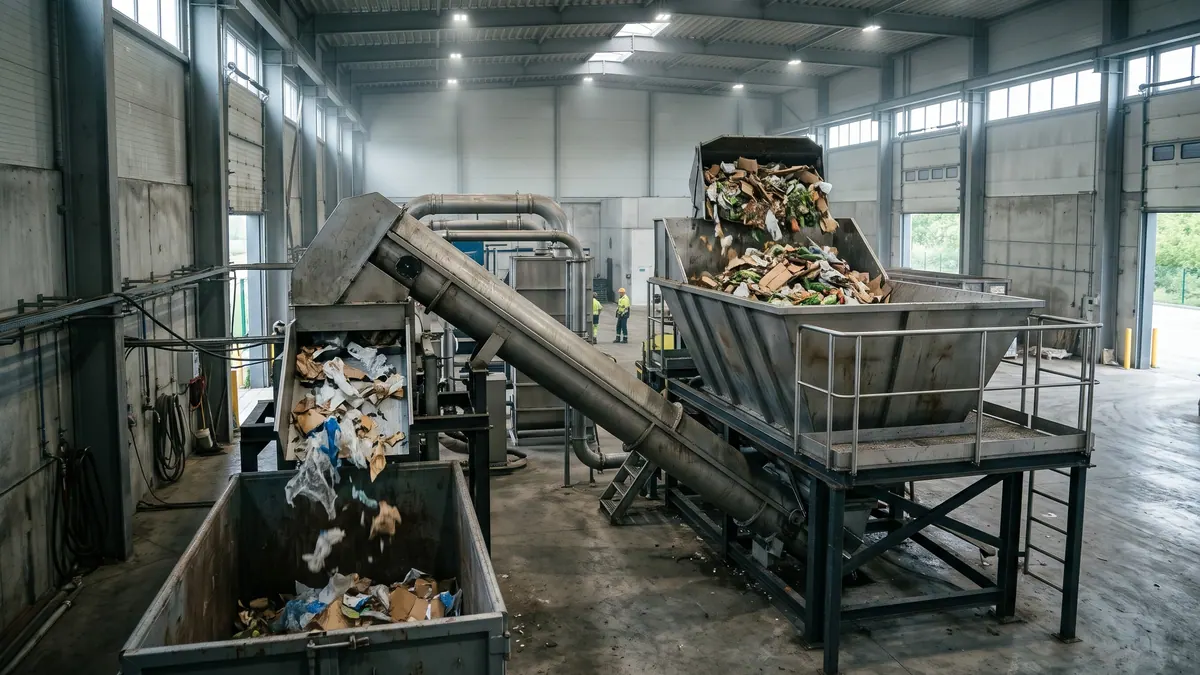
Wet fermentation works with a suspension of dry matter (TS) usually below about 15% and is the basic technology of agricultural biogas plants, while dry fermentation works with material of about 20–40% TS, which is not pumpable in the classical sense. The choice depends on the substrates: wet is flexible and well studied, dry copes better with bedded manure, green waste and bio-waste, using less water and mixing energy. There is no universal answer; the differences concern kinetics, costs and risks.
Definitions and ranges
| Feature | Wet | Dry |
|---|---|---|
| TS content in the reactor | usually below about 15% | about 20–40% |
| Consistency | pumpable suspension | solid, moist material |
| Mixing | mechanical agitators | none or percolate recirculation |
| Pretreatment | shredding, dilution | usually lower requirements |
| Typical substrates | slurry, silages, liquid waste | manure with bedding, bio-waste, green waste, straw |
Types of dry installation
- Garage-type (box) chambers in batch mode — material is loaded by a loader into airtight chambers and sprayed with percolate; after fermentation the chamber is emptied. Several chambers work offset in time so that gas production is continuous.
- Flow reactors (e.g. plug-flow) — material is introduced by a positive-displacement pump or conveyor and moved through a horizontal or vertical reactor.
- Percolation reactors and others — variants with liquid recirculation.
Kinetics and yield
A high TS content slows mass transfer and can cause local acidification. In batch chambers the yield depends on inoculating the new batch with digestate from the previous cycle (inoculation) and on good percolation. Yields per kilogram of VS can be comparable with wet fermentation for suitable substrates, and HRT in batch chambers reaches several dozen days.
Energy and water consumption
Dry technology uses less energy for mixing and heating (less water to heat) and delivers a smaller quantity of liquid digestate. However, it requires loaders and mechanical handling. Wet technology needs energy for pumps and agitators and water for dilution, but it is easier to automate.
Comparison example (simplified)
Assumption: 10,000 t/year of bedded manure at 25% TS.
- In wet technology it has to be diluted to about 10–12% TS, which means adding about 11–15 thousand t of water or slurry; the mass of digestate rises about two- to two-and-a-half-fold.
- In dry technology little additional water is needed (percolate), and the digestate has about 20–25% TS — easier to transport and to treat further (e.g. composting).
- The cost is more complicated loading and unloading logistics and less flexibility of the mix.
Advantages and disadvantages
| Wet | Dry | |
|---|---|---|
| Advantages | flexible mix, automation, continuous flow, extensive market experience | less water, resistance to foreign bodies, low energy consumption for mixing, convenient for bio-waste |
| Disadvantages | sensitivity to foreign bodies and foaming, large volumes of digestate | lower flexibility, harder process control, risk of uneven fermentation, emissions when chambers are emptied |
Safety and the environment
In batch chambers safe opening is key: at the moment the door is opened the atmosphere contains methane and H₂S, so ventilation or flushing with nitrogen or CO₂ is required, in line with the explosion-hazard assessment. Odour emissions during unloading and keeping the yard clean are among the typical challenges.
Selection criteria
- Which substrates will dominate for 10 years and how variable are they?
- Is water or slurry available for dilution?
- How will the digestate be managed (liquid or solid)?
- What are the requirements for hygienisation and substrate quality?
- Does the crew have experience in operating machinery (loaders) and process control?
- What is the investment cost per tonne of substrate processed?
Conclusions
In Polish conditions wet fermentation dominates, because it is suited to slurry and silages. Dry makes sense when the basis is bedded manure, green waste or selectively collected bio-waste. It is worth considering combined systems (e.g. dry pretreatment and wet post-digestion) and a pilot on your own substrates.
Additional design aspects
In batch chambers attention must be paid to the tightness of the doors and the percolation system, because uneven spraying results in dead zones. The batch is stacked so that the material is not too compacted (restricting liquid flow), mixing structural material (straw, wood chips) with the more moist material. A loader working inside the hall requires ventilation and gas detection. In flow reactors, piston pumps or auger conveyors of higher power are usually used for feeding.
What happens to the digestate
Digestate from dry fermentation often has a structure suitable for composting or direct use after hygienisation, which is an advantage for bio-waste, but also a challenge in terms of quality and legal requirements. For wet fermentation, separation into a solid and a liquid fraction is typical. Before choosing a technology it is worth establishing how, and to whom, the digestate will be sold or given away.