Tanks and membranesExplainer
Enamelled steel tanks: segmental sheet technology, assembly and joint sealing
Steel sheets with a glass coating, joined by bolts, form a tank in a few weeks. We explain segment assembly, critical points and the protection of elements outside the enamel.
Other language versions: Polski, Deutsch, Español, Français, Italiano, Nederlands.
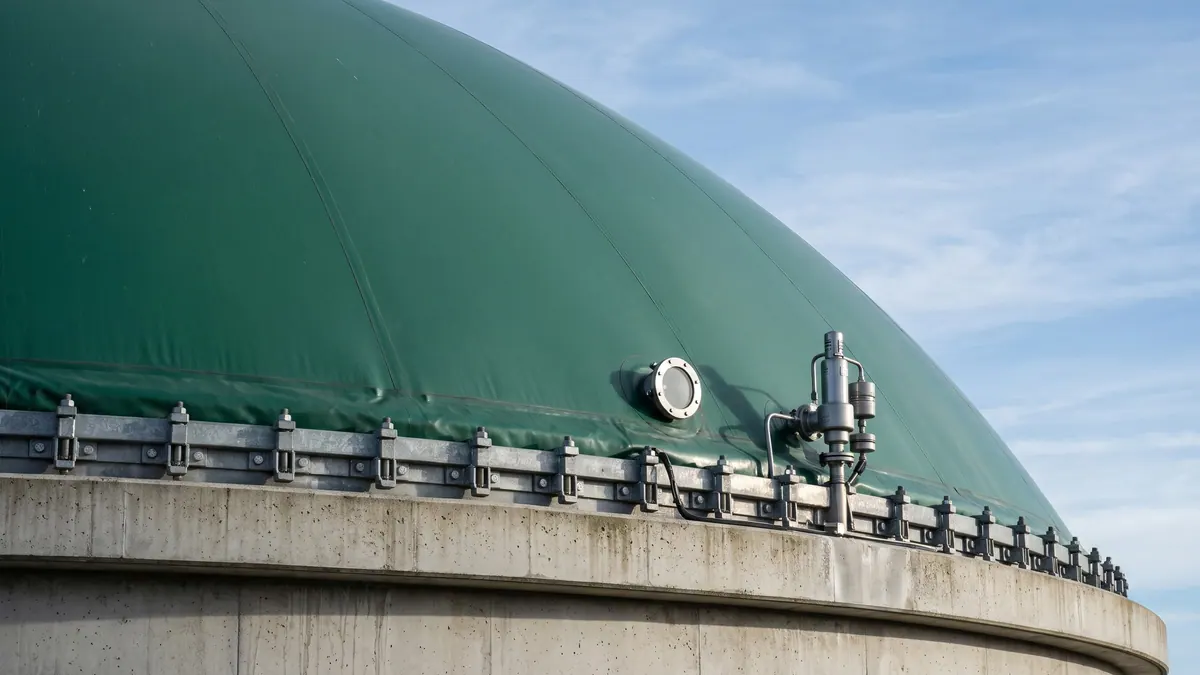
A tank made of enamelled sheets resembles a large, bolted ring. The steel segments are coated with glass enamel in a furnace at a temperature of several hundred degrees, which creates a hard glassy layer permanently bonded to the steel. The advantages are a short assembly time and the resistance of the enamel to acids, and the weak points are the connections between segments and mechanical damage to the enamel. You will find a comparison with reinforced concrete in the article Reinforced concrete or enamelled steel tank; here we describe the technology itself.
Structure of the system
The basic elements are:
- segmental sheets of a fixed module (the height and width of a segment range from several dozen centimetres to over a metre, depending on the system),
- galvanised or stainless steel bolts and nuts, often with gaskets under the head,
- gaskets or sealing compounds in the horizontal and vertical joints,
- a base ring seated in or on the foundation slab,
- flanges for process penetrations supplied as special segments,
- a roof structure (rigid or load-bearing for a membrane).
The thickness of the sheets increases towards the bottom of the tank, where the liquid pressure is greatest, which reduces steel consumption.
Transport and storage of the segments is also an important element. Sheets with enamel are carried on pallets with spacers and stored on site on level ground, away from machine traffic. Every drop or knock against an edge can chip the enamel, so before assembly the segments are inspected and damaged ones rejected or repaired. Such incoming inspection is cheaper than replacing a segment in a finished wall.
Why enamel
Enamel protects steel from corrosion through a glassy barrier. It is resistant to organic acids, to ammonia in the concentrations found in a digester and to abrasion by suspended solids. It does not age like organic coatings. It has one limitation, however: it is brittle. An impact or over-tightening of a bolt can chip the enamel, exposing steel, which will begin to corrode at that spot.
Assembly on the foundation slab
The tank is assembled on a previously made reinforced concrete slab. First the base ring is seated, then successive rings are raised from the bottom or, in versions using the jacking method, from the top. The segments are laid with the vertical joints offset in successive courses. Each joint is filled with sealing compound or a gasket is laid, and the bolts are tightened with a torque in line with the instructions, so that the pressure is even and does not damage the enamel. After the wall is assembled, the roof and penetrations are installed, and the whole is subjected to a water test.
Joints and seals
Tightness is created by the flexible seal in the joints and the gaskets at the bolts. Such materials age faster than the enamel, especially with temperature changes, because the tank expands and contracts. That is why inspections check:
- traces of leaks and staining at the joints,
- the condition of seals accessible from the outside,
- the tightening torque of selected bolts (spot checks),
- corrosion of bolt heads, nuts and segment edges,
- enamel damage visible after emptying.
Gaps in the joints in which substrate accumulates can be a place of local corrosion.
Gas zone and elements outside the enamel
In the gas zone the enamelled segments are resistant, but the last courses, the roof and the supporting elements are exposed to condensate and variable humidity. Steel elements not covered with enamel, such as the roof structure, ladders, railings and flanges, are protected with a paint coating system or hot-dip galvanising, selected according to the corrosivity category of the environment in the EN ISO 12944 series. The assessment of the corrosivity category (from C1 to CX) and of the durability of the system is part of the protection design.
Critical points in operation
The most common problems are:
- enamel damage after assembly and during later work (for example when replacing a mixer),
- corrosion under accumulated moisture at the joint between the wall and the slab,
- leaks at the joints after several years of operation,
- corrosion of bolts in the zone of variable humidity,
- point loads from mixers, which require reinforcement of the wall.
Minor enamel chips are repaired with special mortars or patch systems; a cracked segment is replaced after the tank has been emptied.
Documentation and warranties
Before acceptance it is worth demanding: material certificates for the sheets, data on the enamel thickness and the method of its inspection (usually a high-voltage porosity test), assembly instructions with tightening torques, and the scope of the warranty separately for the enamel, seals and bolts.
What to look out for
At the acceptance of the assembly it is worth inspecting the whole surface from the outside and from the inside, and after emptying, the interior again. Enamel damage is easier to repair right after assembly than after years of operation. A record from acceptance with a map of any chips makes it possible to check later whether they are growing.
Summary
A tank made of enamelled sheets is a technology that is quick to assemble and chemically resistant, but dependent on the quality of the joints and on the care of the contractor. The most important things are protecting the enamel from damage, correct sealing of the joints, checking the tightening and protecting the steel elements outside the enamel.
Sources
Related articles