Tanks and membranesExplainer
Concrete corrosion above the liquid level: how biogas destroys the roof slab and the upper part of the tank wall
Concrete is destroyed fastest above the liquid surface, where it is in contact with moist biogas. We explain the mechanism of acid formation and the monitoring of concrete condition.
Other language versions: Polski, Deutsch, Español, Français, Italiano, Nederlands.
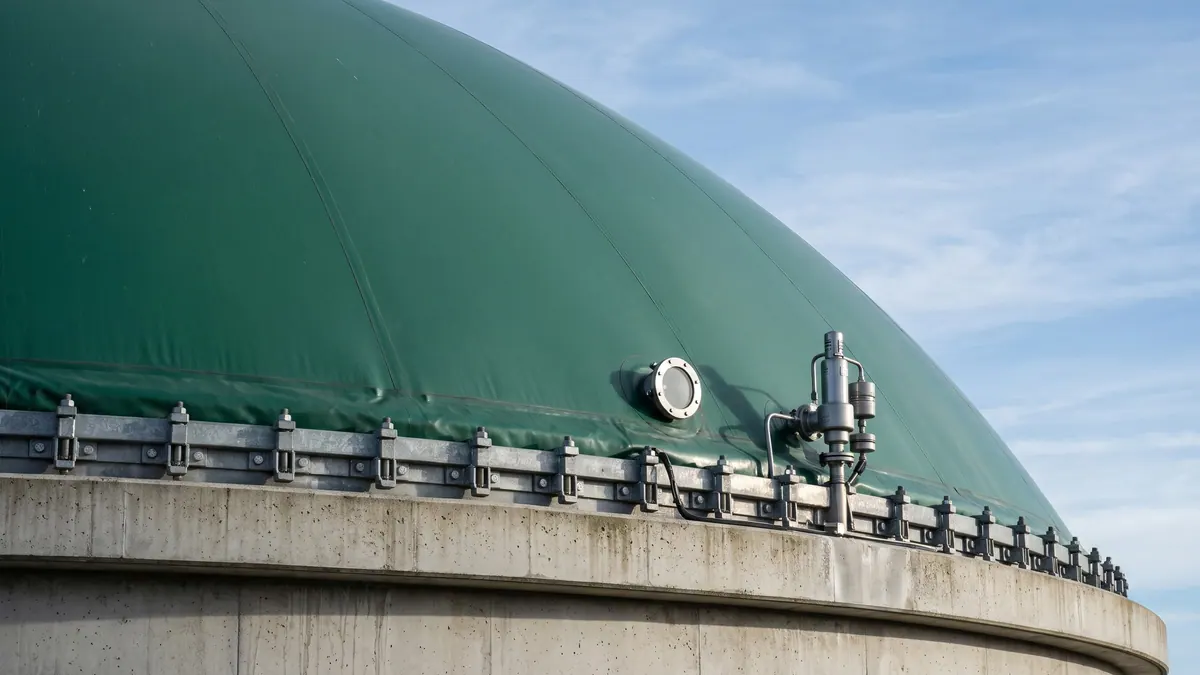
In a tank in which substrate ferments, the liquid itself is only moderately aggressive to concrete. The surface above the liquid level is much more exposed, because there moist gas containing sulphur compounds is in contact with the concrete, and microorganisms live on the wall. This phenomenon is called biogenic corrosion and is well described in the literature on sewers. Here we focus solely on the mechanism of concrete degradation and on ways of monitoring its condition.
The mechanism in three steps
The process runs as follows:
- Biogas contains trace amounts of sulphur compounds, which dissolve in the layer of moisture covering the wall and the roof slab, forming condensate. Condensate collects especially on cooler surfaces.
- In this layer of moisture, if oxygen is available in the gas zone (for example through leaks or deliberate introduction of air for other purposes), sulphur compounds can be oxidised by microorganisms to sulphuric acid.
- The acid reacts with calcium hydroxide and the hydrated phases of cement. Products of low strength are formed (gypsum, and subsequently ettringite), which increase in volume and burst the paste. The binder turns into a soft, brittle mass.
It is important that the phenomenon requires three conditions at once: moisture, sulphur compounds and the presence of oxygen at the surface. In the gas zone of a digester with a tight cover and no air supply the risk is lower than in chambers with a leaky cover or frequent openings, but it does not disappear.
Where and how fast
The damage covers the roof slab, the upper part of the wall down to several dozen centimetres below the liquid surface, the zone around penetrations and the edges where condensate runs and drips. The rate depends on the quality of the concrete, humidity, temperature and sulphur load; the literature on sewers gives losses of the order of a fraction of a millimetre to several millimetres per year, and in biogas tanks the values vary widely and depend on the specific plant. It is therefore not worth adopting a general figure, but rather measuring one's own facility. The first symptoms usually appear after several to over ten years, and sooner with weak concrete.
What the damage looks like
Typical symptoms are:
- a matt, soft, flaking layer on the surface (it can be scratched with a fingernail or a screwdriver),
- a whitish deposit of gypsum,
- exposed aggregate, and then reinforcement bars with rust,
- spalling of the cover over the bars,
- lowered pH of the condensate at the surface.
Exposed reinforcement corrodes faster, which enlarges the damage and may reduce the load capacity of the roof slab or ring beam.
Factors that accelerate the process
The corrosion rate increases where moisture persists for a long time: on cool surfaces of the roof slab, in places of poor gas circulation and under penetrations, where condensate drips onto the same spot. The content of sulphur compounds in the biogas also matters, which depends on the substrate and on whether desulphurisation is carried out; the less of them in the gas, the less acid can form. In addition, a rough or porous concrete surface retains moisture and makes it easier for microorganisms to settle, so smooth, well-compacted concrete is inherently more resistant.
Monitoring the condition of the concrete
The assessment is carried out during a planned emptying of the tank, as part of a technical inspection:
- visual inspection with photographic documentation and a damage plan,
- measurement of the depth of loss at fixed points,
- a hardness or pull-off test of the surface,
- measurement of the pH of the moist surface (indicator strips or a contact pH meter),
- measurement of cover and bar position with a rebar detector.
Comparing the results with those of previous inspections makes it possible to assess the rate of deterioration and to plan refurbishment at the right moment. Entering the tank is work in a confined space and requires a separate, written procedure, including ventilation, atmosphere measurement and fall protection.
Protection and repair
To protect the concrete the following are used:
- a design with concrete of low w/c and a suitable cement, which reduces susceptibility to acid,
- protective coatings or plastic linings of the tank interior,
- keeping the cover tight and limiting condensation thanks to insulation,
- removal of the damaged layer down to sound substrate, repair with mortar and restoration of surface protection, in line with the principles of the PN-EN 1504 series.
A repair without removing the cause, that is without surface protection, gives a temporary effect. The renewed layer will be destroyed in the same way as the original.
What to look out for
Record the measurement results in a single sheet with point numbers, date and photograph. After several inspections you will obtain a loss curve showing how many years remain before refurbishment is needed. Such information makes it possible to plan a plant shutdown in a convenient season, instead of reacting to a failure once the damage reaches the reinforcement.
Summary
Biogenic corrosion is a slow but predictable process in the gas zone. Concrete is destroyed by acid formed on the moist surface, and the effects become visible only after years. Regular measurement of concrete condition and surface protection make it possible to plan refurbishment before the reinforcement and the load capacity of the element suffer.
Sources
Related articles