Tanks and membranesAnalysis
Thermal insulation of a digester: materials, thermal bridges, moisture and outer cladding
Digester insulation decides how much heat from the CHP goes into maintaining the process. We compare mineral wool, PIR/PUR, EPS/XPS and foam glass, and typical mistakes.
Other language versions: Polski, Deutsch, Español, Français, Italiano, Nederlands.
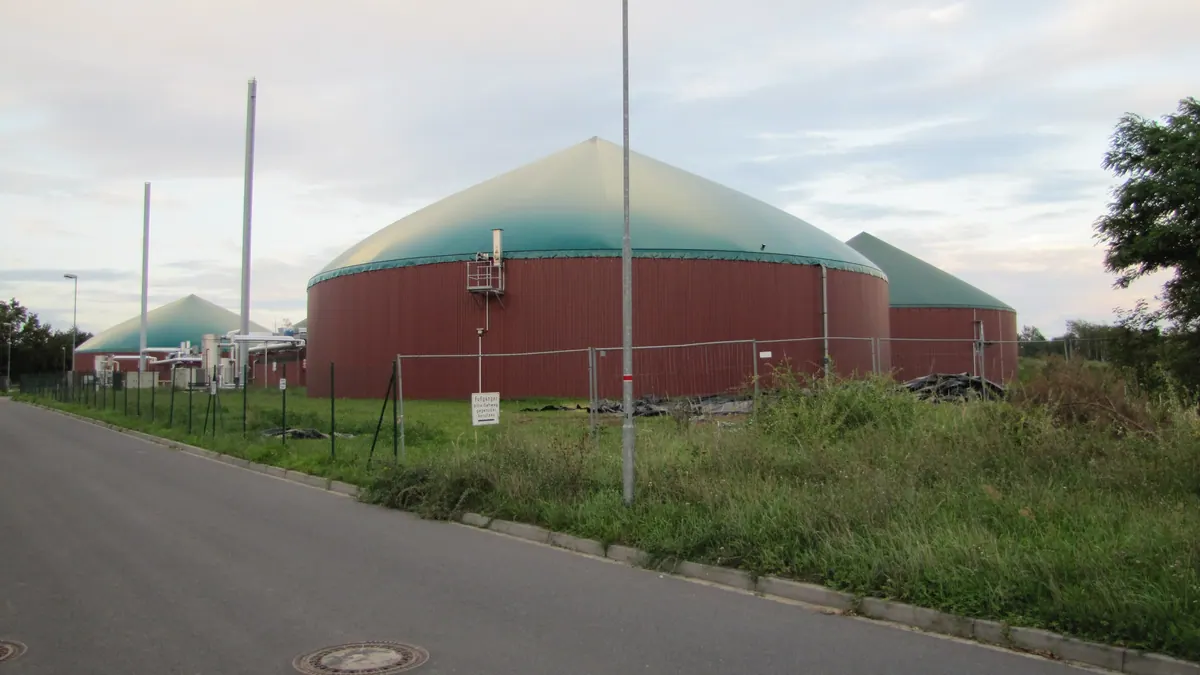

A digester operates at a constant temperature, so every watt of heat loss has to be produced, usually in a CHP unit. Insulation limits losses, but its effectiveness depends not only on the material and thickness but also on thermal bridges, moisture and the outer cladding. Below is an overview of the most common materials and mistakes.
Comparison of materials
The values are indicative and come from typical ranges of product declarations; always check the data sheet of the specific product.
| Material | Lambda, W/(m·K) | Water absorption | Mechanical resistance | Notes |
|---|---|---|---|---|
| Mineral wool | approx. 0.034–0.045 | high if moistened | low, needs cladding | non-combustible, good for walls with a jacket |
| PIR / PUR | approx. 0.022–0.030 | low | medium | thinnest layer for a given U, sensitive to UV |
| EPS | approx. 0.031–0.040 | low | medium, depends on density | cheap, thicker layers, combustible |
| XPS | approx. 0.029–0.036 | very low | high compressive strength | often under the base slab |
| Foam glass | approx. 0.038–0.050 | practically zero | high | high price, resistant to rodents and moisture |
A low lambda means thinner insulation for the same resistance, which can matter where perimeter space is limited and with cladding costs.
When comparing materials, remember that the declared lambda applies to the material when dry and new. In operation, what counts is the design value, which takes into account moisture, ageing and the method of installation. For this reason two products with a similar lambda on the data sheet can give different losses after several years if one is better protected from water. In a tender enquiry, a declaration of performance in accordance with Regulation (EU) No 305/2011 should be required, together with information on the conditions under which the parameters remain valid.
Wall
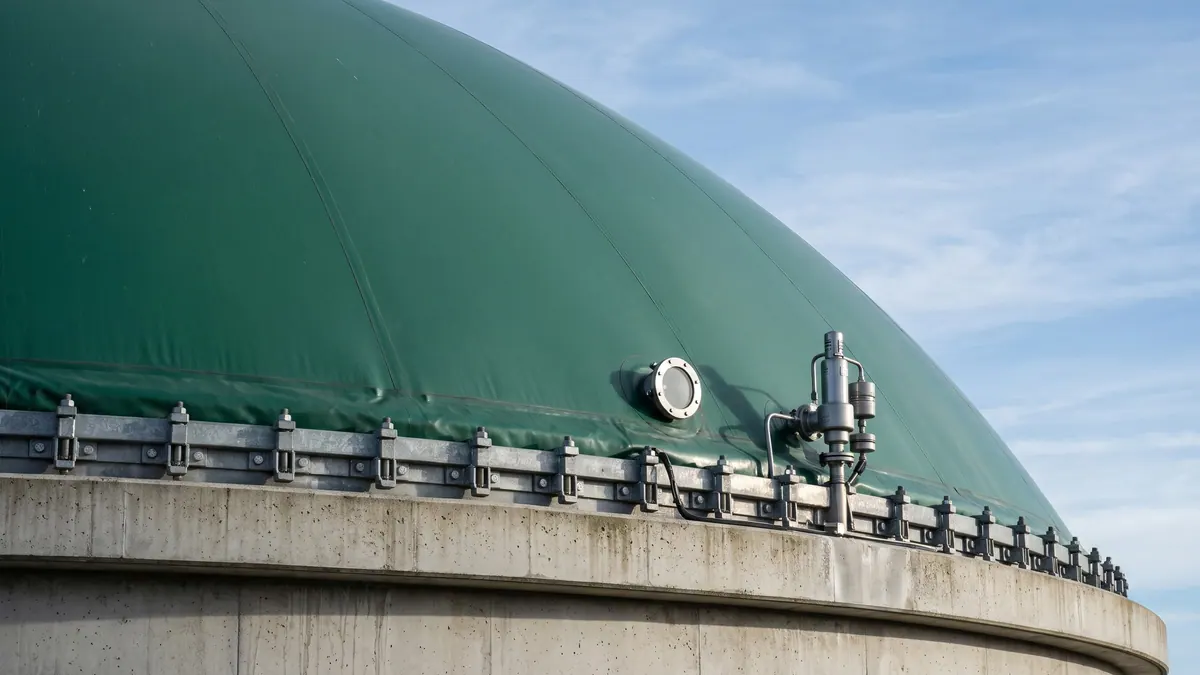
On the tank wall the insulation is installed on the outside and protected with a jacket, for example of trapezoidal sheet or sandwich panels. Mineral wool works well if moisture is eliminated by a tight cladding. PIR/PUR makes it possible to reduce the layer thickness but requires protection from UV radiation and damage. The insulation layer should be continuous, without gaps, and the anchors and brackets of the jacket should not be connected directly to the tank structure, because they create bridges.
Base and roof
Under the base slab, insulation resistant to compression and moisture is used, usually XPS or foam glass. Replacement is impossible without dismantling the tank, so this location requires a decision for the highest durability. In the roof slab or roof, insulation is limited by load capacity and the gas space; in tanks with a membrane roof the insulating part is often the air chamber between the membranes, not a separate layer.
Thermal bridges
Bridges arise where an element with good conductivity passes through the insulation: penetration flanges, jacket brackets, anchors, supports, the slab edge. They can account for several to over ten per cent of total losses, and locally they cause moisture condensation and corrosion. The solutions are thermal breaks, insulated flanges and a continuous insulation layer around the perimeter of the base.
Moisture
Damp insulation loses part of its properties; moistened wool can have a lambda clearly higher than declared. Moisture gets in through leaking flashings, run-off from the roof, condensation on the cold side or leaks from the tank. That is why the following are important: tight flashings, slopes, raising the jacket above the ground, ventilation openings in the jacket and periodic inspection. Moistening can be detected with a thermal imaging camera after a cold day.
Outer cladding, rodents and damage
The jacket protects against rain, wind and mechanical damage, and in the lower part, exposed to loaders and rodents, it requires reinforcement or mesh. Gaps at ground level are entry points for rodents, which gnaw out foam insulation. Inspection of the lower band of the jacket is a simple preventive measure.
Typical mistakes
- Too thin a layer in the places most exposed to wind.
- No insulation or poorly executed insulation of the base at the joint with the slab.
- Breaks in the layer at penetrations.
- Leaving the cold-side insulation exposed during construction.
- Improper pressing of the panels, creating air gaps.
- No access to inspection windows and measuring ports after cladding.
How to decide
The choice of material results from a compromise: wool – cost and fire safety, PIR/PUR – a thin layer, XPS or foam glass – the base, EPS – budget with a large area. The value of investing in better insulation is worth estimating with a heat loss calculation (the formula Q = U · A · ΔT and summing the partitions) and comparing with the price of heat that the plant could sell. The effects of winter losses on the operation of the digester are described in the article Winter operation of the digester.
What to look out for
A good test of workmanship quality is a thermographic survey carried out on a cold day a few months after start-up. It shows bridges, gaps and moistened fragments that are hard to see with the naked eye. The result recorded in the documentation is a reference point for later inspections and for any claims against the insulation contractor.
Summary
Good insulation is not only a material with a low lambda. What counts is the continuity of the layer, the absence of bridges, protection from moisture and the outer cladding. Neglecting any of these elements can cancel out the advantage of a more expensive product.
Sources
Related articles