Safety and ATEXGuide
Digester start-up and shutdown: explosive mixtures, inerting and sequence of actions
Starting a digester and emptying it before repairs are moments when the gas space passes through the explosive range. We describe measurements and inerting.
Other language versions: Polski, Deutsch, Español, Français, Italiano, Nederlands.
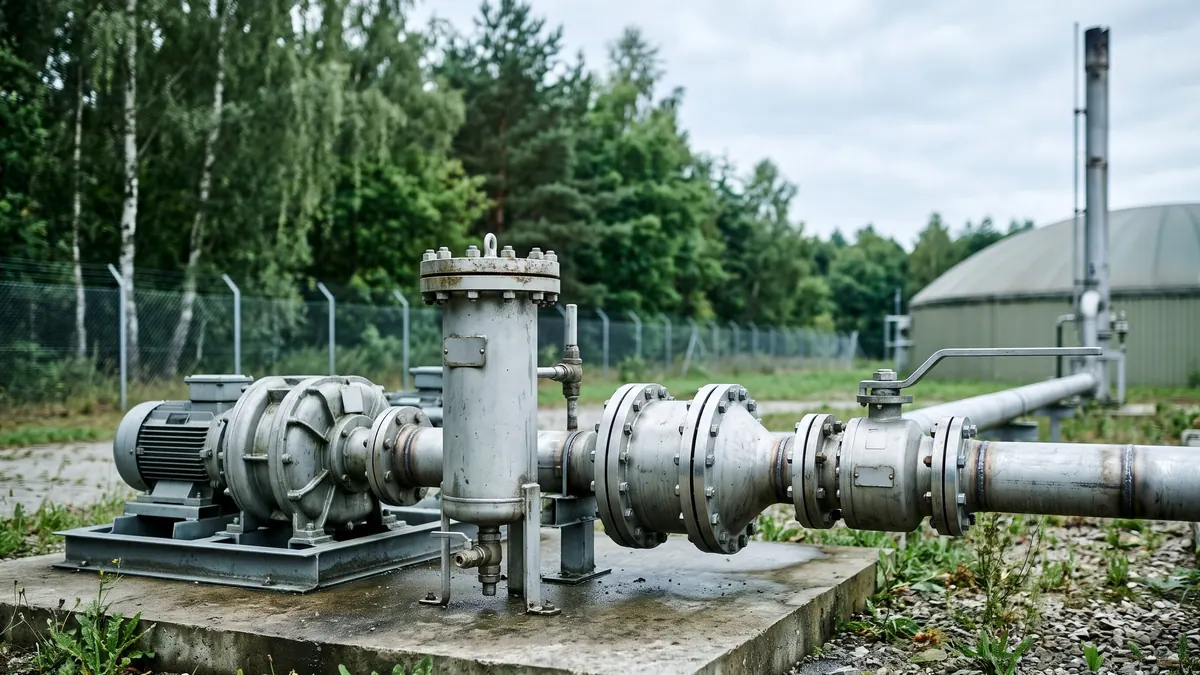
A biogas installation is safest in steady state, when the gas space contains biogas of constant composition and is free of oxygen. Two moments do not meet this condition: filling a fresh tank and emptying it before repairs. In both, the gas space at some point contains a mixture of methane and air within the explosive range, so the sequence of actions and measurements matter more than haste. Below we discuss this in practice, without people entering the tank, which is a separate topic. The general course of starting up the biology is described in the article Start-up of a digester, step by step, and the leak test before filling in the text Water leak test of a tank before start-up.
Start-up: where the explosive mixture comes from
A newly built or emptied digester has a gas space filled with air. After it is filled with substrate and inoculated with sludge, the biomass starts to produce gas. At first this is mainly CO₂ and nitrogen with air losses, and the share of methane rises gradually. The methane concentration in the mixture with air therefore passes through the range from the lower to the upper explosive limit. In addition, pressure drops and temperature changes cause gas movements that can draw in air.
The rules follow from this:
- Gas from the beginning of start-up is not used in the engine or boiler, but directed to the flare or a safe discharge.
- Until it is confirmed by measurement that the methane content is above the limiting value and the oxygen below it, the system stays in start-up mode.
- Ignition sources in the zone around the tank and outlets are limited to the necessary minimum.
Inerting before start-up
To avoid passing through the flammable range, the gas space can first be filled with an inert gas. The method consists of displacing the air with nitrogen or CO₂ until the oxygen content falls below the value at which the mixture with methane does not sustain combustion. The limiting oxygen concentration (LOC) for methane is roughly a dozen or so percent by volume and depends on the inert gas; in protection practice a safety margin is applied, for example a target of a few percent O₂, not the limiting value.
Shutdown and emptying
Before repairs the tank is emptied of substrate, and the gas space fills with air as the level falls. If the gas was removed without inerting, the mixture passes through the flammable range along the way. Biogas may remain absorbed in the sediment and scum and be released later, for example during mixing.
Recommended sequence:
- Isolating the tank from the gas installation (valves, blanks according to the instructions) and securing it against reopening.
- Lowering the gas level: drawing gas off to the flare or a tank until the pressure falls to a minimum.
- Inerting the gas space with nitrogen or CO₂ with control of O₂ and CH₄.
- Only then ventilation with air and emptying of the substrate.
- Check measurements before work, especially after starting the agitators or changing conditions.
Measurements during the process
Oxygen and methane are measured at several points of the gas space, using meters approved for use in Ex zones. For start-up it is important to measure the oxygen concentration first and methane second. During inerting the pressure is also monitored so as not to exceed the settings of the protection devices. Results are recorded in the start-up or shutdown report.
The role of the explosion protection document
The document should state clearly that start-up and shutdown are states in which the explosion hazard is greater than in steady operation, and specify the measures: the flare operating mode, switching off ignition sources, inerting, the presence of a responsible person, communication and an emergency plan. If such situations are recorded only with the shorthand "according to the manufacturer's instructions", it is worth supplementing them with specific steps.
Calculation example (indicative)
Assume a tank with a gas space of 1000 m³ filled with air (21 % O₂), in which we want to reduce oxygen to about 8 %. With ideal mixing the relationship is: number of volumes of inert gas = ln(21/8) ≈ 0.96, that is, about one tank volume (about 1000 m³ of nitrogen). In reality mixing is incomplete and some of the gas bypasses dead zones, so for safe inerting usually 1.5 to 3 volumes are assumed, that is 1500–3000 m³. On top of this comes gas lost through leaks. The result is an estimate for planning deliveries and time, and the final criterion is the oxygen measurement, not the calculations.
Who should know what before starting
Before start-up or shutdown it is worth holding a short briefing: who leads the work, who operates the flare, who measures the gas, what the stop signal is and where people evacuate to in the event of an alarm. The procedure should be available on site as a short checklist card, not only in a binder in the office. When finished, it is worth recording what went differently from the plan, because the next start-up will then be safer.
Typical mistakes
- Feeding start-up gas to the engine instead of the flare.
- Opening a manhole or ventilating without prior inerting.
- Measuring at a single point, without checking dead zones.
- No blanks and no securing of fittings against accidental opening.
- Haste resulting from production pressure and skipping steps described in the procedure.
Sources
Related articles