Safety and ATEXExplainer
Explosive properties of biogas: explosive limits, ignition energy and the effect of CO₂
An explosion needs fuel, oxygen and ignition in the right proportions. We explain the explosive limits of methane and biogas, ignition energy and the role of CO₂.
Other language versions: Polski, Deutsch, Español, Français, Italiano, Nederlands.
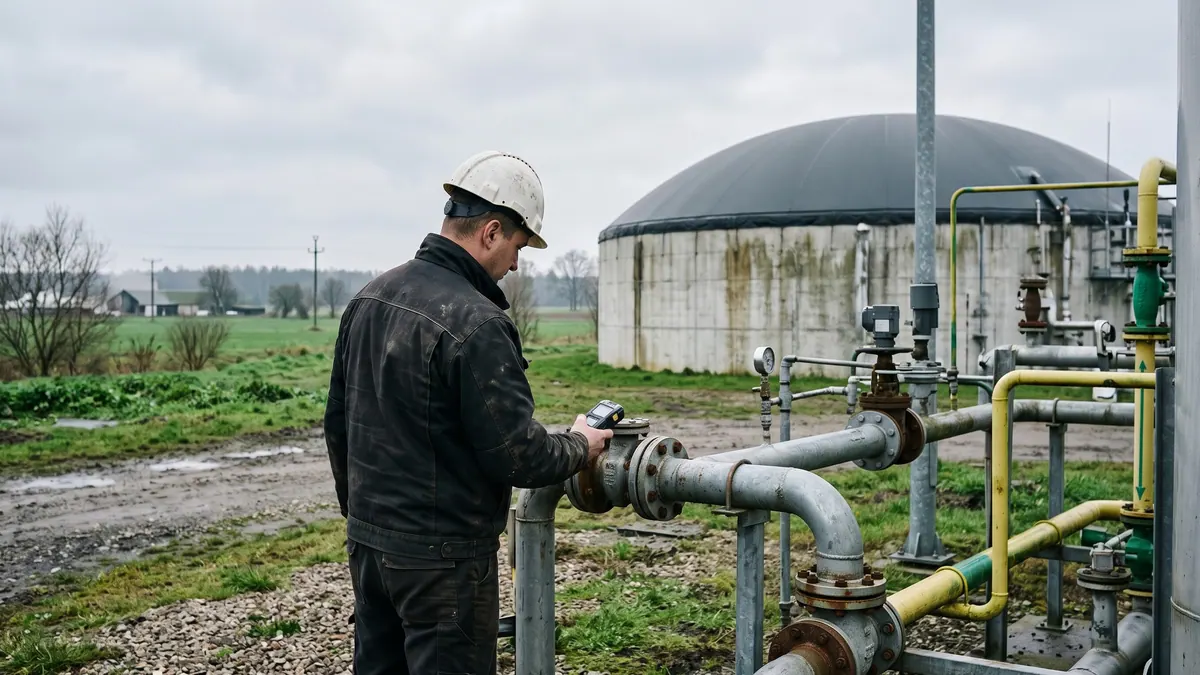
An explosion in a biogas plant requires nothing exotic: a flammable gas, oxygen from the air and an ignition source are enough. Biogas is a fuel with a wide flammable range and very low ignition energy, so protection relies on preventing a mixture with air from forming where ignition sources may appear. Below we explain the basic physical parameters without which zones and protective measures are hard to understand.
The fire triangle and the concept of explosive limits
Ignition requires three elements at the same time: fuel, oxidiser and activation energy. Removing any one of them stops the process, which is the basis of the three pillars of explosion protection: preventing an explosive atmosphere from forming, avoiding ignition sources and limiting the effects of an explosion.
A mixture of gas and air can propagate a flame only within a certain range of concentrations. The lower explosive limit (LEL) is the lowest fuel concentration at which a flame is sustained; below it the mixture is "too lean". The upper explosive limit (UEL) is the concentration above which the mixture is "too rich" because oxygen is lacking. For pure methane in air, under ambient conditions, about 4.4–5 % by volume is usually taken as the LEL and 15–17 % by volume as the UEL.
An important practical point follows: in a tank filled only with biogas, the mixture is above the UEL and will not explode on its own. The hazard arises at the interface, that is, where biogas mixes with air during a leak, start-up or air ingress.
What carbon dioxide changes
Biogas is usually 50–65 % CH₄, 35–45 % CO₂ and trace amounts of H₂S, water vapour, NH₃ and other components. CO₂ is an inert gas: it does not take part in combustion, but absorbs heat and dilutes the reactants. The effect is twofold.
- The explosive limits of biogas are narrower than those of pure methane when expressed per total volume of gas. For biogas with 60 % CH₄, the lower limit is roughly several to a dozen or so percent of biogas by volume in air, and the upper limit is usually lower than 17 %.
- The less methane in the biogas, the lower the combustion energy and the milder the course of an explosion, but the flammability limit does not disappear. Biogas with a methane share of around 40 % can still be flammable under favourable conditions.
One should not conclude from this that "biogas is safer than natural gas". The differences are small compared with the consequences: explosion pressure in an enclosed space can reach several bar, which is enough to destroy a membrane, a roof or a non-load-bearing structure.
Ignition energy and autoignition temperature
The minimum ignition energy (MIE) of a methane–air mixture, at a concentration close to the optimum (about 8–9 % by volume), is of the order of 0.3 mJ. For comparison, an electrostatic discharge from a person charged by walking on an insulating floor is often in the range of a few to several dozen millijoules. This means an ordinary static spark is able to ignite the mixture.
The autoignition temperature of methane is about 537 °C. This is high compared with many other fuels, which is why methane is classified in temperature class T1, but it does not mean hot surfaces are safe. In practice, contact time, surface geometry and the presence of catalysts or deposits also matter. They are therefore considered in the hazard assessment as one of many ignition sources.
Biogas density and places where gas collects
Pure methane is lighter than air (about 0.72 kg/m³ compared with about 1.29 kg/m³ for air at 0 °C). CO₂ is much heavier (about 2 kg/m³). Biogas of typical composition has a density roughly close to that of air, usually slightly lower, but the mixture changes with the amount of CO₂ and moisture. In practice one cannot assume that leaking biogas will escape entirely upwards. During a leak from a small opening a cloud forms, which mixes with air and can accumulate under closed ceilings, in ducts and in depressions.
Headspace above the liquid, start-up and negative pressure
There are three most common scenarios in which air enters biogas.
- The gas space above the liquid in a freshly filled tank, or after it has been emptied, contains air, and methane appears only as fermentation develops. The concentration then passes through the flammable range.
- Negative pressure, for example after gas is drawn off too quickly, can draw air in through half-closed valves and loosened connections.
- Repair work after the tank has been emptied, when residual gas in the sediment or in the scum layer is released during mixing.
All three require procedures, oxygen and methane measurements and an explosion protection document that states which situations were considered possible and how they were controlled.
How to use this in practice
- Check whether concentrations within the installation could fall within the flammable range not only in continuous operation but also in transient states.
- When assessing ignition sources, assume that an energy of 0.3 mJ is available: static electricity, tools and phones can supply it.
- Treat the values given here as indicative. The exact parameters of biogas of a specific composition are determined from standards and laboratory data, not from shortcuts.
- The obligations arising from the explosion risk assessment, including the explosion protection document, are discussed in the article: ATEX at a biogas plant: directives, obligations and the explosion protection document.
Sources
Related articles