Tanks and membranesExplainer
Digester tank: what it consists of and what each structural element does
A digester tank is not just a concrete cylinder: the base slab, wall, cover, heating, insulation and penetrations work together. We describe the role of each element.
Other language versions: Polski, Deutsch, Español, Français, Italiano, Nederlands.
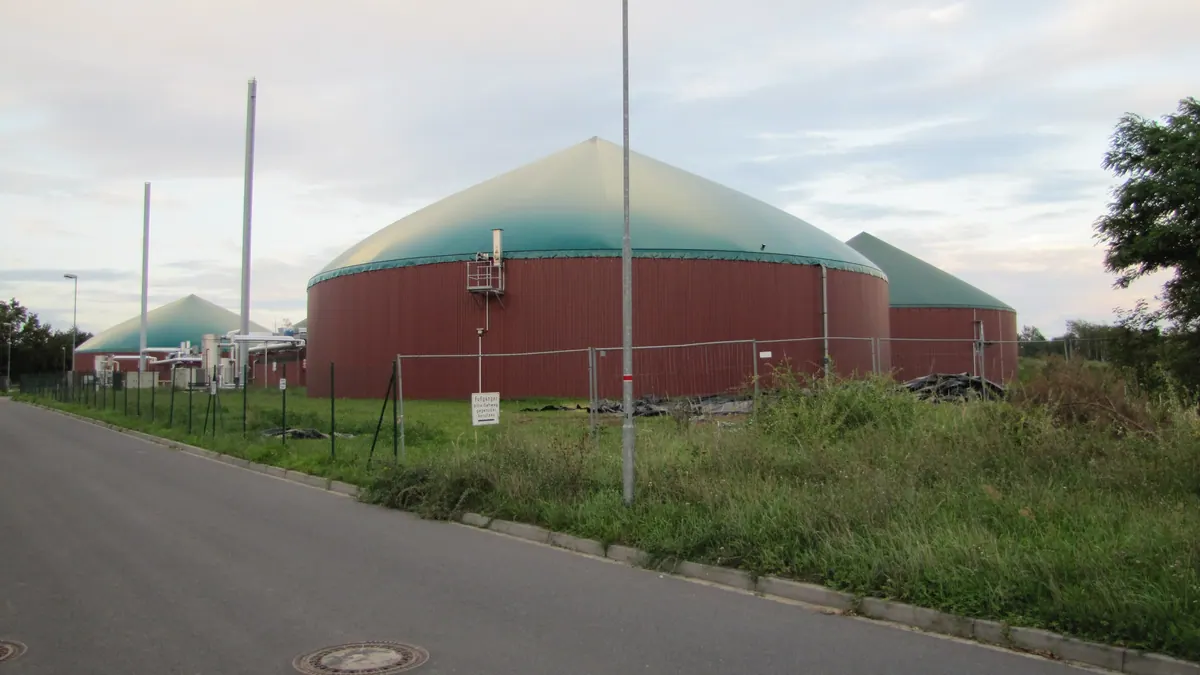

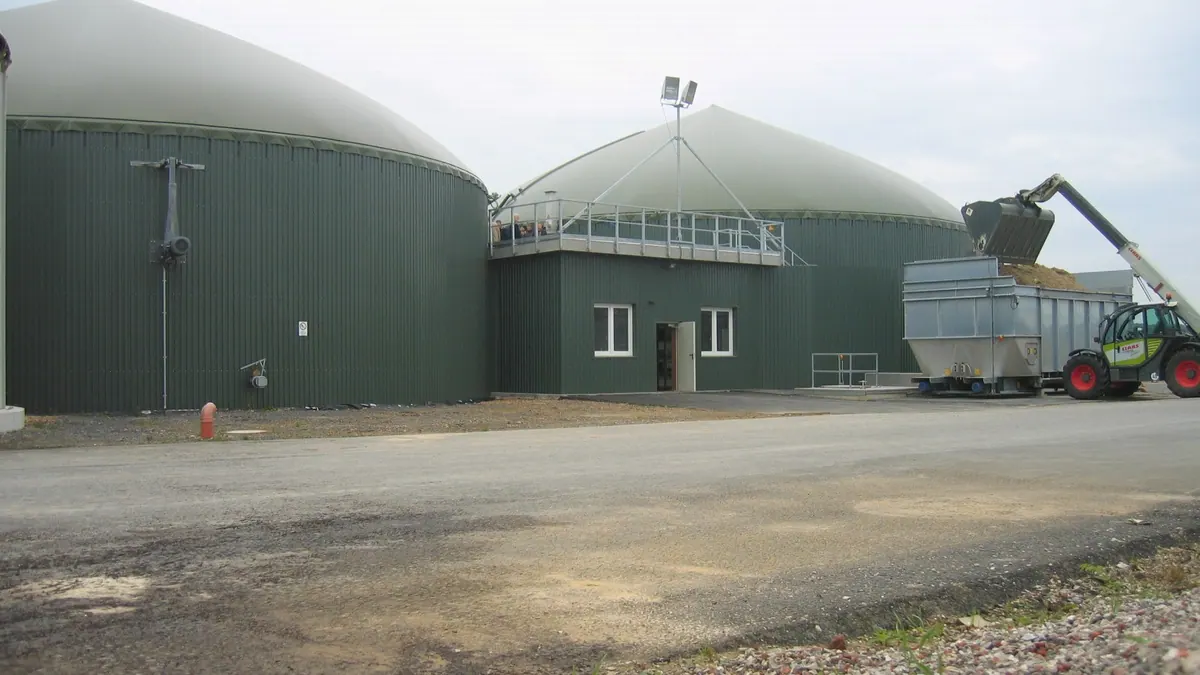
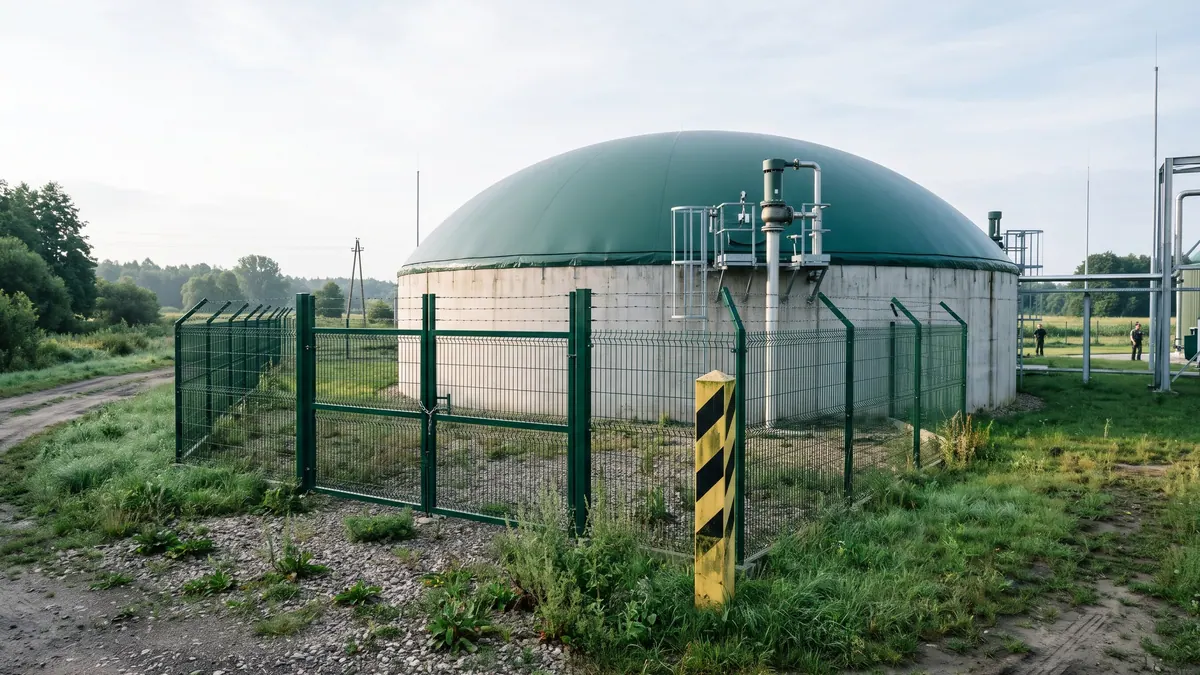
A digester tank (digester, fermentation chamber) is a sealed, heated and mixed tank in which microorganisms break down the substrate without access to oxygen. It consists of several elements that work together: a base slab, a wall, a gas cover, a heating system, insulation and process penetrations. The failure of any one of them usually stops the whole process. This article opens the section on tanks and membranes and sets out the terms used in the later texts.
Base slab and foundation
The base slab carries the weight of a tank filled with substrate, which has a density close to that of water (about 1000–1050 kg/m³). With a volume of several thousand cubic metres, this means a load of several dozen kilopascals on the ground, which is why the structure is preceded by a geotechnical survey. In reinforced concrete tanks the slab is usually monolithic; in steel tanks it is reinforced concrete, with a perimeter seal at the joint with the wall. Under the slab a layer of insulation and a control drain are often laid, which makes it possible to detect leaks before they wet the ground.
Wall
The wall resists the liquid pressure, which increases linearly with depth. In reinforced concrete tanks it is a monolithic wall or one made of precast elements with a cast-in-place ring beam; in steel tanks it consists of bolted sheet segments. The wall must be tight to liquid and gas, chemically resistant to organic acids and ammonia, and stiff enough to carry the loads from the mixers and the cover. The wall height of agricultural digesters is usually several metres (roughly 5–10 m), and the diameter ranges from over ten to more than 25 m. These ranges are indicative; the exact dimensions are set by the design.
Gas cover
Above the liquid level there is a gas space in which biogas collects. The cover can be a membrane (single- or double-membrane) or rigid, for example a reinforced concrete slab or a steel roof. A membrane cover also serves as gas storage; the construction of the storage is described in the article Biogas storage and the double-membrane roof. A rigid cover requires a separate gas tank or roof. In the gas zone there is moisture and aggressive condensate, so materials are selected with corrosion in mind.
Heating
Mesophilic digestion usually runs at a temperature of about 38–42°C, and thermophilic digestion at 50–55°C. Heat is supplied through:
- heating pipes embedded in the wall or fixed to its inner surface,
- internal heat exchangers suspended in the chamber,
- external heat exchangers on the substrate loop.
The choice affects the uniformity of the temperature and the ease of servicing: pipes cast into concrete cannot be replaced, while an external heat exchanger can be cleaned without emptying the tank.
Insulation
Insulation limits heat losses through the wall, floor and roof. It usually consists of a layer of insulating material and an outer cladding, for example of trapezoidal sheet, which protects it from moisture and mechanical damage. The size of the losses depends on the layer thickness, thermal bridges and moisture, so it is worth estimating them by calculation already at the design stage.
Process penetrations
Substrate and digestate pipelines, overflows, sensors, gas lines and mixer shafts pass through the wall and the roof slab. Each penetration is a potential point of leakage. Sleeves with a sealing flange cast into the wall or penetrations with a mechanical seal are used. Mixer shafts require a reinforced wall and service access; the details of mixer selection depend on the substrate and the geometry of the chamber.
Inspection window and monitoring equipment
An inspection window (sight glass) makes it possible to assess the liquid surface, the scum layer and the foam without opening the tank. It is complemented by temperature and level measuring ports, overpressure and vacuum protection, and a drain inspection chamber. A service manhole leads to the inside of the tank; entering it is work in a confined space and requires a separate procedure.
How it all fits together in practice
The elements depend on one another. Thicker insulation reduces the heat demand but increases the requirements for the cladding. A large number of penetrations makes automation easier but increases the risk of leaks. A thicker wall copes better with the loads from the mixers but costs more concrete. That is why decisions on the tank structure are best made jointly, not element by element.
What to look out for
When reading the design, start with the list of penetrations and the plan of the base slab, because that is where precise information is most often missing. Ask which elements will remain accessible for servicing after the tank is enclosed, and which will be cast in concrete or hidden under insulation. Such a list of questions makes later talks with the contractor easier and helps avoid costly corrections during operation.
Summary
A digester is a system of elements with clearly defined functions: load-bearing, sealing, thermal and process-related. Knowing their roles makes it easier to read a design, compare offers and plan inspections. The following texts in the section cover tank technologies, concrete, insulation and the membrane cover.
Sources
Related articles