Operation and failuresExplainer
Biogas plant in winter: condensate freezing, heat losses and a stable digester temperature
Winter failures at biogas plants start with small things: a frozen siphon, valve or feeder. We explain the mechanisms and the checks to make before the frosts.
Other language versions: Polski, Deutsch, Español, Français, Italiano, Nederlands.
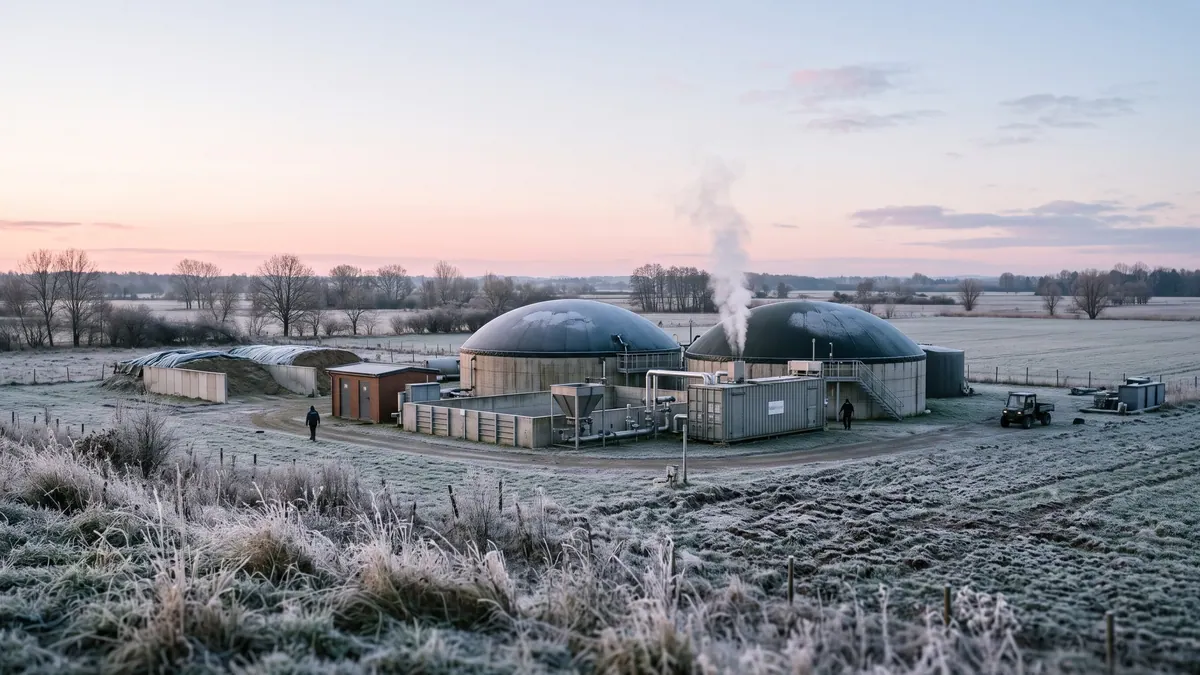
Winter problems at biogas plants are mostly problems of heat and water: biogas is saturated with water vapour, and every cooler section of the installation turns it into condensate, which forms ice in frost. On top of that come heat losses through the walls and roofs of the tanks and the operation of outdoor equipment at temperatures it was not routinely tested at in service. Below we describe the mechanisms and what an operator can check in advance. The choice of a gas dryer is a separate topic, covered in the article on biogas drying.
Where condensate comes from and why it freezes
Biogas in a digester at about 37–42 °C usually contains several percent water vapour by volume. When the gas flows through a pipeline in a cooler zone, the vapour condenses on the pipe walls. The water runs down to the lowest points, that is, to the siphons and condensate traps. If one of these components is outside the insulated area, or the trace heater is not working, the water freezes below 0 °C and forms a plug.
The consequences are more serious than they may seem:
- a blocked condensate trap causes water to accumulate in the pipeline and flow resistance to rise,
- a frozen safety siphon may stop acting as protection against overpressure or underpressure,
- ice in impulse measuring lines gives false pressure and flow readings,
- water in the gas engine or blower worsens combustion and accelerates wear.
Slopes matter along the gas route: the pipeline should fall towards the drainage points, without "water pockets". In winter every such pocket is a potential plug.
Heat losses and digester temperature
A digester is a large tank heated to a constant temperature, and in winter the difference between the inside and the surroundings can exceed 40 K. Losses grow with wind, the moisture content of the insulation and the surface exposed to air. In addition, fresh substrate, for example silage from a clamp or slurry from an outdoor tank, enters the digester cold, so every feed requires heating.
For the process, stability is what counts. Methanogens grow slowly and their activity responds to rapid temperature changes; as a general rule of thumb, swings above about 1–2 °C per day can reduce methane production and increase the concentration of volatile fatty acids. A longer drop of a few degrees usually reduces biogas production, and returning to the previous level takes longer than restoring the temperature itself. The values depend on the installation and the composition of the microbial community, so this is general guidance, not a guaranteed threshold.
What to monitor:
- the temperature at several points (a sensor at the wall may show less than the centre of the tank),
- the heating run time and the heat carrier flow on a daily basis,
- the return temperature from the heat exchanger, which indicates how effectively heat is being transferred,
- daily heat consumption in relation to the outdoor temperature.
If the heat demand rises faster than the drop in outdoor temperature would suggest, it is a sign of wet insulation, damaged cover or deposits on the heat exchanger.
Outdoor equipment in frost
Outside the tanks, winter puts a strain on moving parts. Solid substrate feeders can jam because of silage frozen to the hopper walls; frozen biomass itself can also overload the screw or conveyor mechanism. Pumps with oil or grease of unsuitable viscosity run heavily, and gate valves with water in the stem can freeze shut. Level and pressure sensors with diaphragms can be sensitive to ice. On liquid pipelines, unprotected sections with no flow must not be left in winter.
A useful list of questions for the start of the season:
- is the gas pipeline insulation dry and free of mechanical damage,
- does the trace heating work and does it have a suitable temperature sensor,
- have all condensate traps and siphons been emptied, and does the antifreeze fluid (if used) have the correct level and concentration,
- do the covers of the feeder and hopper reduce the inflow of cold air,
- do the oils and greases have the correct viscosity grade for low temperatures,
- will the stocks of consumables (oil, filters, spare sensors) suffice when deliveries are hindered by the weather.
What a winter failure usually looks like
A typical scenario: a night at −15 °C, a condensate trap on an outdoor section of the pipeline freezes, the gas pressure rises or falls, the gas engine reports a supply pressure error and stops. If the outage lasts several hours, the digester temperature falls because there is no heat from the CHP unit, and the backup boilers do not always cover the full demand. After the fault is cleared, the plant starts up more slowly because the process needs to stabilise.
That is why it is worth ensuring that a backup way of heating the digester is always available in winter, together with a procedure for manually checking critical points. In winter it is also worth remembering that ice in impulse lines can mimic a drop in production: before changing anything in the process, check that the readings do not come from a frozen sensor.
Key takeaways
Winter reliability depends on simple things: dry insulation, pipeline slopes, working trace heating and a stable digester temperature. An inspection before the season and an increased round frequency during the hardest frosts are the cheapest safeguard. The numerical values in the text are general ranges; specific alarm thresholds are set on the basis of the installation documentation and the recommendations of the equipment manufacturers.
Sources
Related articles