Operation and failuresExplainer
Scum and bottom sludge in the digester: where they come from, how to recognise them and how to remove them
A floating layer on the surface and sludge on the bottom reduce the active volume of the digester and load the agitators. We explain where they come from and how to recognise them.
Other language versions: Polski, Deutsch, Español, Français, Italiano, Nederlands.
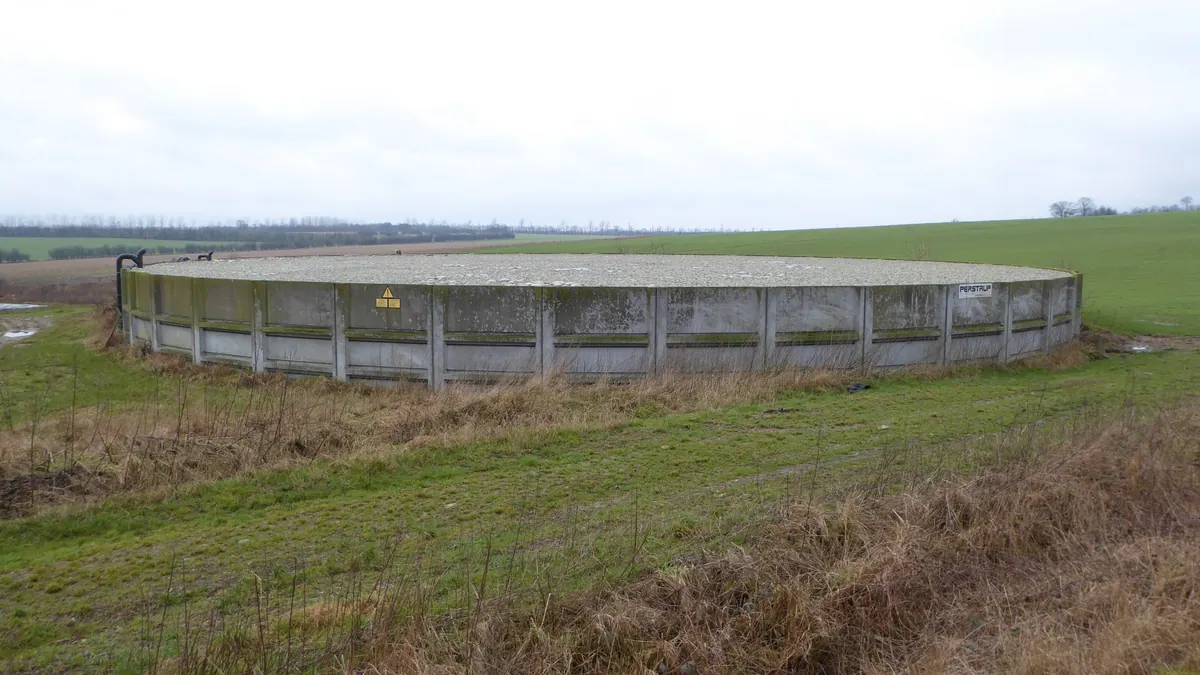

Scum and bottom sludge are two opposite ends of the same problem: material that is not mixed with the rest of the digester contents. Lighter components (fibres, fats, straw) form a floating layer, heavier ones (sand, fine minerals, struvite) sink to the bottom. In both cases part of the tank volume does not take part in the process, and the agitators work harder and harder. The separation of sand at the inlet is described in the article on shredding and removal of foreign bodies, and foaming is a separate disturbance; here we focus on what happens already inside the tank.
Where scum comes from
Scum forms when fibres or fats are carried up by biogas bubbles and do not return to the liquid. It is favoured by:
- long, unshredded fibres (straw, stalk residues, grass),
- fats and oils, which have a lower density than water,
- high dry matter and high viscosity of the contents,
- insufficient or poorly distributed mixing,
- substrates containing feathers, bedding and manure fibres.
Over time the layer dries out, forms a hard crust and stops being permeable to gas. Gas accumulates beneath it, which can cause a sudden release when the agitators move and pressure disturbances.
Where bottom sludge comes from
Sludge consists mainly of mineral particles (sand from silage and slurry, soil from the clamp), fragments of stones and precipitated salts. In an environment with a high concentration of ammonium nitrogen, phosphorus and magnesium, struvite is also deposited. Manure from poultry houses and poultry slurry usually contain more sand, calcium and mineral impurities, so sludge builds up faster. Agitators that are too small or badly positioned leave dead zones in which particles settle and are not lifted again.
Effects on the process
The actual active volume decreases, and since retention time is the ratio of active volume to the daily feed, the actual HRT shortens even when the feed does not change. The hydrolysis of poorly degradable fractions takes time; when it is lacking, part of the organic matter leaves the digester unused. Added to this are poorer heat transfer, higher energy consumption for mixing and a threat to the mechanics: sludge loads the lower bearings, and scum wraps around the blades.
It is worth remembering that the problem grows gradually. A loss of several to a dozen or so percent of the active volume over the years may give no clear symptoms, and yet it accounts for a small but constant drop in efficiency.
How to recognise them
Indirect symptoms:
- rising agitator motor current at unchanged speed,
- a drop in biogas production per tonne of feed at stable chemical parameters,
- differences between the temperature at the wall and in the centre of the tank,
- uneven gas pressure, gas "bubbles" when the agitators move,
- difficulty taking a representative sample from different depths.
Direct methods of measuring the sludge level are a probe or pole introduced through an inspection opening, sonar or ultrasonic devices, and in extreme cases an assessment after emptying the tank. Scum is assessed through a sight glass or inspection opening; a layer of several tens of centimetres is already a clear signal. Work at openings and entries to tanks counts as work in confined spaces and requires appropriate procedures.
What can be done
- The cause at source: shredding of fibres, limiting the share of substrates with a high sand content, quality control of deliveries.
- Mixing: adjusting the position, angle and schedule of the agitators; sometimes a more powerful agitator or an additional one at the dead zone helps.
- Recipe change: reducing the share of floating and very fibrous substrates.
- Sludge removal: pumping from the bottom through a dedicated nozzle (if provided), periodic flushing, and when these methods are not enough, emptying the digester and mechanical cleaning.
Emptying the digester is a costly decision: it requires a production break, disposal of a large mass of digestate and a restart. It is therefore better to prevent than to remove, and to monitor the state of the sludge every few months.
It is worth remembering that the actual active volume is one of the most important parameters, yet the one least often measured. A simple illustrative calculation: if in a tank with a volume of 3,000 m³ sludge and scum together occupy 300 m³, the retention time is shortened by about a tenth at the same feed. Such a change can be enough for the content of residual acids in the digestate to rise and the gas yield to fall. Measuring the sludge level once every few months and recording it in the log costs little, and makes it possible to plan cleaning in advance.
Key takeaways
Scum and sludge are problems that build up slowly and are often overlooked. Indirect signals, such as rising agitator current, a drop in yield and a non-uniform temperature, are worth comparing with the results of sludge level measurement. Emptying is a last resort after ongoing methods have been exhausted.
Sources
Related articles