Cogeneration and enginesExplainer
The biogas engine from the inside: the Otto cycle, lean mixture and pre-chambers
How a reciprocating gas engine works at a biogas plant: four strokes, turbocharging, lean mixture and the pre-chamber. An introduction for people starting out with CHP.
Other language versions: Polski, Deutsch, Español, Français, Italiano, Nederlands.
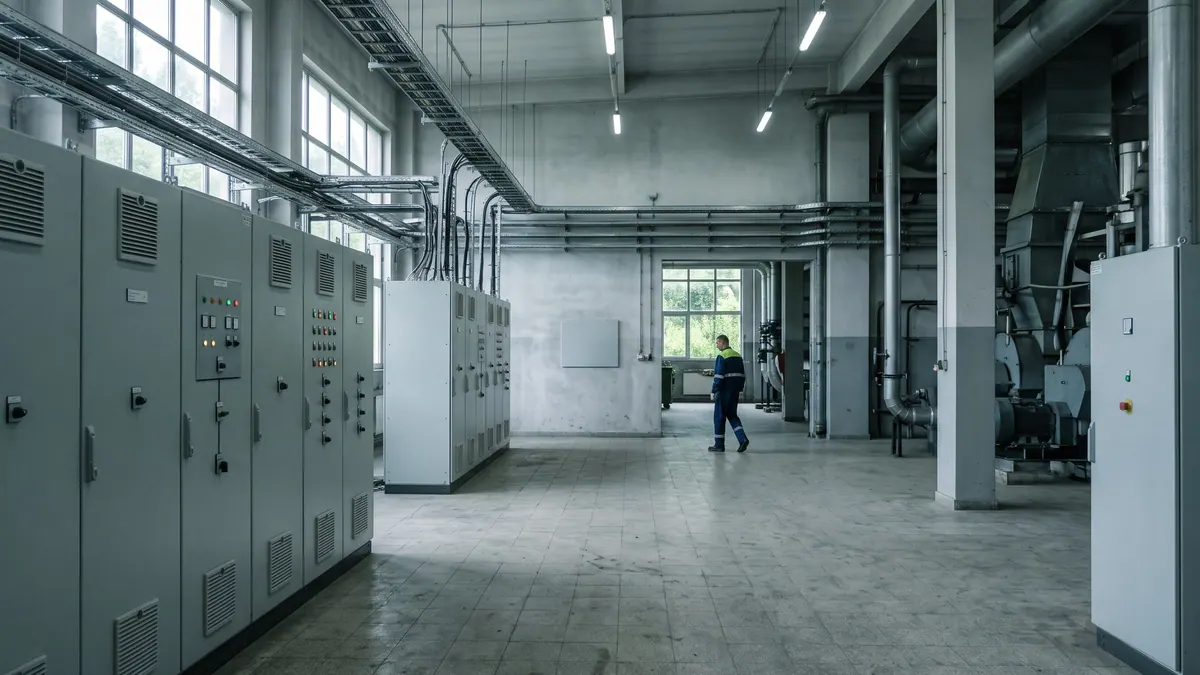
A biogas engine in a cogeneration unit is usually a four-stroke spark-ignition reciprocating engine that burns a mixture of biogas and air on the Otto cycle, most often with a large excess of air, turbocharging and mixture cooling. In design terms it is closer to a large diesel engine fitted with an ignition system than to a car engine. This article sets out what happens in the cylinder and why manufacturers choose one solution rather than another. The numerical values are indicative and depend on the manufacturer and model. The efficiency of whole units, including part-load operation, is covered in the article The CHP engine at a biogas plant: electrical and thermal efficiency and part-load operation, while this text concentrates on the combustion process.
The four strokes in brief
In the intake stroke the cylinder draws in a mixture of gas and air (in turbocharged engines at above atmospheric pressure). In the compression stroke the piston reduces the volume of the charge, and pressure and temperature rise. Just before top dead centre a spark ignites the mixture, and the expanding exhaust gas does work in the expansion stroke. The exhaust stroke removes the exhaust gas. The theoretical efficiency of the Otto cycle rises with the compression ratio and with the adiabatic exponent of the mixture, which is why a lean mixture (higher exponent) and high compression favour efficiency. Biogas containing methane has a high resistance to knock, which allows compression ratios higher than in typical petrol engines.
How the mixture is formed
In most biogas engines the gas and air are mixed upstream of the turbocharger compressor or in a mixer (for example of the Venturi type) in the intake line. Older designs use central mixing, while newer ones increasingly dose the gas through a separate valve for each cylinder, which improves the evenness of the load between cylinders. The mixture passes through the compressor, where it heats up, then through the mixture cooler, and only once cooled does it reach the intake manifold. Cooling increases the density of the charge, and therefore the mass of air in the cylinder, and reduces the tendency to knock. The quantity of mixture is controlled by the throttle, and the composition is corrected by a controller on the basis of measurements (for example of power, temperature or oxygen in the exhaust gas).
Why a lean mixture
The excess air ratio lambda describes how much air is in the mixture relative to the amount theoretically needed for complete combustion. Cogeneration engines usually run well above the stoichiometric value, typically at lambda of about 1.6–1.8. There are three reasons.
- A lower peak combustion temperature, and therefore far less nitrogen oxide, without an expensive catalytic reduction system.
- Lower thermal load on pistons, cylinder heads and valves, and a lower tendency to knock.
- Higher efficiency thanks to the more favourable thermodynamic properties of the working gas.
The price is a narrow operating window. A mixture that is too lean causes misfires and an increase in CO and hydrocarbons, while one that is too rich raises NOx and temperatures. The controller therefore keeps the composition within a very small tolerance.
The pre-chamber and gas injection
Igniting a very lean mixture with a single spark plug in the main chamber is unreliable, because the flame kernel either dies out or develops too slowly. The solution is the pre-chamber, a small space above the cylinder in which the spark plug is mounted. It receives a small portion of a richer gas mixture from a separate valve. The spark ignites it easily, and the flame jetting through the orifices into the main chamber acts as a high-energy igniter that ignites the lean mixture at many points at once. The result is more stable ignition, a shorter combustion time and lower NOx at a very lean composition. In smaller engines direct ignition by a spark plug in the main chamber is also found, in which case the mixture is usually somewhat richer.
Gas injection can take place into the intake manifold just before the valves (port injection) or jointly upstream of the turbocharger. The closer to the cylinder, the faster the response of the system, but the greater the number of valves and components to service.
Power, efficiency and low methane concentration
The power of an engine results from the energy introduced with the gas. Gas with a lower methane content has a lower calorific value, so to obtain the same power the cylinders must take in a larger volumetric flow of gas, which occupies the space of air. When CH4 falls below the range specified by the manufacturer (this often begins at about 45–50% by volume, depending on the model), the controller reduces power or the engine drops out of operation. A high CO2 content acts at the same time as ballast that suppresses knock, but it also lengthens combustion and can reduce efficiency. Variation in gas composition over time is a greater challenge for the control system than a low average on its own.
The typical electrical efficiency of biogas engines is, indicatively, in the range of about 37–44%, with larger units reaching values from the upper part of the range. The remaining energy is heat from the coolant, exhaust gas and oil, plus losses. Practical rules for servicing spark plugs, valves and oil are described in the article Servicing a CHP gas engine: oil, spark plugs, valves and overhauls.
Cooling and lubrication
An engine usually has two cooling circuits: a high-temperature one (cylinder jackets, cylinder heads, part of the mixture cooler) and a low-temperature one (the second part of the mixture cooler, the oil cooler). The lubricating oil, a special grade for gas engines, has a low sulphated ash content in order to limit deposits in the combustion chamber. Its quality has a direct effect on the life of spark plugs and valves.
Summary
A biogas engine combines the classic Otto cycle with a lean mixture, turbocharging and a pre-chamber in order to achieve high efficiency at low emissions. Understanding this arrangement makes it easier to interpret alarms, control data and service recommendations. Detailed parameters should always be read from the documentation of the specific engine.
Sources
Related articles