Safety and ATEXAnalysis
Functional safety: the basics of SIL and PL in process installations
SIL and PL are two scales of safety function reliability. We explain where they come from, how the IEC 61511 and ISO 13849 standards differ, and how to approach them at a biogas plant.
Other language versions: Polski, Deutsch, Español, Français, Italiano, Nederlands.
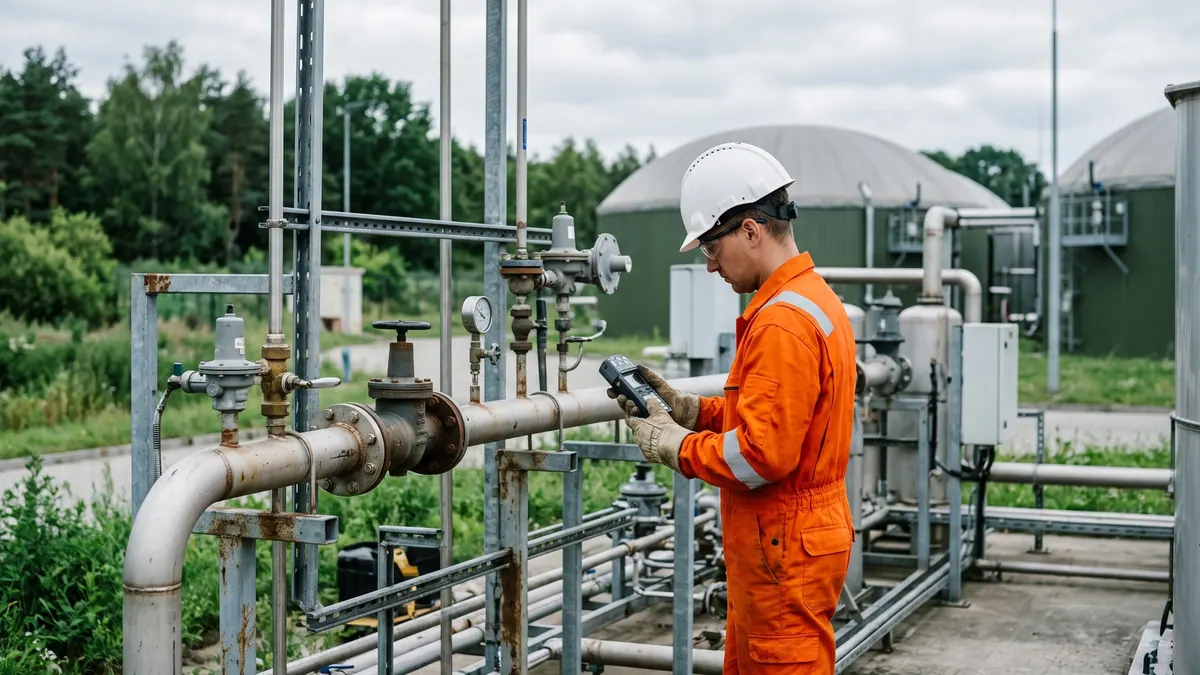
SIL and PL are two scales used to express the required reliability of a safety function. A safety function is a set of automatically performed actions intended to reduce risk to an acceptable level, for example closing a gas valve after excessively high pressure is detected. SIL (Safety Integrity Level) is used in the process industry and is based on the IEC 61508 and IEC 61511 standards, while PL (Performance Level) is used in machinery safety under ISO 13849-1. Both concepts answer the same question: with what probability will the function operate when it is needed.
Where the required level comes from
The level is not picked from a catalogue. It results from a hazard analysis and a risk assessment. A typical procedure in the process industry looks as follows:
- Hazard identification (e.g. HAZOP, a review of failure scenarios).
- Estimation of the risk without additional protection: how frequent and how serious the consequences may be.
- Setting the target, acceptable risk.
- Determining the risk reduction required from the safety function and assigning it a SIL (methods: risk matrix, risk graph, LOPA).
- Design, verification by calculation, commissioning, periodic testing and management of change.
This whole path is known as the safety lifecycle. SIL is therefore not a property of a sensor or a valve, but of the protective loop in a specific application.
What SIL is
The IEC 61508 standard defines four SIL levels (from 1 to 4), although SIL 4 is encountered almost exclusively outside the process industry. The level is tied to a permissible reliability measure:
- for functions with a low demand rate (low-demand mode) the measure is the average probability of failure on demand, PFDavg. For SIL 1 it lies in the range from 10⁻² to 10⁻¹, for SIL 2 from 10⁻³ to 10⁻², for SIL 3 from 10⁻⁴ to 10⁻³,
- for functions with a high demand rate or continuous operation the measure is the frequency of dangerous failures per hour, PFH. For SIL 1 this is the range from 10⁻⁶ to 10⁻⁵ per hour, for SIL 2 from 10⁻⁷ to 10⁻⁶, for SIL 3 from 10⁻⁸ to 10⁻⁷.
Calculating the PFD alone is not enough, however. The standard also requires meeting architectural constraints (hardware fault tolerance, safe failure fraction) and applying systematic measures to prevent errors in the design and software.
What PL is
ISO 13849-1 expresses the required performance level in five grades, from PL a (lowest) to PL e (highest). The level results from a risk assessment (severity of consequences, frequency of exposure, possibility of avoiding the hazard), and meeting it requires choosing an architecture (category B, 1, 2, 3 or 4), component reliability (MTTF), diagnostic coverage (DC) and protection against common cause failures. The approximate ranges of dangerous failures per hour run from about 10⁻⁵ to 10⁻⁴ for PL a to about 10⁻⁸–10⁻⁷ for PL e. A related standard is IEC 62061, which expresses its requirements on the SIL CL scale.
Comparison
| Feature | SIL (IEC 61508 / 61511) | PL (ISO 13849-1) |
|---|---|---|
| Application | process industry, E/E/PE systems | machinery control systems |
| Scale | SIL 1–4 | PL a–e |
| Measure | PFDavg or PFH | PFH |
| Domain at a biogas plant | process protection (pressure, level, gas) | machinery: feeders, agitators, blowers with guards |
| Risk assessment | LOPA, HAZOP, risk matrix | risk graph according to the standard |
At a biogas plant the two worlds meet. Safety fittings on the tank, gas shut-off valves, gas detection and engine protection belong to the process domain, while dosing units, augers and drives belong to the machinery domain.
Where this affects a biogas plant
Typical functions for which a formal assessment is worth considering: limiting overpressure or underpressure in a tank, overfill protection, shutting off the gas supply when abnormal parameters are detected, automatically stopping the engine and starting the flare, and gas detection with isolation of ignition sources in hazardous zones. Many of these functions are performed by simple mechanical devices (e.g. safety valves with a defined characteristic), which do not require SIL calculations but must still be designed and tested correctly. Protections of this kind are covered in the explosion protection document, described in the article on ATEX at a biogas plant.
How to approach the topic in practice
- Start with scenarios, not certificates. First establish what you want to avoid and how often it may happen.
- Treat the loop as a whole. The sensor, logic solver and final element must together meet the required level. A weak link, for example a valve without position confirmation, lowers the entire result.
- Plan periodic tests. PFD calculations assume a specific proof-test interval. If the tests are not carried out, the assumptions are not met.
- Manage change. Replacing a sensor, changing setpoints or modifying a program can invalidate an earlier assessment.
- Do not promise more than the assessment shows. Claims of "SIL 2" in an offer without a description of the loop, the test interval and the architecture have no value.
The basics of gas safety and work in hazardous zones are also described in the article on hydrogen sulphide and gas detection. The assessment of safety functions should be carried out by people with suitable competence, in line with the site's instructions, and its results should go into the operating documentation.
Typical mistakes in the approach to SIL
- Treating a device's SIL certificate as a certificate for the entire loop. The certificate concerns a component under specified conditions and does not replace calculations for a specific architecture.
- Skipping periodic tests and the documentation of their results, which makes the actual PFD higher than assumed.
- Mixing process control functions with the safety function in the same path, without an analysis of common cause failures.
- Underestimating the effect of program and setpoint changes during operation.
- Assuming that a higher SIL always means a better solution. An excessive requirement can be costly and hard to maintain, while a simpler protection, well designed and tested, may meet the objective.
Limits of the concepts
SIL and PL do not describe the safety of the whole installation, only the reliability of selected functions. A high SIL does not replace good design, maintenance or staff training. Nor is it a guarantee that no incidents will occur: residual risk remains. It should therefore be treated as one element of the safety system alongside technical and organisational barriers and procedures.
Sources
Questions and answers
Must every safeguard at a biogas plant have a defined SIL?
No. The required level is determined for safety functions that are to significantly reduce risk following a risk assessment. Many safeguards are simple solutions with no formal SIL.
Related articles