InnovationGuide
How to assess a new technology at a biogas plant: TRL, references and questions for the supplier
The TRL scale, a careful reading of references and a checklist of questions help tell proven technology from merely promising technology. A guide for investors and operators.
Other language versions: Polski, Deutsch, Español, Français, Italiano, Nederlands.
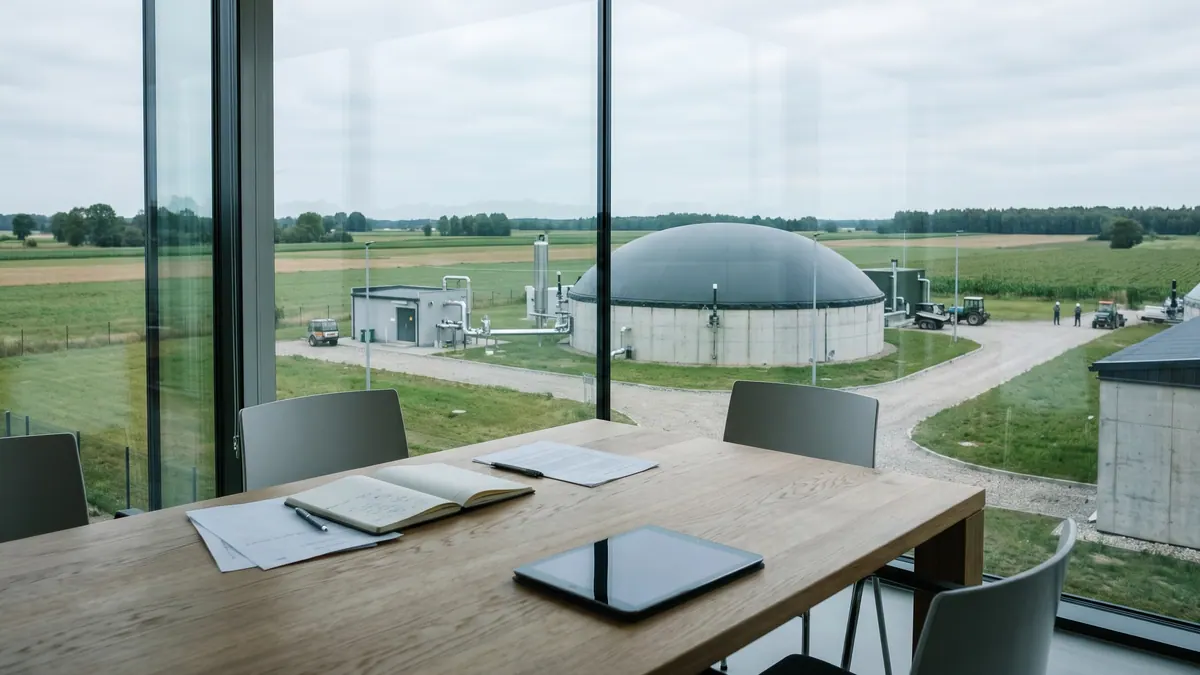
A new technology at a biogas plant — from microbial additives to control systems — is usually presented as ready to buy. First establish what maturity stage it has really reached, who has tested it and at what scale, and what happens when the promises are not met. This guide organises such an assessment into a few steps that can be completed before a contract is signed.
The TRL scale: what the levels mean
The Technology Readiness Level (TRL) scale has nine steps. In the Horizon 2020 programme the European Commission defined them in an annex to the work programmes. In simplified terms:
- TRL 1–3 — the operating principle is described and confirmed in basic research and a proof-of-concept experiment,
- TRL 4–5 — validation of components or the system in the laboratory, and then in conditions close to real ones,
- TRL 6–7 — a prototype demonstrated in a relevant environment (pilot) and in operational conditions (demonstration),
- TRL 8 — a complete system qualified, that is, proven in its first deployment,
- TRL 9 — a system proven in operation, in many applications, in normal use.
For an investor, the boundary between TRL 6–7 and 8–9 is what counts. Below it, this is still a research and development project in which the user bears the technical risk. Keep in mind that TRL refers to a specific application: a technology that is mature in wastewater treatment plants may be TRL 4 at an agricultural biogas plant, because it works on a different substrate and under a different operating regime.
Prototype, pilot, demonstration, commercial
In marketing materials these words are used loosely, so ask for definitions:
- prototype — a single unit, often operated by its developers,
- pilot — a scaled-down or partial installation working on real substrate, usually for months,
- demonstration — full scale, but the first or second installation, with intensive supplier support,
- commercial — a series of installations, standard documentation, and service and spare parts available without the involvement of the designer.
A sensible rule: if the supplier calls an installation "commercial", ask for a list of all operating sites, not just the best one.
How to read references
A reference without context says little. For each one, check four things:
- Operating time — how many months of continuous operation, including through winter and substrate changes. The first few weeks rarely reveal wear or fouling problems.
- Scale — whether the installation handles the same flow size as yours. A result from a reactor of a few dozen litres does not transfer linearly to a digester with a volume of thousands of cubic metres.
- Substrate — slurry, silage and slaughterhouse waste behave differently; a reference from a different mix is only circumstantial evidence.
- Availability and operating costs — downtime, part replacements, utility consumption and operator working hours.
The most valuable thing is a conversation with an operator that you chose, not the supplier, and a visit to the site. Ask about what did not work: an honest operator can usually name it.
Checklist of questions for the supplier
- Which parameters are contractually guaranteed, how are they measured and who measures them?
- Will the reference measurement be carried out by an independent body, using what methodology (e.g. BMP, mass balance)?
- What are the penalties or cost refunds if the guarantee is not met?
- What happens to the installation if the technology is switched off — can it be returned to its initial state?
- What is the impact on digestate, gas and other installations (e.g. does it change the legal status of the digestate)?
- What operator qualifications are required and how many additional working hours?
- Does the supplier have service in Poland and what are the response times?
- Does the technology require changes to permits or to explosion protection documentation?
The small-pilot rule and go/no-go criteria
If a technology is promising but below TRL 8, the safest approach is to proceed in stages. First a paper balance based on your own data: how much energy, utilities and money the solution must deliver in order to pay back. Then a short pilot on part of the stream or on a single tank, with a comparison group. The key is to set the go/no-go criteria before the start: what methane yield increase, what availability and what costs count as success, and how long the trial period lasts. Without this, the pilot ends in a discussion about interpretation rather than a decision.
When assessing effects, remember that biogas production changes because of changes in the mix, temperature and silage quality. Therefore the effect of the technology should be measured against a reference period with comparable feedstock and, where possible, in parallel with a control line.
Typical red flags
- Laboratory-only results presented as full-scale (typical for additives and conductive materials; see biochar and magnetite in the digester).
- An increase in production given as a single number, without a range, substrate and conditions.
- No data on availability, utility consumption and operating costs.
- A refusal to guarantee results combined with certainty about the effects.
- An attractive pilot price with opaque scale-up costs.
- Reference to a "certificate" without stating what exactly was certified and by whom.
What next in the series
In the following articles in this section we describe specific directions: phosphorus recovery, membrane treatment of digestate, NIR spectroscopy, the ADM1 model and others. Apply the same questions to each. For hydrogen technologies, see the separate maturity assessment in the article Hydrogen from biomass and electrolysis: technology readiness levels (TRL), costs and realistic prospects.
Sources
Related articles