InnovationAnalysis
Membrane treatment of the liquid fraction of digestate: ultrafiltration, reverse osmosis and fertiliser concentrate
Separation, ultrafiltration and reverse osmosis reduce the mass of digestate to be transported, but they cost energy. An analysis of the balance, costs and legal limitations.
Other language versions: Polski, Deutsch, Español, Français, Italiano, Nederlands.
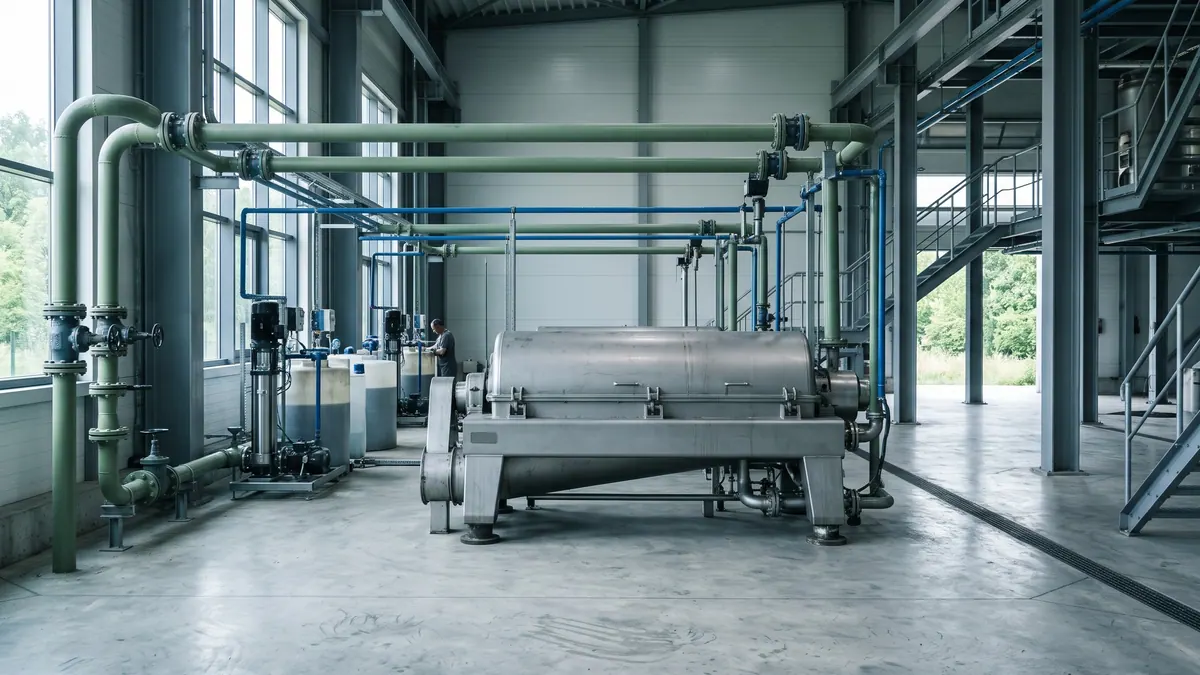
At a high-capacity biogas plant, or in a region with an excess of organic fertilisers, the main cost becomes not gas production but digestate management — water makes up the largest part of it, and hauling it is expensive. Membrane treatment tries to split this stream into water and concentrate. We assess when this makes sense.
The process train
A typical system consists of several stages, each of which prepares the stream for the next:
- Mechanical separation (screw press, centrifuge) removes the solid fraction. It is described in the article on digestate separation; here this stage is only the starting point.
- Removal of fine suspended solids — flotation with flocculant dosing, or ultrafiltration (UF), which retains particles and colloids and lets dissolved salts through.
- Reverse osmosis (RO) — at a pressure of several dozen bar, water passes through the membrane while the salts (ammonium, potassium, chlorides) remain in the concentrate. Two stages or a system with pH control are often used, because ammonium in ionic form is retained better than ammonia.
- Output: permeate (low-salinity water) and fertiliser concentrate.
Unlike biogas upgrading, where membranes separate gases (membrane upgrading), here the components dissolved in a liquid are separated.
Mass balance
The result depends on the degree of water recovery. Assuming that 1 t of liquid fraction enters the system and water recovery is 70–85%, markedly less concentrate is produced — on the order of a dozen or so to thirty percent of the feed mass — and a correspondingly large amount of permeate. Two things must be kept in mind, however:
- The higher the water recovery, the higher the salinity of the concentrate, the higher the operating pressure and the greater the risk of scaling.
- The balance must include the streams from the preliminary stages: flotation sludge and the solid fraction from separation, which also require management.
Nitrogen in the concentrate occurs mainly as ammonium, potassium is entirely in solution, and phosphorus only in part, because the rest remained in the solid waste. The concentrate is therefore a nitrogen-potassium fertiliser with a relatively low dry matter content.
Energy and costs
Electricity consumption per m³ of treated fraction depends on pressure, recovery, temperature and salinity; the literature and supplier materials give values from a few to a dozen or so kWh/m³ for the whole train, but markedly higher or lower values are possible. Treat them as an order of magnitude, not as a promise. Further costs include:
- chemicals for cleaning and pH control,
- membrane replacement in a cycle usually counted in years, depending on feed quality,
- operation and instrumentation,
- management of the concentrate and waste from the preliminary stages.
The gain comes from avoiding the transport and spreading of water and from selling the concentrate as a fertiliser, if a market for it exists. It is worth doing the calculation as follows: the cost per m³ of digestate transported and spread within the radius typical for the installation versus the cost of processing a unit of the fraction.
Fouling: the biggest problem
A membrane works stably only when the feed is clean. Digestate contains colloids, fats, struvite and other mineral deposits, as well as biofilm. The result is a drop in flux and a rise in pressure. The standard response is careful pretreatment, pH control and antiscalants, periodic flushing and chemical cleaning. With differing substrates and variable dry matter content, the train has to be readjusted; this is why in practice experienced operators and supervision are required.
When it holds up
Treatment has a chance of being justified when the following conditions are met together:
- a digestate surplus relative to one's own land and offtake agreements,
- an NVZ zone or other nitrogen dose restrictions, which make utilisation difficult,
- no access to land within a reasonable distance,
- large scale, because the fixed costs of the system are high and the value of a single m³ is low,
- the possibility of selling the concentrate or using it oneself.
At a typical agricultural biogas plant with access to fields, simpler solutions (lagooning, spreading, separation) are cheaper. It is also worth checking the alternative of ammonia stripping, which deals with the nitrogen without recovering water.
Law: waste or product
Water after RO may be discharged or reused only if it meets the requirements for introducing wastewater into waters or soil; in practice this requires a permit and tests. For the concentrate to be a fertilising product, it must have an appropriate status — e.g. a fertiliser made from digestate in accordance with national regulations, or a CE product under Regulation (EU) 2019/1009, provided it meets the criteria for components. Without this it remains digestate or waste, with all the restrictions. The rules for assessing a supplier and a pilot can be found in the guide How to assess a new technology.
Sources
Related articles