Digestate and fertilisersExplainer
Ammonia stripping from digestate: how it works, what it costs and what is produced
Stripping recovers ammonium nitrogen from digestate in the form of ammonium sulphate. Principle of operation, process conditions, a balance example, acid and energy consumption, and limitations.
Other language versions: polski.
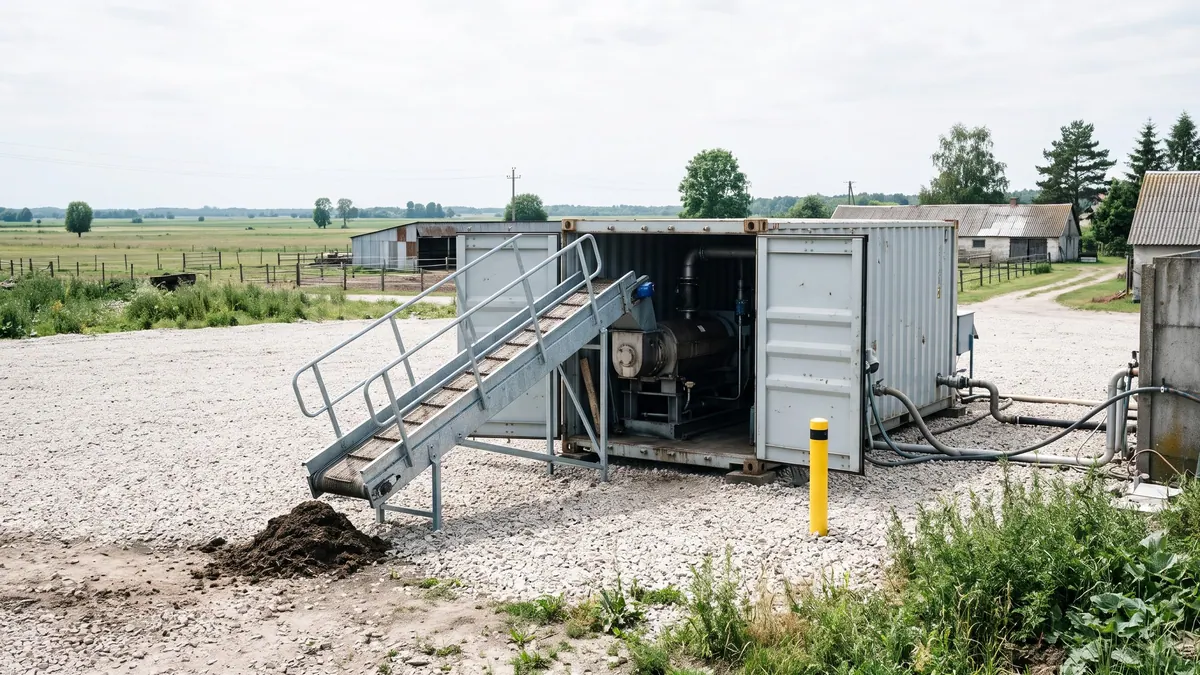
Ammonia stripping is a process in which ammonium nitrogen is transferred from a liquid (usually the liquid fraction of digestate after separation) to a gas stream and then bound in an acid in the form of a salt — most often ammonium sulphate. The condition for effective stripping is shifting the NH₄⁺ ⇄ NH₃ equilibrium towards free ammonia by raising the pH and temperature; recovery is typically from several dozen per cent to over 90% of the ammonium nitrogen. The product, an ammonium sulphate solution, is a concentrated nitrogen fertiliser of a much smaller volume than digestate.
Principle of operation
- Preparing the liquid: the liquid fraction after separation (to limit suspended solids and clogging of the packing) is heated, often with waste heat from the CHP.
- Raising the pH: adding a base (sodium hydroxide or lime) or degassing CO₂ shifts the pH to values of the order of 9–10 and more; the higher the pH and temperature, the greater the share of NH₃.
- Stripping: in a packed column the liquid flows down, while air or steam flows counter-currently and carries off NH₃.
- Absorption: the gas stream with ammonia goes to a scrubber with sulphuric acid; ammonium sulphate (NH₄)₂SO₄ is formed, usually as a solution with a concentration of the order of several dozen per cent by mass.
- Gas circulation: the air after the scrubber can return to stripping.
- Liquid after the process: it has a reduced ammonium nitrogen content and can be used as a diluent in the digester or applied to the field.
Because of the equilibrium, free NH₃ constitutes a significant fraction of TAN only at high pH — we gave the formula in the article on ammonia inhibition. For 70 °C the pKa is about 8.0, so even at pH 9 the free form dominates.
Balance example
Assumptions: 10,000 m³ of liquid per year, TAN = 3.0 g N/l (30 t N per year), recovery 80% (24 t N). Ammonium sulphate contains about 21.2% N (28 / 132), so the mass of salt = 24 / 0.212 ≈ 113 t (as a solid); in a 35% solution that is about 320 t of solution per year. Sulphuric acid consumption: 1 mol of H₂SO₄ binds 2 mol of NH₃, i.e. 24,000 kg N / 14 = 1,714 kmol N → 857 kmol H₂SO₄ ≈ 84 t of 100% acid (about 86 t with 98% acid). In addition, a base is needed to raise the pH, as well as thermal energy to heat the liquid. The exact consumption depends on the alkalinity of the liquid (high alkalinity = higher consumption of base).
Technological variants
| Variant | Description | Notes |
|---|---|---|
| Air stripping from columns | liquid heated, pH raised | most commonly used, sensitive to suspended solids |
| Steam stripping | steam strips off NH₃ | higher energy consumption, higher recoveries |
| Vacuum stripping | reduced pressure and lower temperature | lower heat consumption, more expensive equipment |
| Gas-permeable membranes | NH₃ diffuses through a membrane into acid | modularity, sensitivity to fouling |
| Recovery via struvite (MAP) | precipitation with Mg and phosphates | recovery of N and P, a different technology |
Advantages
- reduction of the nitrogen content in the liquid, easier compliance with requirements for fields,
- a fertiliser product of constant composition and small volume, easy to transport,
- reduction of ammonia inhibition when the liquid after the process returns to the digester,
- the possibility of selling nitrogen.
Limitations and costs
- costs of chemicals (acid, base), energy and service,
- the need for preliminary separation and removal of suspended solids,
- scaling (carbonates) in the columns,
- use of the ammonium sulphate solution — legal status and product quality (metal content); sale as a fertiliser requires meeting the requirements for fertilising products; they should be checked for the specific case,
- risk of ammonia emissions and the need for occupational health and safety when working with acid and base.
When it makes sense
- The digestate has a high TAN concentration (several g N/l) and the cost of using the nitrogen is rising.
- Ammonia inhibition occurs, forcing a limit on feed rates.
- Cheap waste heat is available.
- There is a market for a nitrogen fertiliser.
Decision checklist
- Measure the TAN, pH, alkalinity and suspended solids of the liquid.
- Calculate the N balance and reagent consumption for the assumed recovery.
- Verify the legal requirements for the product and the installation (emissions, storage of chemicals).
- Compare with the alternative: dilution, changing the mix, transporting digestate to recipients.
- Ask the supplier for references on digestate from a similar mix.
Stripping is a useful tool in plants with an excess of nitrogen, but rarely the first choice: it is worth optimising the mix and logistics first.
Operation and typical problems
In practice the biggest troubles are the deposition of carbonate scale on the column packing (requires periodic acid flushing), clogging of the system with suspended solids when separation is insufficient, corrosion and fluctuations in product concentration. It is good to measure continuously the pH, temperature, liquid and air flow and the TAN concentration at the inlet and outlet; a drop in recovery is the first signal of fouling of the packing. The ammonium sulphate solution is stored in chemically resistant tanks, with leak protection and ventilation control, and operation requires personal protective equipment and training in handling acids and bases.
Sources
Questions and answers
Is stripping suitable for every biogas plant?
Most of all where the digestate has a high concentration of ammonium nitrogen (poultry manure, protein wastes), there are problems with managing the nitrogen or with ammonia inhibition, and cheap heat is available. With small nitrogen loads, the investment usually does not pay back.
Related articles