Digestate and fertilisersGuide
Nitrogen balance and digestate rates: a step-by-step calculation example
How to calculate the rate in m³/ha from the digestate analysis and the fertilisation plan, check the nitrogen limit and estimate losses. An example with explicit assumptions.
Other language versions: polski.
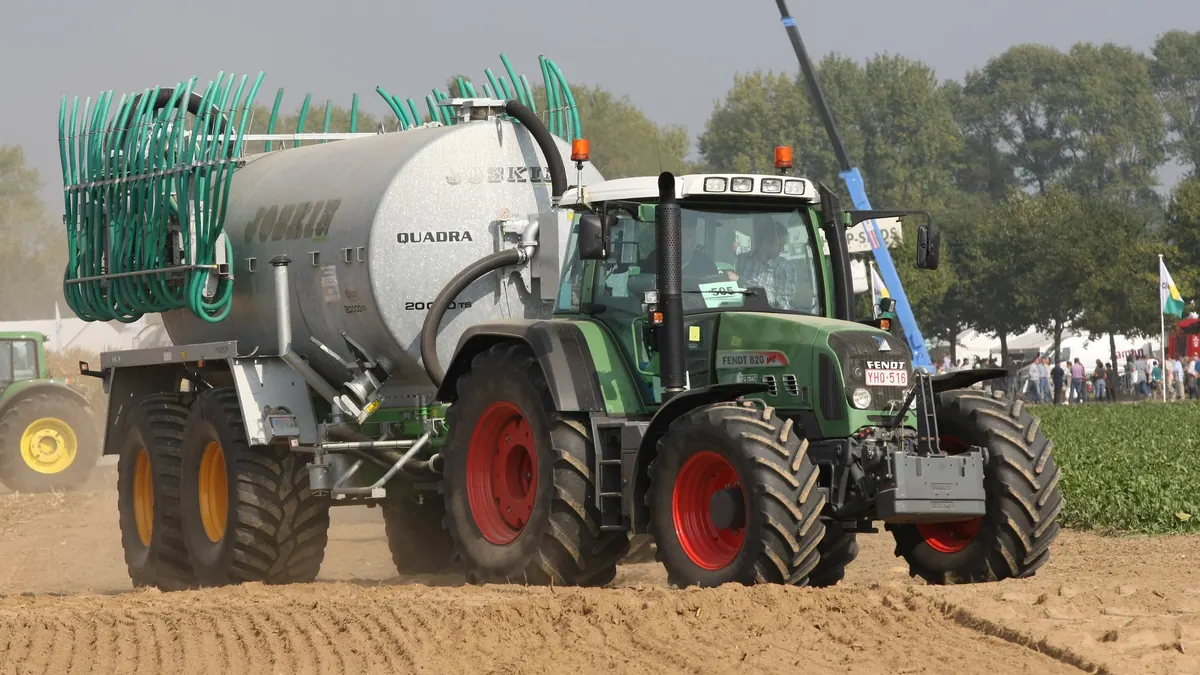

The digestate rate per hectare is calculated by dividing the planned nitrogen rate (kg N/ha) by the nitrogen content of the digestate (kg N/m³ or kg N/t), corrected for the utilisation coefficient and losses. The first constraint is usually the limit of 170 kg N/ha per year of nitrogen from livestock manures resulting from the Nitrates Directive and the national action programme (it applies to digestate only where it is so classified – this depends on the substrates and national regulations), the second — the crop requirement, and the third — soil factors and timing. The example below illustrates the line of reasoning; the figures are assumed, not representative.
Input data
What is needed: the digestate analysis (total N, N-NH₄⁺, P, K, dry matter), the area and crop, the target yield and soil nutrient status. Carry out the analysis for each batch or at least seasonally, because the composition depends on the mix of substrates. For simplicity let us assume:
| Parameter | Value (assumption) |
|---|---|
| Total N | 4.5 kg/m³ |
| N-NH₄⁺ (of which) | 2.7 kg/m³ (60%) |
| P₂O₅ | 1.6 kg/m³ |
| K₂O | 4.0 kg/m³ |
| Dry matter | 6% |
Step 1: the rate resulting from the limit
Limit of 170 kg N/ha: 170 / 4.5 ≈ 37.8 m³/ha per year from livestock manures, provided that all sources of natural nitrogen on that field are this very digestate. If manure or slurry is applied in addition to digestate, the nitrogen from them is added up.
Step 2: the rate resulting from the plant's needs
Let us assume winter wheat with a fertiliser N requirement of about 160 kg/ha (after taking soil reserves and the preceding crop into account — set the value according to local recommendations). Let us assume the N utilisation coefficient of digestate in the year of application: 0.6 for total N (a simplification; practice uses different values depending on timing and technique). Effective N per m³: 4.5 × 0.6 = 2.7 kg. Rate: 160 / 2.7 ≈ 59 m³/ha. This is more than the limit allows (37.8 m³), so the limit is the deciding factor; the rest of the N must come from mineral fertilisers.
Step 3: supplementing with mineral fertiliser
At 37.8 m³/ha the effective N supplied is: 37.8 × 2.7 ≈ 102 kg. To cover 160 kg, about 58 kg N from mineral fertilisers is still needed. The phosphorus and potassium balance is checked in the same way: 37.8 × 1.6 ≈ 60 kg P₂O₅/ha and 37.8 × 4.0 ≈ 151 kg K₂O/ha — compare with crop removal and soil nutrient status. On soils rich in P an excess of phosphorus may be a constraint.
Nitrogen losses
Ammonium nitrogen escapes in the form of NH₃, especially at a digestate pH of 8 and more, high temperature and wind. Application techniques (trailing hoses, soil injector, rapid incorporation) significantly reduce losses. In the balance a lower utilisation coefficient is adopted for surface application on mature vegetation in summer than for soil application in spring.
Decision table
| Situation | Recommendation |
|---|---|
| Digestate with a high N-NH₄⁺/N ratio | apply close to the period of demand, by soil injection |
| Digestate with high dry matter | allow for a greater share of organic N (slower release) |
| High soil P status | limit the rate according to P, supplement N with mineral fertiliser |
| Sloping terrain, proximity of water | increase caution, use buffer strips |
Checklist
- Carry out an analysis of the digestate from the current batch.
- Calculate the 170 kg N/ha limit and the sum from other livestock manures.
- Calculate the rate according to the plant's needs and the utilisation coefficient.
- Adopt the smaller of the rates.
- Verify the P and K balance.
- Take into account the timing and conditions of application.
- Keep records of operations.
Common mistakes
- Using values "from a table" instead of analyses.
- Omitting nitrogen from other livestock manures.
- A rate calculated in tonnes instead of m³ (density differs).
- Application in winter or on water-saturated ground.
- Failing to take into account that N utilisation indicators vary over a wide range.
National regulations (permitted rates, timing, records, the obligation to have a fertilisation plan) may change; before the season check the current action programme and the recommendations of agricultural advisory services.
Conversion to the whole farm
Let us assume 120 ha of crops on which application of 37.8 m³/ha is planned: 4,536 m³ in total. With a production of 22,000 m³ of digestate per year this means that only about 20% of the stream fits on one's own fields at this limit. The rest requires agreements with neighbours, recipients or processing (separation, nitrogen recovery, granulation). This is the most important planning exercise when designing a biogas plant: the area available for using digestate often limits the scale of the plant more than the technology does. A similar analysis is carried out for phosphorus, which on many farms is the limiting factor.
Documentation
Keep the analysis results, dates and rates, field maps and digestate collection agreements. In the event of an inspection this makes it possible to demonstrate compliance with limits and timing.
Sources
Related articles