Digestate and fertilisersGuide
Digestate separation: screw presses, centrifuges, mass and nutrient balance
Why digestate is separated into a solid and a liquid fraction, which technologies are most commonly used and how to calculate the mass and nutrient balance using an example.
Other language versions: polski.
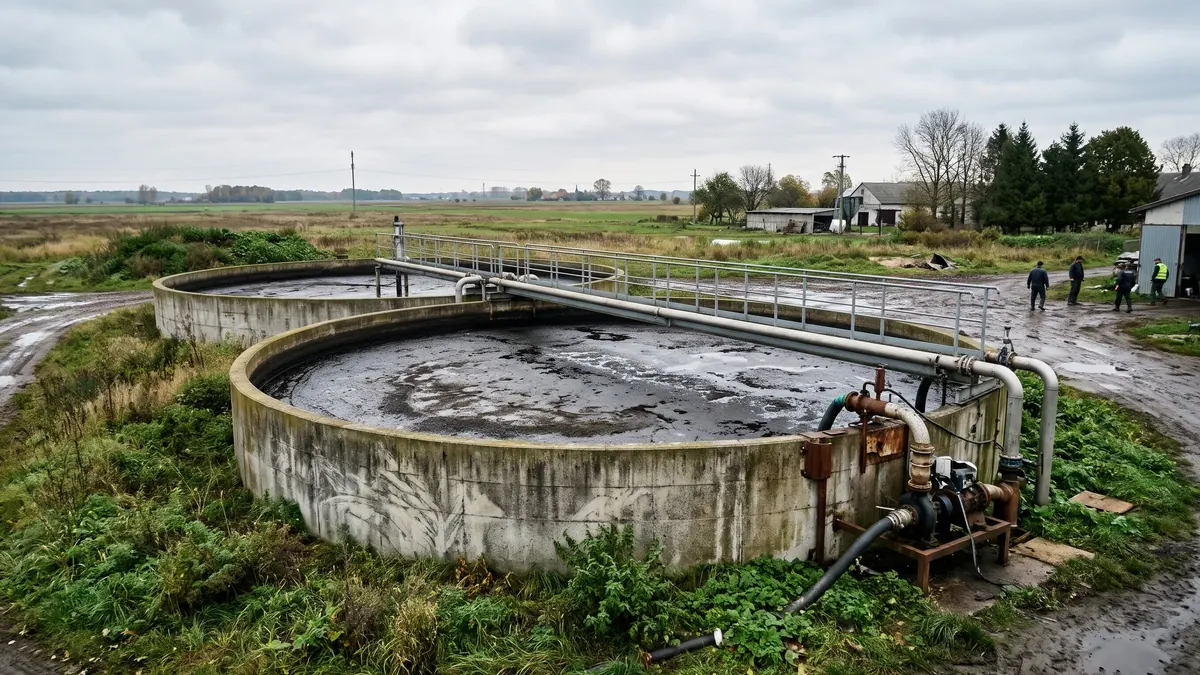
Digestate separation consists in mechanically dividing it into a solid fraction and a liquid fraction. The solid fraction contains most of the phosphorus and a significant part of the organic matter, the liquid one — most of the potassium and ammonium nitrogen. This makes it possible to transport phosphorus over longer distances more cheaply, to make better use of the nutrients and to reduce the volume of tanks for the liquid part. Typically the solid fraction accounts for a dozen or so per cent of the mass of the digestate and has several dozen per cent dry matter.
Technologies
| Technology | Principle | Typical dry matter of the solid fraction | Notes |
|---|---|---|---|
| Screw press | pressing in a screen | approx. 20–30% | most popular, simple to operate |
| Vibrating / arc screen | draining | approx. 10–20% | lower effectiveness, cheap |
| Decanter centrifuge | centrifugal force | approx. 25–35% | better phosphorus recovery, higher cost and energy |
| Belt press | pressing between belts | approx. 20–30% | often with a flocculant |
| Flotation, membrane filtration (further stages) | separation of the liquid fraction | — | advanced, expensive |
The ranges given are indicative and depend on the digestate (viscosity, fibres), the settings and the dosing of flocculants.
Where the nutrients go
Approximately (ranges depend on the technology and the material):
- dry matter — a dozen or so to several dozen per cent goes to the solid fraction,
- phosphorus — a significant part (often half to over 70%) to the solid fraction,
- total nitrogen — about 20–40% to the solid fraction; ammonium nitrogen remains mainly in the liquid,
- potassium — almost entirely in the liquid.
Balance example
Assumptions: 10,000 t of digestate per year, dry matter 7% (700 t TS). A screw press produces a solid fraction: 12% of the mass (1,200 t) with TS of 25% (300 t TS). Liquid fraction: 8,800 t, TS = (700 − 300) / 8,800 ≈ 4.5%. In this example 43% of the dry matter goes to the solid fraction. If the digestate contains 1.5 kg P₂O₅/t (15 t per year) and 60% goes to the solid fraction, then about 9 t of P₂O₅ is in the 1,200 t of solid fraction (7.5 kg/t), and about 6 t of P₂O₅ remains in the liquid in 8,800 t (0.7 kg/t). Such a calculation shows that the solid fraction is 10 times richer in phosphorus per tonne than the liquid.
Advantages and disadvantages
Advantages:
- the solid fraction is suitable for transport, composting, drying, granulation,
- the liquid is easier to pump and apply, lower risk of hose blockages,
- lower demand for storage volume for the liquid,
- the possibility of better matching nutrients to the needs of the fields.
Disadvantages:
- investment and energy,
- the need to find outlets for both fractions,
- risk of ammonia emissions from the solid fraction during storage,
- flocculants (polymers) require an assessment of their impact on soil.
Choosing a technology
- Define the aim: transport of phosphorus, drying, compost, volume reduction.
- Check the viscosity and fibre content of the digestate; straw and manure increase the effectiveness of the press.
- Ask the supplier for the guaranteed dry matter of the solid fraction on a digestate similar to yours (references).
- Calculate the energy costs and the consumption of flocculants.
- Plan a storage place for the solid fraction (slab, roofing) in line with the regulations.
Operation
- Regularly inspect the screens, blades and seals.
- Measure the dry matter of both fractions and record it; a drop in effectiveness signals wear.
- Ensure flushing after work is finished.
- Take care of ventilation and safety: digestate can release NH₃ and H₂S.
Common mistakes
- Expecting high dry matter from digestate made from slurry alone without fibres.
- No space for the solid fraction.
- Too high a dose of flocculant.
- Ignoring the nitrogen balance when storing the solid fraction.
Separation is a logistical and agronomic tool; its profitability depends on what happens to the fractions next.
Use of the solid fraction
The solid fraction can be applied directly to fields as a phosphorus–organic fertiliser, composted, dried or granulated. When storing heaps in the field or on a yard, remember the requirements for sealed slabs and leachate, and the seasonal restrictions. The liquid is stored in tanks, and its application is planned according to the N and K content. It is worth balancing the phosphorus in the solid fraction against soil nutrient status, because with frequent fertilisation it can accumulate.
Control indicators
Good practice is to measure the TS of both fractions weekly or after every change of settings, to keep a record of the separator's operating hours and flocculant consumption (kg/t) and to log energy (kWh/t). This makes it possible to detect a drop in effectiveness and to justify service costs.
Questions for the separator supplier
Ask about the guaranteed dry matter of the solid fraction on a material similar to yours, energy consumption per tonne, flocculant consumption, the service life of screens and screws, the cost of wear parts and the required operating time per day. Ask for references from plants running a similar mix. The total cost (investment plus operation over 8–10 years) determines the choice better than the purchase price.
Sources
Related articles