Digestate and fertilisersAnalysis
Drying digestate: how much energy is needed, which dryers and what next
How much heat is consumed by drying the solid fraction and digestate, which dryers are used and when it makes economic sense. A calculation example with explicit assumptions.
Other language versions: polski.
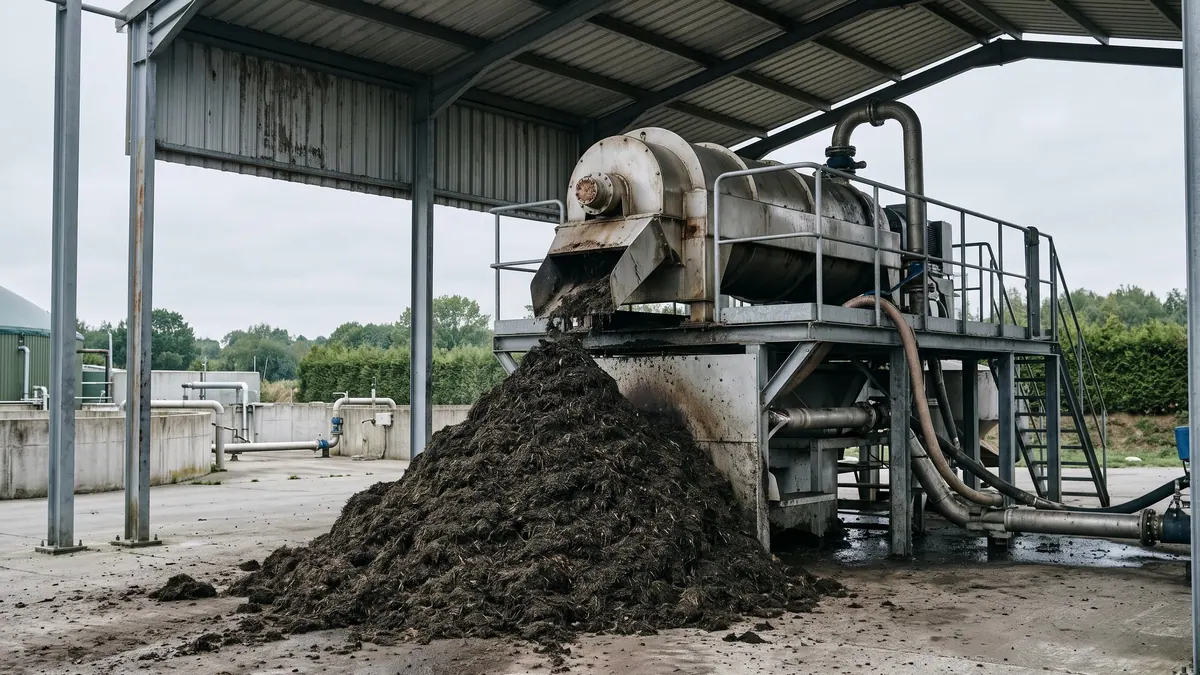
Drying digestate is the evaporation of water from the solid fraction (more rarely from the whole digestate) in order to reduce mass, stabilise it and obtain a product suitable for transport, storage or granulation. It is an energy-intensive process: in practice 1 kg of evaporated water requires about 0.8–1.2 kWh of heat, so profitability depends on the availability of cheap waste heat from the CHP. It is therefore worth calculating the balance before deciding on an investment.
Calculation example
Assumptions: 1,000 t per year of solid fraction with TS of 28%, drying to TS of 85%. Mass of dry matter: 280 t. Mass after drying: 280 / 0.85 ≈ 329 t. Water in the input material: 720 t; in the product: 49 t; evaporated ≈ 671 t of water. At a consumption of 1.0 kWh of heat/kg of water: 671 MWh of heat per year, i.e. 0.67 MWh per tonne of fresh fraction. For a plant with a CHP of 500 kW electrical output and about 500 kW of useful heat (at 8,000 h) the available heat is about 4,000 MWh per year, of which part goes to heating the digester; 671 MWh is therefore about one sixth of that heat, which may be realistic to use. Changing the assumptions will shift the result: a target dry matter of 90% instead of 85% increases the amount of evaporated water by only about 3% (about 689 t instead of 671 t), whereas a different dryer efficiency or heat consumption per kg of water will change the result by several dozen per cent.
Types of dryers
| Type | Description | Application |
|---|---|---|
| Belt | material on a conveyor, blown with hot air | high capacity, popular in medium and large plants |
| Drum | rotating drum, hot gases | high temperature, large capacities, fire risk |
| Floor/cabinet | air through a layer of material | small quantities, simple, slower |
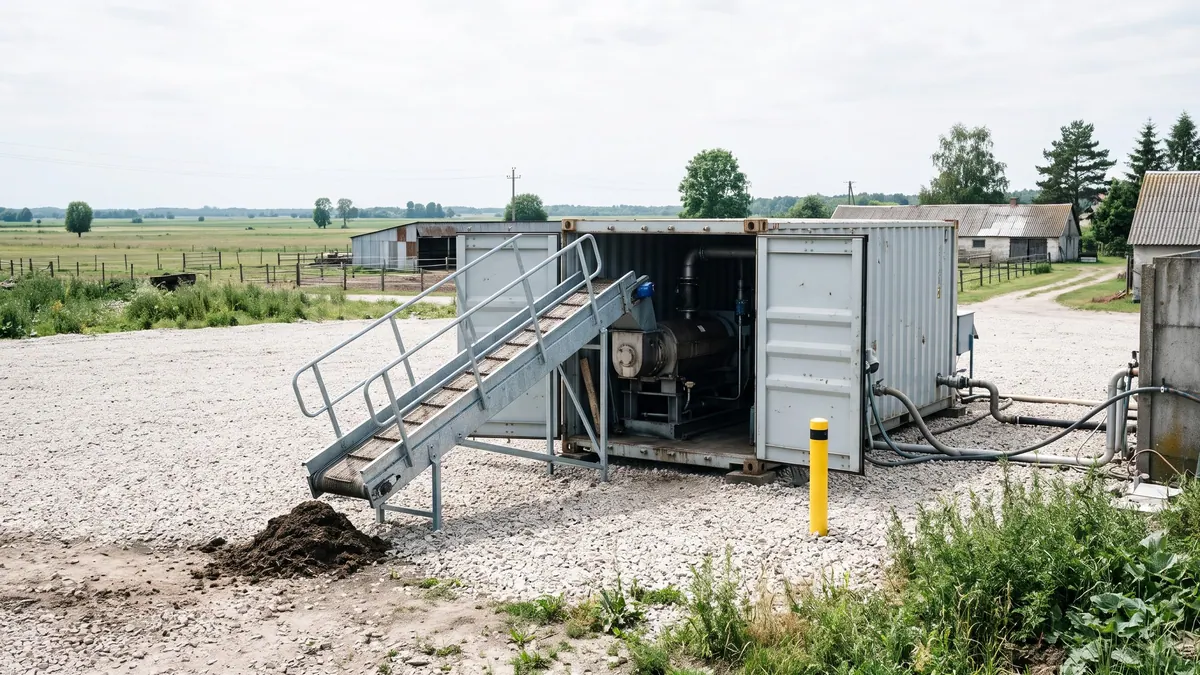
| Container/low-temperature | heat of about 50–80 °C | for waste heat, smaller scale |
| Solar | greenhouses with mixing | seasonal, low power density |
Advantages of drying
- reduction of mass and transport costs (from 1,000 t to about 330 t in the example),
- biological stabilisation and the possibility of long storage,
- the possibility of granulation and sale as an organic fertiliser,
- use of heat that is produced anyway.
Disadvantages and risks
- Investment and operating costs.
- Nitrogen losses: during drying ammonia escapes if the fraction contains a lot of ammonium nitrogen; acid scrubbers (ammonium sulphate) are used or the temperature is limited.
- Emission of odours and dust — filtration and scrubbing of the exhaust air.
- Risk of fire and dust explosion in dryers and in the store of dried material — hazard classification, temperature control and removal of deposits.
- The need for permits/regulations regarding emissions to air and waste management; depending on the plant and substrates, it is worth consulting the requirements with the environmental authority.
When drying pays off
- There is a surplus of heat that cannot be sold in winter/summer.
- The buyer of the solid product is far away, and transporting the wet fraction is expensive.
- The product can be sold (granulate, organic fertiliser) at a price covering costs.
- There is demand for a material with stabilised parameters.
When the heat has another cheap use (heating buildings, industrial processes) or when the solid fraction can be used on nearby fields, drying is rarely defensible economically.
How to increase efficiency
- Dewater the material mechanically as far as possible before drying (every percentage point of TS means less water to evaporate).
- Use heat from the exhaust gases and engine cooling.
- Recover heat from the exhaust air (heat exchangers).
- Limit the temperature to reduce nitrogen losses.
- Measure heat consumption per tonne of water.
Decision checklist
- Heat balance: how much heat can actually be allocated to drying throughout the year.
- Target moisture and the buyer.
- Scope of air cleaning.
- Fire hazard and ATEX.
- Cost of operation and service.
- Alternatives: composting, direct application.
Sensibly planned drying is an element of a biogas plant's heat management system, not a stand-alone business — the assessment should cover the whole chain from separation to sale of the product.
What next with the dry product
The dried solid fraction can be stored in bags or heaps under a roof, sold loose as an organic fertiliser or processed into granulate (a separate article). Pay attention to stability: material with a moisture content below about 15% is resistant to decomposition, but it absorbs moisture from the air and may cake. Burning digestate as a biofuel requires meeting the requirements for combustion installations and is possible only under certain legal conditions — it is not a default solution.
Monitoring
Record heat consumption (kWh/t of water), inlet and outlet moisture, exhaust air temperature and ammonia concentration after the scrubber. These data allow the plant to be compared with the design assumptions and a drop in efficiency to be detected.
Summary
Drying turns a wet, logistically difficult material into a stable product, but at the cost of energy and additional equipment for air cleaning. Before you decide, make a mass and heat balance on your own data, calculate the cost of one tonne of dried product and compare it with the price obtained for the product and with the cost of alternative use of the solid fraction without drying.
Sources
Related articles