Process biology and start-upGuide
Restarting a digester after a shutdown or failure: assessing the state and returning to the full feed rate
Restarting a digester with its biomass intact differs from a start-up from scratch. What to measure before the first feed, how to raise the feeding and when to replace the contents.
Other language versions: Polski, Deutsch, Español, Français, Italiano, Nederlands.
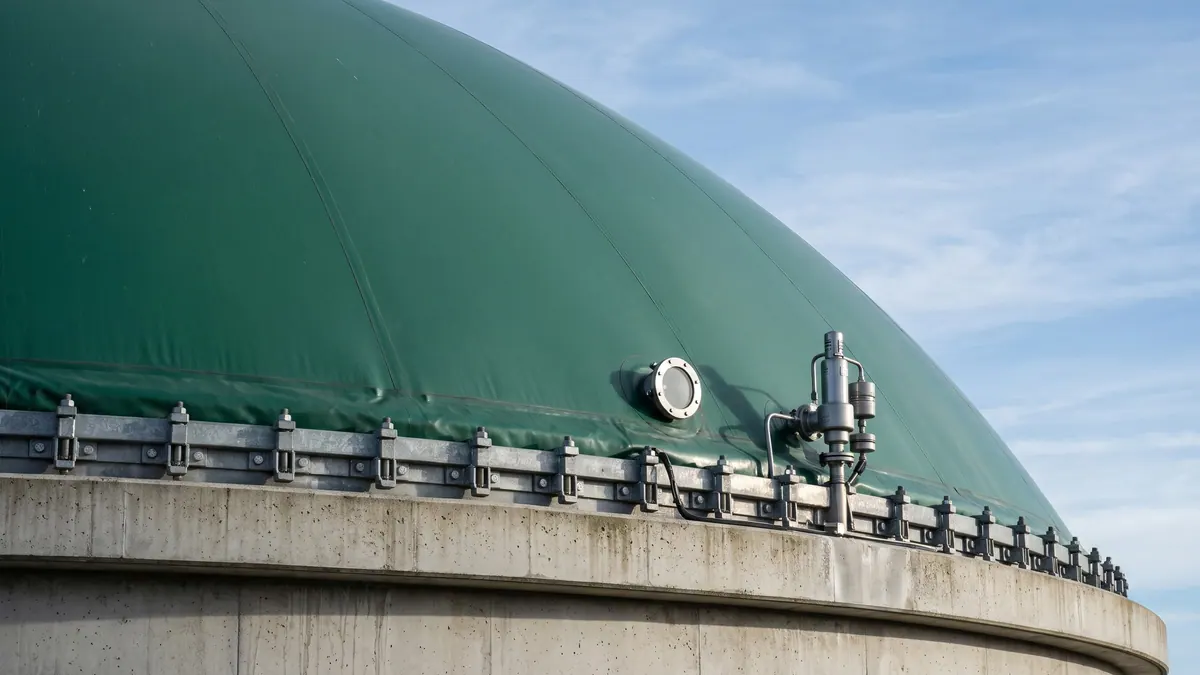
Restarting a digester means returning to work with biomass that already exists but has been thrown out of balance by a shutdown, an agitator failure, a loss of heating or an interruption in feeding. It differs from starting a chamber from inoculum in that the starting point is a living, though weakened, population, and the task is to assess its condition and load it carefully.
What happens to the biomass during a shutdown
When feeding stops but the contents stay warm, hydrolytic and acid-forming bacteria exhaust the available substrate, and the methanogens consume the acids for some time. The process slows down, biogas production falls and the biomass enters a starvation state. This is usually not dangerous: well-stabilised mesophilic biomass tolerates several days, and often several weeks, without feeding, as long as the temperature does not drop sharply.
It is worse when heating and mixing were switched off at the same time. Cooling below approx. 25–30 °C strongly inhibits methanogenesis (which is usually slower than the acid-forming stages), and the lack of mixing promotes stratification: sludge thickens at the bottom, a scum layer forms on the surface, and local pH gradients build up in dead zones. When the agitators are switched on again, these gradients mix throughout the whole volume, which may temporarily worsen the parameters.
As a guide (depending on the substrate, temperature and history of the biomass):
| Situation | Typical effect | Approach |
|---|---|---|
| A few days without feeding, temperature maintained | slight drop in activity | restart with a feed rate close to 20–30% of the previous one |
| 1–3 weeks, temperature maintained | clear drop in production, possible rise in VFA | restart from approx. 10–20%, strict monitoring |
| Cooling below 25 °C for many days | severe loss of methanogens | laboratory assessment, consider replacing part of the contents |
The values are indicative; the range depends on the specific plant.
Measurements before the first feed
Before the first portion of feedstock enters the digester, you need to answer the question of whether the biomass is able to process the acids it contains.
- Temperature at several points, preferably with recirculation switched off. A restart begins with restoring the operating temperature, without jumps faster than approx. 1–2 °C per day.
- pH and alkalinity. A pH below approx. 6.8–7.0 in a mesophilic system usually indicates an accumulation of acids.
- FOS/TAC according to the method described in the guide; with a high ratio, feeding should not begin until it starts to fall.
- VFA broken down by acid, if the laboratory can do this. A high share of propionic and valeric acid relative to acetic acid indicates disturbed syntrophy (profile and thresholds).
- Composition and quantity of biogas with no feeding. If biogas with several tens of percent methane is produced, methanogenesis is working; if CO₂ dominates and production is only a trace, the situation is more serious.
- Ammonium nitrogen, especially when the plant was running on poultry slurry or protein waste before the shutdown.
It is good practice to record all values as a reference point. It is then easier to assess later whether the following steps improve the state or worsen it.
Feed rate ramp-up scheme
Below is an example scheme for a mesophilic system, with explicit assumptions: the biomass is at operating temperature, the pH is in the range 7.0–7.6, FOS/TAC is falling or low, and biogas production is returning. The figures are a starting point for your own arrangements, not a prescription.
| Step | Feed rate relative to the previous full one | Time at the step |
|---|---|---|
| 1 | approx. 10–20% | at least 2–3 days |
| 2 | approx. 30–40% | 2–3 days |
| 3 | approx. 50–60% | 3–4 days |
| 4 | approx. 75% | 3–4 days |
| 5 | 100% | with further observation for 1–2 weeks |
The choice of the first substrate matters. At the start it is better to feed components that break down easily but not abruptly and that bring buffer, for example cattle slurry or silage in a small quantity, and to avoid substrates that acidify very quickly (e.g. simple sugars, beet pulp, a lot of green forage) as well as those with a high nitrogen load.
The feed rate is spread over as many small portions as possible during the day; this reduces spikes in organic load.
Criteria for moving to the next step
Moving to the next step requires all of the conditions to be met, not just one:
- pH stable or rising, with no drop of more than approx. 0.1–0.2 units in response to the feed,
- FOS/TAC does not rise after the feed and is heading down or staying at the pre-shutdown level,
- total VFA is falling or stable, and the propionate share is not rising,
- biogas production rises in proportion to the feed rate, and the methane content does not fall,
- no foaming and no unusual changes in conductivity.
If any indicator worsens after the feed rate is raised, go back one step rather than waiting "until it settles". A short stabilisation at the previous step costs less than another acidification episode (see: diagnosis and action in case of acidification).
When a restart is worse than replacing part of the contents
It is not always worth reviving what is in the digester. Replacing part of the contents (by pumping it out to the digestate tank and topping up with healthy biomass from another chamber or from a partner) is sometimes better when:
- the pH stays below approx. 6.5 despite waiting and without feeding, and the alkalinity is very low,
- biogas is practically not produced, and the total VFA has stayed high for many days,
- the cooling was deep and prolonged,
- foaming or stratification occurred in the digester, requiring removal of scum and sludge.
Healthy biomass brought in from another plant provides a population of methanogens, but it requires sanitary control and compatible conditions (temperature, ammonia, substrate composition), because biomass accustomed to different conditions must itself go through adaptation. The decision should be based on analysis results, not on a hunch.
Documentation and conclusions
Every restart is worth describing: the cause and length of the shutdown, the results before the first feed, the steps taken, and the time to return to the full feed rate. Such documentation makes it possible to shorten the next restart and points to which elements of the plant (emergency power, agitator redundancy, temperature alarms) are best improved. In practice, the shortest route to the full feed rate is not haste but control at every step.
Sources
Related articles