InnovationExplainer
The ADM1 model and the biogas plant digital twin: what it gives the operator and what it cannot replace
ADM1 is a recognised digestion model, and a digital twin combines it with data from the installation. We explain what data is needed and where the model stops being sufficient.
Other language versions: Polski, Deutsch, Español, Français, Italiano, Nederlands.
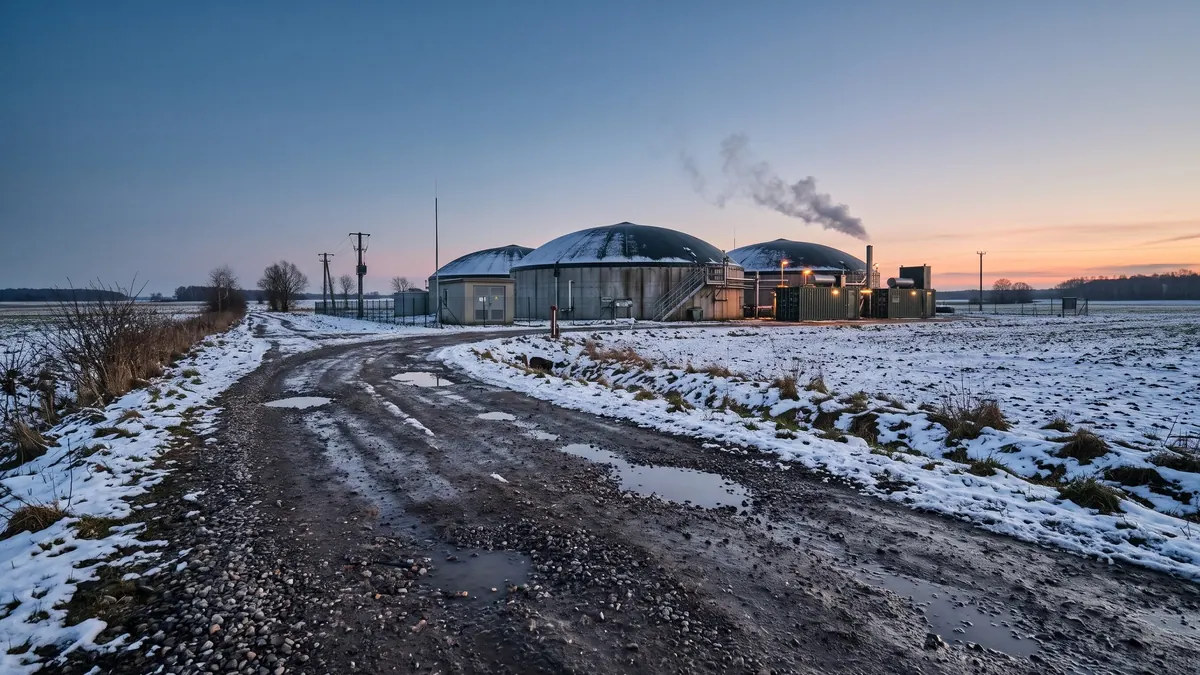
The term "digital twin" in the biogas industry is sometimes used for anything that has a chart. A real twin is a process model continuously fed with data from the installation, able to answer the question "what will happen if...". Let us start with the model, because it is the heart of such a system.
ADM1: a structured model
The Anaerobic Digestion Model No. 1 was developed by a task group of the International Water Association (IWA) and published in 2002. It is a structured model: it breaks digestion down into steps and variables, rather than describing only the outcome. It includes:
- disintegration of complex matter into carbohydrates, proteins and fats,
- hydrolysis of these fractions into sugars, amino acids and long-chain fatty acids,
- acidogenesis, acetogenesis and methanogenesis — with separate groups of microorganisms,
- physicochemical equilibria: acid dissociation, the CO₂/HCO₃⁻ and NH₃/NH₄⁺ equilibria, and gas transfer from the liquid to the gas phase,
- inhibition: by pH, free ammonia, and also hydrogen (for the oxidation of acids).
Thanks to this, the model can reproduce behaviours known from practice: acidification after overloading, a drop in methanogenesis at high ammonia, a rise in CO₂ in the biogas when the pH falls. A description of the stages for those interested is in the article on the four stages of digestion.
Simplified models
ADM1 has several dozen variables and many parameters, so in operational practice simplified versions are used: models with one or two microbial populations, models focused on VFA and alkalinity, or hybrid models. They have fewer parameters and are therefore easier to fit to data, at the expense of resolving detail. The choice depends on the purpose: for scientific simulation, full ADM1; for routine control, a simplified model.
From model to twin
A digital twin has three components:
- A process model (ADM1 or a simplified one).
- A data stream: substrate composition and doses, pH, FOS/TAC, VFA, temperature, biogas quantity and composition, often also the power draw of the agitators.
- State estimation: an algorithm that, based on measurements and the model, estimates unmeasured quantities (e.g. the concentration of individual acids, methanogen biomass) and fits parameters, e.g. a Kalman filter or moving-horizon estimation.
When data from the installation differ from the model's predictions, the system corrects its internal state, and the deviation itself is information: something has changed in the process or in a sensor.
What data is needed
The greatest limitation is usually the characterisation of the substrate. The model requires the fractions of carbohydrates, proteins and fats, degradability and organic dry matter, and these data come from laboratory analyses and are often estimated. Also crucial are: accurate (weighed) doses, the frequency of pH and temperature measurements, regular VFA and FOS/TAC analyses and the biogas composition (CH₄, CO₂, H₂S). The sparser or less accurate the data, the more uncertain the conclusions. Quick substrate assessment methods help, e.g. NIR spectroscopy.
Calibration and identifiability
The model has parameters (rate constants, yield coefficients, inhibition thresholds) that cannot be measured directly. They are fitted to data, but not always unambiguously: different parameter sets may give a similar fit, which is called a lack of identifiability. A sensible approach is to calibrate a small number of the most influential parameters (e.g. the hydrolysis rate, the ammonia inhibition threshold) and leave the rest at literature values. After a change of mix or conditions, the calibration is worth checking.
Applications
- Mix scenarios — how will production and VFA concentration change after increasing the share of a substrate with a high protein content?
- Load shock simulation — how quickly will the process recover after a one-off overload, and what dose reduction will be safe?
- Early warning — deviation from the predicted result as a signal of disturbance, before alarm thresholds are exceeded.
- Operator training — a simulator allows situations to be practised without risk to the installation.
Limitations
- The model is only as good as the data and the characterisation of the substrate; input errors carry over to the result.
- It does not describe everything: foaming, stratification, mixing problems or sediment build-up require additional models or are not covered.
- It requires constant care: calibration, sensor servicing and updates.
- Predictions for a range outside the calibration experience are uncertain.
A digital twin is therefore a tool that supports decisions, not a replacement for the operator. The broader background on sensors and alarms is described in the article on monitoring and automation of biogas plants, and methods based solely on data in the article on machine learning. The rules for assessing an offer can be found in the guide How to assess a new technology.
Where to start
An operator who wants to check the usefulness of a model does not have to buy a ready-made system straight away. It is enough to start with a reliable log: weighed doses, regular pH measurements, FOS/TAC and gas composition. Such data have value in themselves, and if they one day serve to calibrate a model, they will save months of work. Only then is it worth commissioning a simple trial model, with a clearly defined question, e.g. what increase in the share of protein substrate is still safe.
Sources
Related articles