Process biology and start-upGuide
Adapting a digester to a new substrate: introduction schedule and control points
A new feedstock component requires adaptation of the biomass. We describe the initial share, the step size, control indicators and the conditions for rolling back the feed rate.
Other language versions: Polski, Deutsch, Español, Français, Italiano, Nederlands.
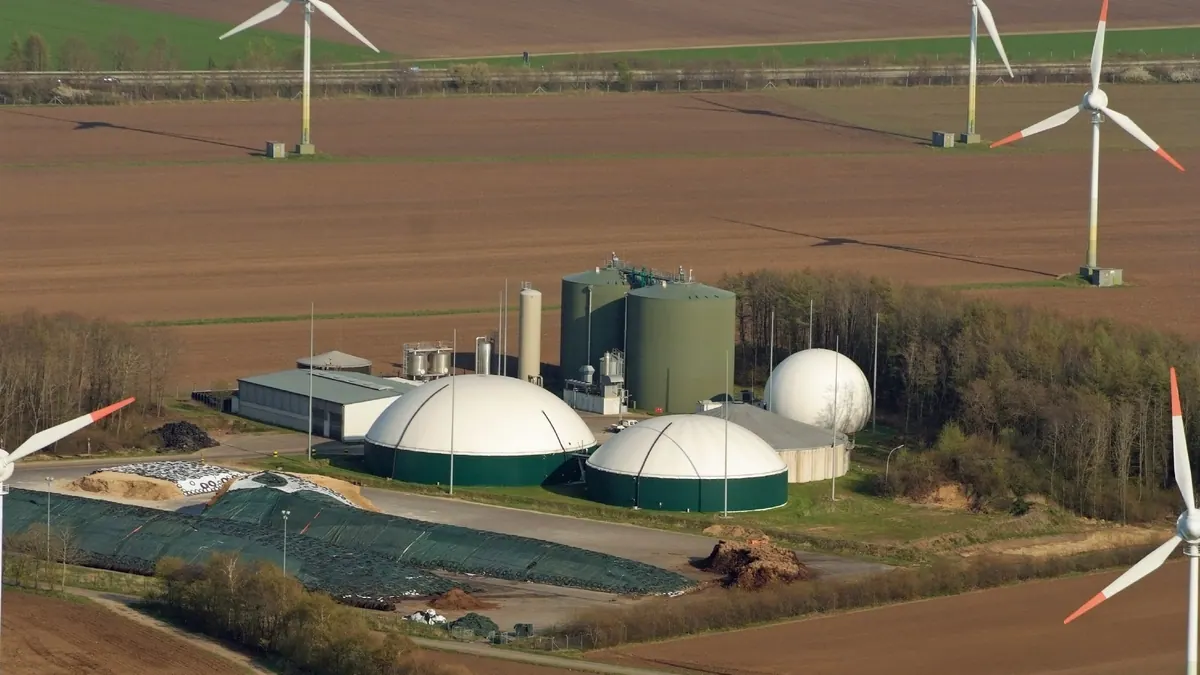

Adapting a digester to a new substrate means the controlled introduction of a new feedstock component at a pace that allows the biomass to rebuild its enzyme set and populations without losing stability. It applies both to entirely new components (fats, food waste, straw) and to a change in the variety or batch of a known substrate, for example silage from a different harvest. Planning the mix itself in terms of yield is described in a separate guide on co-digestion; here we deal with the process side.
Why adaptation is needed
Biomass is a community of specialised groups. When a new compound appears, e.g. fats, cellulose or animal protein, first the population of microbes able to break it down grows, and only then do the further stages follow, including methanogenesis. The delay between stages is a risk of acid accumulation. Adaptation time depends on the type of substrate: a few days for easily degradable sugars, and many weeks for fats and for nitrogen-rich substrates.
For every new component it is worth defining the main process risk before the first feed:
| Component | Main risk | What to check first |
|---|---|---|
| Fats, oils | LCFA, flotation, foam | VFA, foaming, methane in biogas |
| Food waste | rapid acidification, salt | pH, FOS/TAC, conductivity |
| Poultry slurry | ammonia, sodium, potassium | NH₄-N, pH, VFA |
| Straw | slow hydrolysis, scum, mixing | viscosity, mixing, gas yield |
| A different silage variety | change in sugar and DM content | FOS/TAC, pH after the feed |
Introduction schedule
The scheme below is a proposed starting point for a stably running mesophilic digester and a substrate of medium risk (assumption: the dose is expressed as a share of the volatile solids of the feedstock).
- Starting point. Reference measurements for at least a few days (FOS/TAC, pH, biogas composition, VFA, conductivity) with an unchanged feedstock.
- First step. The share of the new component approx. 5–10%; hold for 1–2 HRT or at least a few days if the HRT is long.
- Subsequent steps. Increase by 5–10 percentage points, each time after the control criteria are met.
- Target share. It is reached after 4–8 steps, usually over a period of a few weeks.
- Stabilisation. After reaching the target, 1–2 HRT of observation before any further changes.
For high-risk substrates (fats, waste with a high salt content, poultry slurry) the steps are smaller (approx. 2–5 points) and the pauses longer. For substrates similar to the existing ones (a different silage batch) a few days of gradual transition are enough.
During adaptation, other parameters are not changed at the same time: temperature, total feed rate or the other components, because otherwise the causes cannot be separated.
Control indicators
Before each increase in share, it is checked whether the process has tolerated the previous step:
- FOS/TAC (method): no lasting rise relative to the reference point; a rise above approx. 0.05–0.1 units within a few days is a signal to stop.
- pH: stable within approx. 7.0–7.8 (mesophilic); a downward trend of more than 0.1–0.2 is a warning.
- Biogas composition: methane content does not fall, production rises in proportion to the load.
- Electrical conductivity: important for salty and nitrogen-rich substrates (ions and salinity).
- VFA: no rise in the total or in the propionate share (profile and thresholds).
- Physical observations: foam, scum, pumpability of the slurry.
The frequency of measurements during adaptation should be higher than routine, e.g. pH and biogas daily, FOS/TAC every 1–2 days, VFA every few days.
Conditions for rolling back the feed rate
The rollback rules are set before starting, preferably in writing. Example conditions:
- a rise in FOS/TAC above a set threshold relative to the reference point,
- a drop in pH below a set alarm value,
- a drop in methane content of more than, for example, 2 percentage points,
- the appearance of foam or scum that persists despite mixing,
- a rise in the propionate share of VFA.
When a condition is met, the feed rate is rolled back by one or two steps, not to zero; complete removal of the component is needed only in the case of a clear disturbance. The next attempt is made only after the indicators have stabilised, with a smaller step. In the case of a serious disturbance the descriptions in the guide on acidification are useful.
Documentation
A simple spreadsheet with the columns: date, component, share, measurement results, events, decision. After several adaptations the plant builds its own history, from which it follows how quickly a given biomass accepts individual components and at what share problems begin. This knowledge is more valuable than values from the literature, because it concerns the specific digester.
Most common mistakes
- a jump from zero to the target share within a day,
- changing several feedstock components at once,
- no reference measurements, so it is not known where the change started,
- assessment by gas yield alone, without checking acids,
- failing to adjust the pace to a long HRT: with an HRT of 80–100 days the full effects are seen after a dozen or so weeks.
Patience pays off in adaptation: a change that is too fast ends in a rollback of the feed rate and a loss of time greater than with a sensible pace.
Sources
Related articles