Safety and ATEXGuide
Overpressure and vacuum protection of biogas tanks: settings, freezing and tests
Biogas tanks operate at pressures of around a dozen millibar. We discuss overpressure and vacuum protection, settings, freezing and tests.
Other language versions: Polski, Deutsch, Español, Français, Italiano, Nederlands.
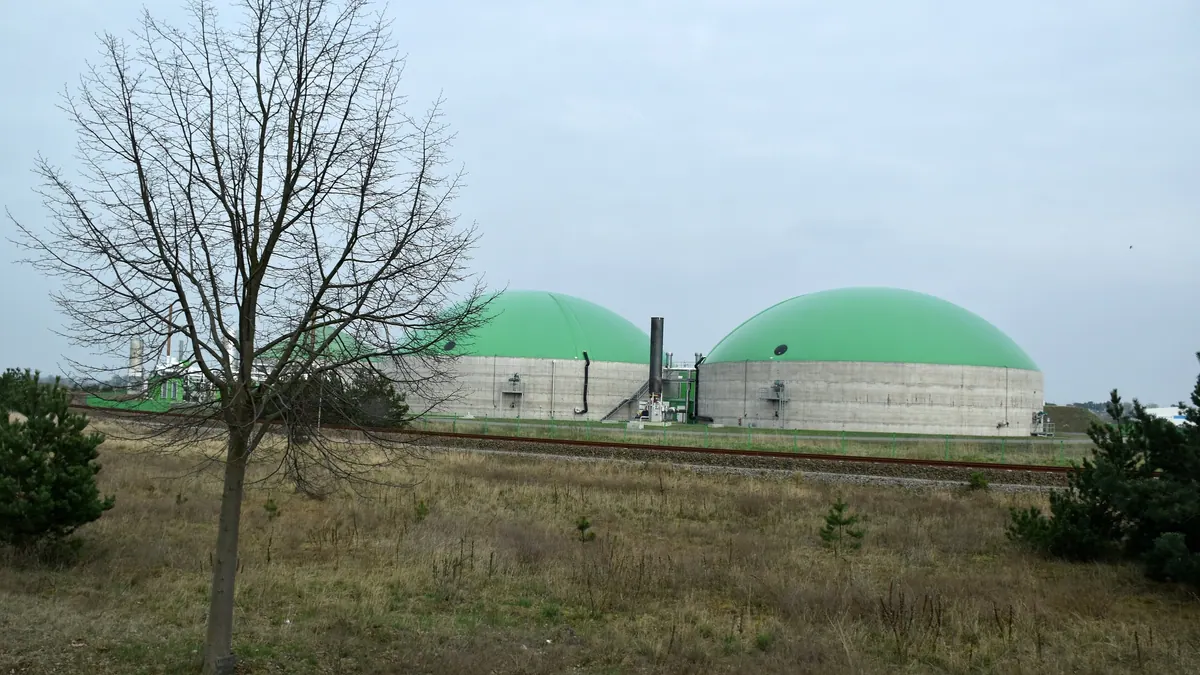

Digesters and biogas stores are low-pressure, but that does not mean they are safe without protection. Too high a pressure threatens damage to the membrane or roof, and too low a pressure, that is, vacuum, threatens air being drawn in. That is why every biogas tank should have independent overpressure and vacuum protection, and its performance must be confirmed by tests, not assumed from the design.
Three solutions and their differences
Three types of protection are most often encountered.
- Mechanical relief valve (with a disc or membrane loaded by a weight or spring). It opens when the pressure exceeds the setting and closes when it drops. It is compact, but can become clogged with deposits or freeze.
- Hydraulic protection: a siphon filled with liquid, most often water with an antifreeze agent added. Gas passes through the liquid when the pressure exceeds the height of the column. It can work both as overpressure and as vacuum protection (in a two-column arrangement).
- Weight-loaded valve: a cover loaded with a weight and lifted by the gas. Simple, but it requires cleanliness and correct guiding.
In practice a combination is used on tanks: a primary protection and a second, independent one, set to a higher level. The principle of independence is important: if both work on the same liquid or in the same duct, they will freeze at the same time.
Settings
Biogas in typical tanks has an overpressure of the order of a few to a dozen or so millibar, and in some designs with membrane roofs up to several dozen. The overpressure protection opens at a value a few to a dozen or so millibar higher than the operating pressure, but lower than that permissible for the structure. The vacuum protection operates at a negative pressure of the order of a few millibar. The exact values result from the design and the manufacturer's documentation, not from a table in this article. Changing the settings, for example raising them to avoid frequent releases, is interference with safety and requires the designer's analysis.
Why vacuum is dangerous
When gas is drawn off by a blower or engine faster than it is produced, the pressure in the gas space falls. When the vacuum protection opens, air enters the tank. As it mixes with the biogas, a mixture forms that can pass through the explosive range. For this reason the blower control should stop gas extraction at low pressure, and the vacuum protection is the last barrier, not the first.
Freezing, corrosion, deposits
In winter the liquid in a hydraulic protection device can freeze, which blocks both overpressure and vacuum action. In summer it evaporates and the level drops. Antifreeze mixtures (for example glycol) are used at a concentration matched to the lowest expected temperature, along with electric heating or insulation. On top of that comes corrosion of fittings in the environment of moist biogas with hydrogen sulphide, and deposits of siloxanes and salt crystals. For this reason not only the liquid level is checked, but also the free passage of the flow channels.
Discharge of the release and the zone around the outlet
The outlet of the protection device is usually located where it discharges gas safely, at a height above roof level and away from openings and people. An explosion hazard zone forms around the outlet, and its extent results from the explosion protection document. No ignition sources may be placed in this zone and the outlet must not be obstructed, and the protection device should not be blanked off during washing.
Tests and documentation
Protection devices are checked periodically according to the manufacturer's instructions and the maintenance programme. A typical scope includes:
- visual inspection of the condition of the valve, gaskets and connections,
- checking the level and composition of the sealing liquid (density, freezing point),
- checking that the channels are clear and free of blockages,
- an opening test at controlled pressure or measurement of the actual setting,
- a test of the signalling and pressure sensors, if they are linked.
Results are recorded in a logbook. The protection devices are also subject to the inspections required for pressure equipment where regulations cover them; the scope is determined by the installation documentation and the supervisory authority.
A release as an environmental failure
Opening the valve releases methane, which is a potent greenhouse gas. A single release can mean the loss of gas with energy value and the emission of a significant amount of methane, depending on the storage volume and how long the valve stays open. Frequent openings are a signal that: the gas store is too small, gas offtake has failed, the flare is not working or the control is set incorrectly. Events should be recorded and their causes analysed.
What to record in the protection log
For each protection device it is worth keeping a card: place of installation, type, overpressure and vacuum settings, date of the last inspection, result of the opening test, condition of the sealing liquid and notes on deposits. Added to this is a list of events, that is, every opening of the valve with the date, cause and action taken. After winter or a longer shutdown, the card is supplemented with the result of the pre-season inspection. The construction and role of a gas store with a membrane roof are discussed in the article Biogas store and double-membrane roof, and problems of condensate freezing in the installation are described in the text A biogas plant in winter.
Typical mistakes
- Filling the protection device with water without antifreeze.
- Changing the setting without analysis.
- Blanking the outlet or cover during washing.
- No vacuum tests because it "has never opened".
- No record of releases and no analysis of causes.
Sources
Related articles