Process biology and start-upGuide
Sampling the digester and the digestate tank: how to take a representative sample for analysis
A FOS/TAC or VFA result is only as good as the sample taken. We discuss sampling points, line flushing, containers, cooling and typical errors that distort results.
Other language versions: Polski, Deutsch, Español, Français, Italiano, Nederlands.

A representative sample is one whose composition corresponds to the composition of the entire contents of the tank at the moment of sampling, not to the composition of a local zone at the valve. In a digester this is difficult, because the slurry is stratified and its composition changes over time. Analytical methods such as FOS/TAC are accurate, but they will not repair an error made at sampling.
Sampling points and stratification
In tanks with agitators the mass is mixed incompletely. Near the walls, in dead zones, under the cover and close to the feedstock inlet, acid concentrations, dry matter and pH differ from the average. In a digestate tank without intensive mixing, stratification occurs: sludge settles, scum forms on the surface, and the middle layer has a different composition.
Therefore:
- Sample from the same point every time. A trend for one location is more reliable than a single result from a random place.
- Avoid points directly after the feedstock inlet and directly after the recirculation pump, unless you are deliberately measuring the stream.
- In the digestate tank consider sampling after mixing or from several depths and combining them into a composite sample; record what was done.
- Take the sample from the pressure pipeline (a sampling valve in the recirculation loop), if such a point exists; this is usually the best representation of the slurry in motion.
- Do not sample from the scum or from the very bottom, unless the assessment concerns precisely those layers.
Flushing the sampling line
A section of pipeline and the valve have a dead volume in which old slurry stands. Before taking the actual sample it must be removed by draining into a separate container a volume at least several times greater than the volume of the pipeline (usually a few litres). This step is often skipped, and the result is understated VFA and overstated pH relative to reality. The flushed material is collected in a closed container and returned to the loop, not poured out.
Volume and containers
- Volume: for FOS/TAC a few tens of ml up to approx. 100 ml is enough, but it is recommended to take approx. 0.5–1 l, so that the determination can be repeated and additional analyses carried out (dry matter, NH₄-N, VFA by chromatography).
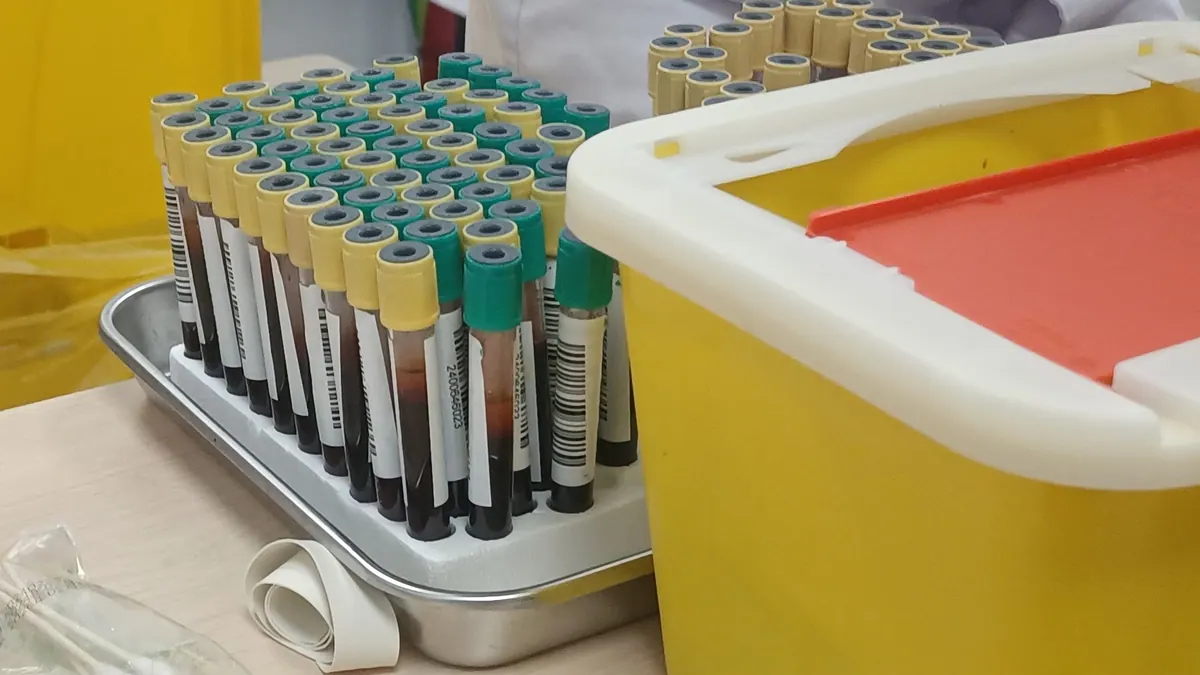
- Containers: clean, tight, preferably plastic (HDPE), with a wide opening; fill to approx. 70–80%, not to the brim, to leave room for gas.
- Label: date and time, sampling point, name of the digester, person taking the sample, temperature of the contents, feeding status (e.g. hours since the last feed).
- A separate container for each point, with no reuse without washing.
Cooling, time to analysis and preservation
The slurry in the container remains biologically active. As a result, after some hours the VFA composition, pH and ammonia concentration change. General recommendations:
- Cool the sample as quickly as possible to approx. 4 °C (a refrigerator or a cool box).
- Carry out FOS/TAC and pH analyses within a few hours, preferably on the same day; if this is not possible, freeze the sample (after agreement with the laboratory), bearing in mind that freezing changes the structure of the slurry.
- For VFA determinations in an external laboratory, ask about the required method of preservation (freezing, acidification or filtration).
- Before analysis, bring the sample to measurement temperature and mix thoroughly, because on standing it stratifies again.
The FOS/TAC value depends on preparation: centrifugation or filtration changes the result compared with a whole-slurry sample, so the method should always be applied in the same way.
Degassing and safety
A sample taken from the digester contains dissolved biogas (CH₄, CO₂ and trace H₂S). After being taken out of the system under pressure, the gases are released; in a closed container the pressure rises, and in an open one flammable and toxic gases are released. Consequences:
- do not seal tightly containers filled to the brim; leave free space or use a cap with venting,
- open samples in ventilated places, away from ignition sources,
- do not smell samples from close up, and carry out sampling in gloves and goggles,
- carry out sampling from points in explosion hazard zones with tools and in a way consistent with the explosion protection document,
- remember the hydrogen sulphide hazard when opening containers and tanks; details can be found in the articles on health and safety and ATEX.
Work with tanks (entry, opening manholes) is treated separately; taking a sample from a valve does not require entry, but it does require appropriate protective measures.
Typical errors that distort FOS/TAC and VFA
| Error | Effect |
|---|---|
| no line flushing | a sample of old slurry, understated VFA |
| sampling just after a feed | temporarily high FOS/TAC, inconsistent with earlier measurements |
| sampling from different places | trends cannot be compared |
| delayed analysis without cooling | breakdown of acids, change in pH |
| inaccurate mixing before analysis | scatter in replicate results |
| different method (whole slurry vs centrifuged) | inconsistency with earlier results |
Repeatability
The most important rule is: always the same way. A fixed point, a fixed time (e.g. in the morning, before feeding or at a fixed number of hours after the feed), the same procedure, the same person or the same instruction. Then changes in results reflect changes in the process, not changes in the way of sampling. When diagnosing a disturbance it is worth additionally taking a "parallel" sample as a control and recording all the circumstances. A short description of sampling can also be found in the article on monitoring digester biology; here the full procedure is presented.
Sources
Related articles