Safety and ATEXAnalysis
Lightning and surge protection at biogas plants: LPS, protection zones and membrane tanks
A lightning strike can ignite an explosive mixture and destroy control systems. How protection is selected under PN-EN 62305: risk, earthing, SPDs.
Other language versions: Polski, Deutsch, Español, Français, Italiano, Nederlands.
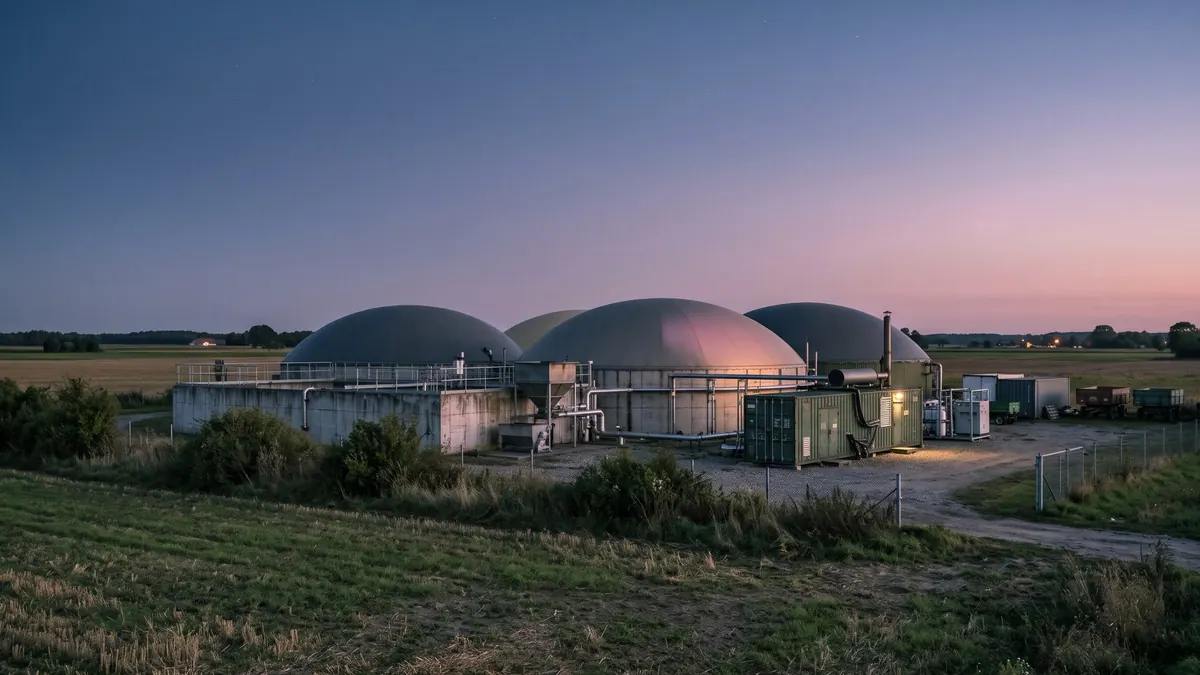
Lightning protection at a biogas plant is not about installing an air-termination rod. It is about a structured decision based on a risk assessment: what can ignite, what can be destroyed, and how the lightning current can safely reach the ground. In a plant with explosion hazard zones, a lightning strike is at once a possible ignition source and a cause of failure of the control systems.
What the PN-EN 62305 series provides
The series consists of four parts: general principles, risk management, physical damage to structures and life hazard, and electrical and electronic systems within structures. The risk management part introduces an approach that is worth applying even outside a formal design: first the risk of losses (loss of human life, public services, cultural heritage, economic value) is estimated, then it is compared with the tolerable risk, and only then are protection measures selected.
The result is a lightning protection level (LPL) from I to IV. Level I means the strictest requirements, that is, protection against most strikes, while level IV is less demanding. The selection is not discretionary: it depends on the lightning flash density in the region, the dimensions and location of the structure, the type of hazard and the consequences of damage. In facilities with an explosion risk, the consequences are rated highly, which usually shifts the decision towards higher protection levels.
Protection zones and the rolling sphere method
An external lightning protection system (LPS) is designed by determining which points of a structure can be struck. The rolling sphere method is the most common: an imaginary sphere with a radius that depends on the protection level is rolled over the structure and touches its exposed points; air terminations must be provided wherever the sphere can touch. Alongside it, the mesh method and the protection angle method are used, although the protection angle loses its validity for taller structures.
At a biogas plant, the engine room building, silos, tanks and the stack are elements of different heights and functions. The designer analyses them separately, because a tall stack or mast can act as a natural air termination for lower structures, but only if its construction and joints ensure electrical continuity.
Earthing and equipotential bonding
The most commonly underestimated element is earthing and equipotential bonding. The lightning current spreads through the structure and the ground, and potential differences between metal parts can cause sparking at a place where a flammable mixture is present. For this reason all conductive elements – steel structures, pipelines, cable trays, protective earthing of the electrical installation, foundation reinforcement – are connected into a single bonding network, and flange joints on gas pipelines are made conductive or bridged.
Typical audit findings are corroded clamps, loose joints, lack of continuity between sections of cable trays and an earth electrode whose resistance nobody has measured for years. As a guide: the earth resistance value is not the only criterion (for lightning earth electrodes the shape and the current distribution matter more), but a sharp rise in it between measurements always indicates a problem.
Membrane tanks and metal structures
A tank with a double-membrane roof has a specific feature: the membrane is non-conductive or poorly conductive, and gas is stored beneath it. Protection relies on the lightning current being taken by the air terminations and the metal parts of the structure (the rim, the anchoring ring, steel walls or reinforced concrete walls with reinforcement connected to the earthing system), and not by the membrane. In steel tanks, a sheet of adequate thickness can serve as a natural LPS element, but the manufacturer or designer should confirm this for the specific structure. Air terminations above the tank must be routed so that they do not cause mechanical damage to the membrane and do not create shaded areas for the ventilation between the membranes.
Particular attention is required at places with relief vents, overpressure and vacuum valves, and pipelines routed above the roof. There the explosion hazard zone extends into the space in which a discharge could occur, so the placement of air terminations must be coordinated with the explosion protection document.
Surges: protecting the electronics
A lightning strike nearby, even hundreds of metres away, induces surges in power and signal lines. The results are burnt-out power supplies, analogue input cards, frequency converters, sensors and PLC controllers. Under the lightning protection zone (LPZ) concept, surges are limited in stages: type 1 arresters at the point where power enters the facility, type 2 in switchboards, type 3 at sensitive loads, and for signal lines dedicated arresters matched to the signal type (4–20 mA, RS-485, Ethernet).
A practical rule: arresters are effective only with short, well-earthed connecting conductors. The best arrester with a long earthing conductor will not perform as stated in the catalogue data. For this reason, gas sensors in Ex zones and the lines leading to them should be considered along the entire chain, together with barriers, taking into account the requirements for intrinsically safe circuits.
An example of the reasoning
An operator plans to expand with a second tank. The steps: 1) risk assessment for the whole site, including the new structures; 2) determining the protection level and verifying the existing LPS (is the new tank within the protected zone); 3) analysing whether the tank structure can serve as natural LPS elements; 4) completing the bonding network and earthing; 5) reviewing the switchboards and selecting SPDs; 6) acceptance with continuity and resistance measurements; 7) entry in the documentation and inspection dates. This approach is easier to defend before an expert and an insurer than adding individual air terminations after the fact.
Inspections and documentation
The lightning protection system and surge arresters are inspected periodically in accordance with building law and the designer's recommendations; an ad hoc inspection is advisable after every direct strike to the facility. The inspection covers visual examination of air terminations and conductors, measurement of joint continuity and earth resistance, the condition of the SPDs (trip indicators) and equipotential bonding. Check the deadlines and scope in the current regulations and the design documentation – they depend not only on the type of facility but also on the hazard category.
Sources
Related articles