Process biology and start-upGuide
Winter digester operation: cold feedstock, heat losses and effects on the biology
Cold feedstock locally chills the biomass and loads the heating system. We calculate the heat demand and describe the symptoms of chilling and feeding practices.
Other language versions: Polski, Deutsch, Español, Français, Italiano, Nederlands.
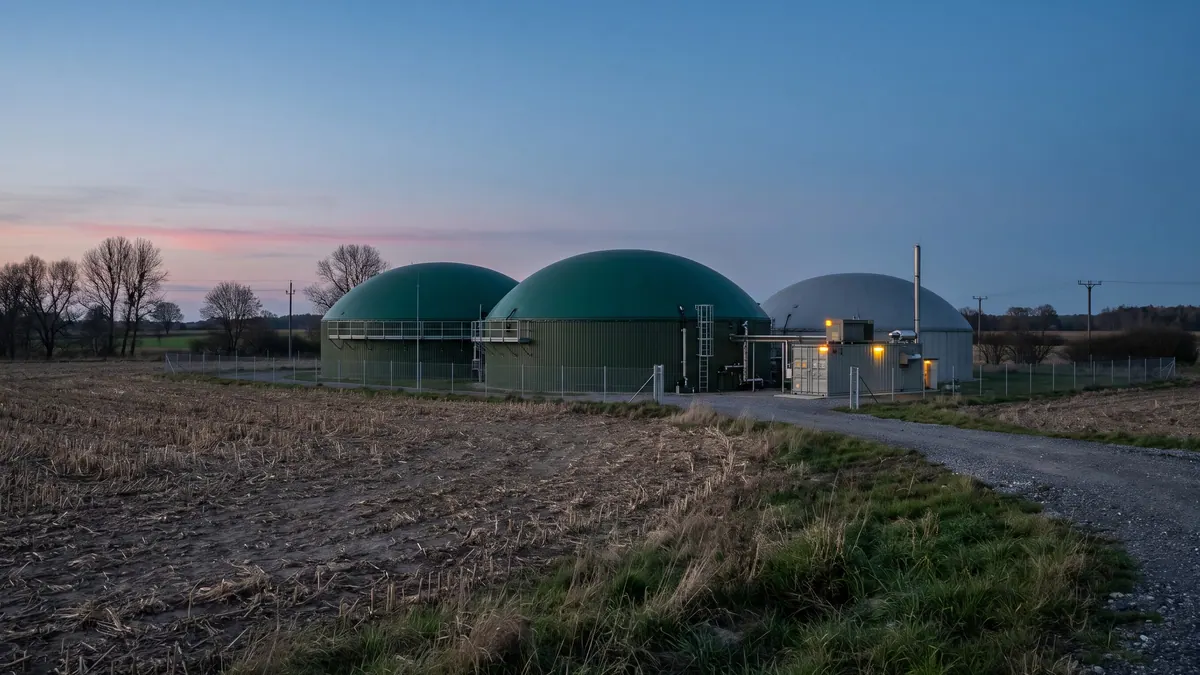
Winter digester operation means maintaining a constant process temperature despite cold feedstock and greater heat losses through the tank walls and cover. Methane-forming bacteria are more sensitive to temperature changes than acid-forming bacteria, so in winter the biological risk concerns above all a disturbance of the balance between these groups. The two operating modes are compared in the comparison of mesophilic and thermophilic digestion; here we focus on the effects of winter in a mesophilic system. Equipment failures in winter (condensate, freezing of fittings) are described in a separate article on biogas plant operation in winter.
How much heat cold feedstock requires
The basis is a simple equation: Q = m · c · ΔT. For substrates with a high water content the specific heat is close to that of water, i.e. approx. 4 kJ/(kg·K); for silage at approx. 30–35% DM the value is slightly lower, but we take 4 as a simplification.
An example with explicit assumptions: 1 t of silage from a clamp at a temperature of approx. 5 °C, digester temperature 40 °C, ΔT = 35 K.
- Q = 1000 kg · 4 kJ/(kg·K) · 35 K = 140,000 kJ = 140 MJ,
- after conversion: 140 MJ / 3.6 ≈ 39 kWh.
For slurry at a temperature of 8–10 °C the result is a few kWh lower. For comparison: 1 t of maize silage typically yields approx. 180–220 m³ of biogas with a methane content in the order of 50–53%, which corresponds to roughly 900–1,100 kWh of energy in the methane. Heating the feedstock therefore consumes a few percent of this energy. On top of this come losses through the walls, roof and pipelines, which depend on insulation and on the temperature difference relative to the surroundings, and in winter they rise several-fold compared with summer.
The conclusion has practical significance: heat from cogeneration is usually sufficient, but in winter the balance can be tight, especially when part of the heat goes to other consumers (drying, heating of buildings). The balance is described in more detail in the article on waste heat from a biogas CHP.
Why local chilling matters
The average temperature of the contents measured with a single sensor may be safe, and yet a zone several to a dozen or so degrees colder forms around the feedstock inlet. In this zone viscosity rises, metabolic rate falls, and methanogens may be locally inhibited while acid-forming organisms continue to produce VFA. The result is a temporary excess of acids, which with large portions spreads to the whole volume.
Permissible fluctuations: for mesophilic systems (usually 37–42 °C) process stability is maintained when changes do not exceed approx. 1–2 °C per day. Jumps of 2–3 °C in a short time begin to reduce methane production, and larger and prolonged ones can lead to acidification. The values are indicative; biomass that works continuously in stable conditions is usually more resilient than one whose temperature changes often.
Symptoms of chilling
A typical picture of thermal disturbance looks like this:
- A drop in temperature at the heating sensors or a prolonged time to reach the setpoint.
- A reduction in the methane content of the biogas and a fall in its quantity at the same feed rate.
- A rise in total VFA, in particular propionic acid (see the VFA profile and thresholds).
- A rising FOS/TAC, followed by a drop in pH if alkalinity is low.
- In extreme cases, foaming and stratification of the contents.
Symptoms 2 and 3 usually precede a change in pH, so it is worth watching the trend rather than waiting for threshold values.
Feeding and handling practices in winter
Smaller portions, more often. Instead of a few large feeds, it is better to feed in many small ones, because this limits the size of the chilled zone. When feeding cold silage, shortening the intervals and mixing it with warmer slurry or recirculate before feeding helps.
Pre-heating the feedstock. If the system allows, feedstock fed from a pre-chamber or mixing tank is already partly warmed. This requires no special solutions: even a rise of a few degrees in temperature reduces the jump at the inlet.
Protecting the substrate. Silage frozen in the clamp needs to be thawed or taken from deeper, warmer layers; feeding lumps of ice makes no sense in terms of either energy or process.
Insulation and tightness. Heat losses depend on the condition of the insulation of the walls, cover and fittings. Damaged insulation, damp wool or a leaking cover increase heat consumption and cause local temperature drops at the wall.
Heating checks. Checking the sensors, three-way valves, circulation pumps and the condition of the heating coils before the season helps avoid failures in the hardest frosts. It is worth comparing the temperature from different sensors and recording deviations.
Mixing. Properly chosen mixing equalises the temperature and disperses the feedstock, but mixing that is too intensive increases heat losses and energy consumption. It is best regulated according to measurements, not a fixed schedule.
What to do at the first symptoms
If the temperature has dropped and the biological indicators are worsening: restore the temperature without sharp jumps, reduce the feed rate by 20–30%, and if FOS/TAC rises, stop feeding quickly acidifying substrates. After the temperature has stabilised, the feed rate is raised gradually (analogously to the scheme described in the guide on restarting after a shutdown). In winter, repeatability is the most important thing: constant temperature, constant times and sizes of feeds, and regular measurements that make it possible to catch a problem before it becomes costly.