Planning substrate demand: the annual balance and area of cropland
How to get from CHP capacity to tonnes of substrates, hectares of crops and silo capacity. A step-by-step calculation with explicit assumptions and a list of risk factors.
Other language versions: polski.

The annual substrate requirement is calculated "from the end": from the capacity of the cogeneration unit and the operating time we obtain the amount of energy, from that the volume of methane, and from the methane potential of the individual substrates — their masses; only then are losses and a reserve added. In a typical example for a CHP with an electrical capacity of 500 kW the result is about a million m³ of CH₄ a year, which is a few to a dozen or so thousand tonnes of maize silage or an equivalent quantity of other substrates. The calculation below is illustrative; your own data must be based on analyses.
Step 1: methane from CHP capacity
Assumptions: electrical capacity 500 kW, electrical efficiency 40%, operation 8,000 h/year, calorific value of methane about 10 kWh/m³ (approximation).
- fuel power: 500 / 0.40 = 1,250 kW,
- methane consumption: 1,250 / 10 = 125 m³ CH₄/h,
- annually: 125 × 8,000 = 1,000,000 m³ CH₄.
If the efficiency is 38%, the requirement rises by about 5%. Remember that part of the energy is used for the plant's own needs, and part of the biogas may go to the flare.
Step 2: methane potential of the substrates
Indicator per tonne of fresh mass (FM) = TS × VS × yield per VS. The values in the table are assumed for the example, not as reference data.
| Substrate | TS | VS in TS | Yield [m³ CH₄/kg VS] | CH₄ [m³/t FM] |
|---|---|---|---|---|
| Maize silage | 0.33 | 0.95 | 0.34 | approx. 107 |
| Cattle slurry | 0.08 | 0.80 | 0.20 | approx. 13 |
Step 3: mix and masses
Let us assume that 15,000 t of slurry a year is available, which gives 15,000 × 13 ≈ 195,000 m³ CH₄. The remaining 805,000 m³ is to be provided by silage: 805,000 / 107 ≈ 7,500 t. At a daily feed: silage about 20.5 t/d, slurry about 41 t/d — these are values close to the examples in the articles on OLR and HRT.
Step 4: losses and reserve
Silage losses from harvest to feeding depend on the quality of ensiling and management of the clamp; in practice a few to a dozen or so per cent is assumed. Let us assume 12%: the silage has to be harvested at 7,500 / 0.88 ≈ 8,520 t. In addition it is worth planning a reserve for a poorer yield, e.g. 10%, which gives about 9,400 t to be contracted or grown.
Step 5: area and storage
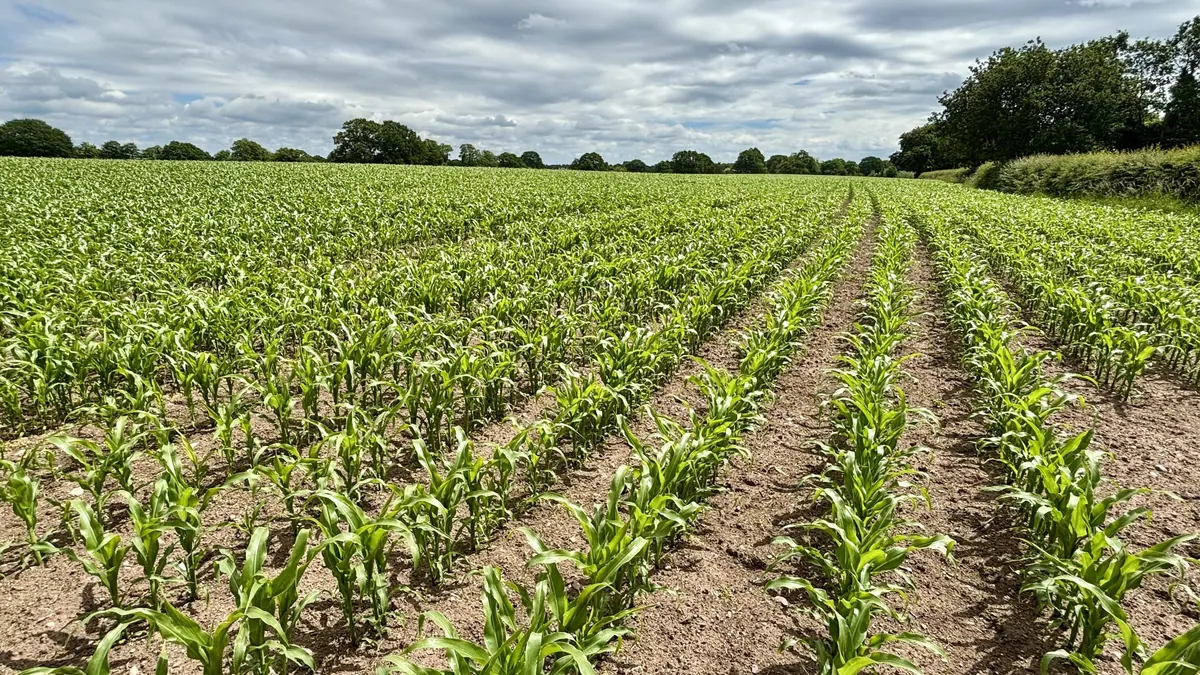
- fresh-mass yield of maize for silage: for example 45 t/ha; 9,400 / 45 ≈ 209 ha. In a dry year the yield can fall by several dozen per cent, so the same acreage will give much less raw material.
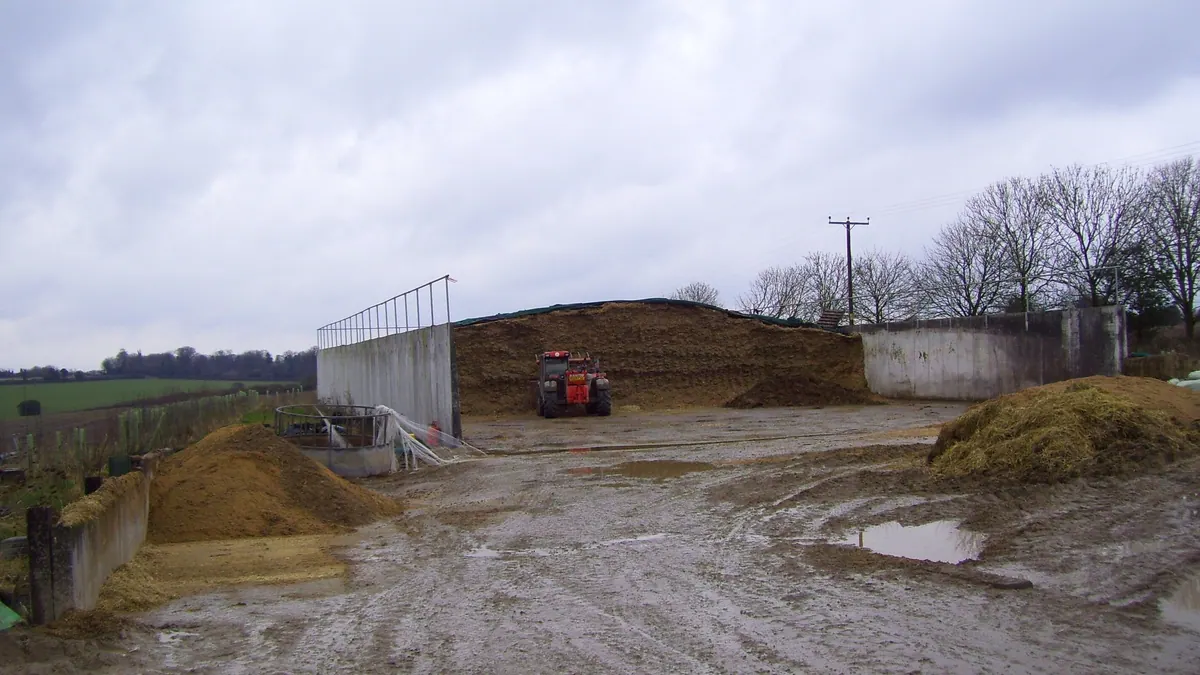
- silo capacity: at a compacted silage density of about 0.65–0.75 t/m³ this is about 12,500–14,500 m³ of volume of the silage alone, plus allowance for the shape of the clamp and machinery manoeuvres.
Risk factors
| Risk | Consequence | Remedy |
|---|---|---|
| Drought, hail | lower yield | stock in the silo from the previous year, external contracts, diversified crops |
| Losses in the silo | less substrate | good compaction, tight cover, control of the exposed surface |
| Price fluctuations | higher costs | long-term contracts, own crops |
| Changes in TS and quality | change in OLR and gas | analyses of every batch |
| Failure of slurry supplies | change in the C/N balance | alternative substrate in the plan |
Planner's checklist
- Collect analyses of TS, VS and the potential of the substrates (your own BMP tests or reference data with a caveat on scatter).
- Calculate the balance at three levels: an average year, a poor year, a very poor year.
- Check the C/N and ammonium nitrogen balance for the established mix.
- Verify storage capacity for continuity of supply over 12 months plus a reserve.
- Consider logistics: transport, harvest time, machinery pressure.
- Plan digestate management (fields, nitrogen balance).
- Review the result with an agricultural adviser or a substrate supplier.
At the end it is worth comparing the result with operating data: if over two years the actual consumption of substrates per MWh deviates from the plan by more than a few per cent, the cause is sometimes wrong assumptions about TS or losses, not the fermentation process itself.
Delivery schedule through the year
An annual balance is not enough, because the installation uses substrate evenly, while silage appears all at once in autumn. A monthly balance is therefore built: the store level at the start of the month, consumption according to the daily feed, any deliveries of slurry and other materials. At a feed of 20.5 t/d of silage, monthly consumption is about 620 t; for the nine months between harvests about 5,600 t in the silo is therefore needed, and a further approx. 1,900 t must come from the current harvest or from purchase. A monthly summary reveals whether a silo of the planned capacity will actually be enough.
What to do when there is too little
- Increase the share of slurry or other locally available substrates.
- Contract silage or grain from outside for set quantities.
- Reduce the load on the installation (lower output, longer HRT) for the duration of the shortage.
- Consider catch crops or second crops as a supplement. Each option has its cost; planning ahead is cheaper than reacting in April, when stocks run out.
Sources
Questions and answers
How many hectares of maize are needed for a 500 kW biogas plant?
It depends on the share of slurry and on the yield. In the example from the article (a mix with approx. 15,000 t of slurry a year, yield 45 t/ha) this comes to approx. 190 ha after allowing for losses (approx. 210 ha with a 10% reserve for a poorer yield), but with a higher share of silage it can be several hundred hectares.
Related articles