Waste and circular economyAnalysis
Sewage sludge after the landfill ban: routes, challenges and Directive 2024/3019
After the landfill ban, sewage sludge goes to agriculture, composting, digestion and incineration. We analyse the routes, restrictions, phosphorus recovery and the impact of the new municipal wastewater directive.
Other language versions: polski.
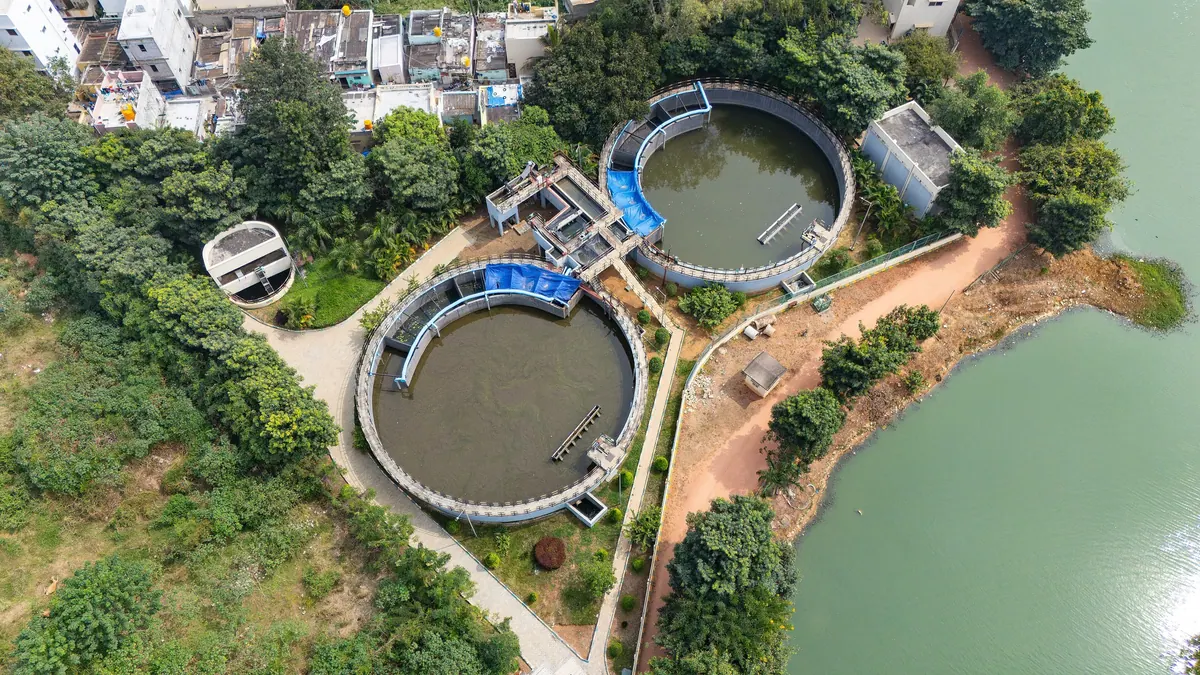

After 2016, landfilling of municipal sewage sludge became in practice impossible, because the criteria for admitting waste to landfill (total organic carbon, loss on ignition and calorific value) eliminated most of it. Since then treatment plants have been looking for other routes: agriculture and reclamation, composting and co-digestion, thermal treatment (mono-incineration, co-incineration) and recovery of components (phosphorus). Each has its limitations, and the new municipal wastewater directive increases the pressure for resource recovery.
The landfill ban in practice
The Minister of Economy regulation of 16 July 2015 on admitting waste to landfill sets, for sludge (including code 19 08 05 — stabilised municipal sewage sludge), the limits: total organic carbon up to 5% TS, loss on ignition up to 8% TS and calorific value up to 6 MJ/kg TS. Sludge from digestion chambers usually has too high an organic matter content to meet them, so landfilling is closed to it.
Routes available today
| Route | Advantages | Limitations |
|---|---|---|
| Agriculture and reclamation | fertilising value (N, P), low cost | requirements of the regulation and Article 96 of the Act on waste, location bans, testing, farmers' acceptance |
| Composting | a product with greater acceptance | structural material needed, hygiene control, odours, product status |
| Co-digestion at the treatment plant | more biogas, energy | change in the nature of the stream, requirements for feedstocks, UPPZ |
| Mono-incineration | mass reduction, energy recovery, possibility of recovering phosphorus from ash | high investment cost, emissions, ash |
| Co-incineration (cement plants, power plants) | use of existing infrastructure | limited capacity, fuel requirements |
The rules for application to land arise from Article 96 of the Act on waste and the 2015 regulation: sludge must be stabilised and tested, and the dose in agriculture may not exceed 3 Mg TS/ha/year. The bans cover, among others, meadows, pastures, orchards and vegetables, steeply sloping land, protection zones and proximity to water intakes. Testing requirements are growing — from 15 January 2026 a changed table of sludge testing frequency will enter into force — and some farmers and recipients avoid sludge for fear of contaminants.
Challenges
- Contaminants — heavy metals, microplastics, organic substances and pathogens; growing attention to new types of contaminants. The sludge regulation governs metals and hygiene, but the debate about additional indicators continues.
- Location — little free land meets all the restrictions of Article 96.
- Costs — incineration and drying are energy-intensive; the price of energy and environmental fees is rising.
- Processing capacity — the number of thermal installations for sludge is limited, which forces transport.
- Public acceptance — odour, truck traffic and health concerns.
- EU fertilisers — under Regulation 2019/1009, sewage sludge is not a permitted input material for compost and digestate with the CE marking.
Phosphorus: from waste to raw material
Phosphorus in sludge is a strategic resource, because the EU imports most of its phosphate rock. Recovery can be carried out from sludge (e.g. struvite), from ash after mono-incineration or from wastewater. Mono-incineration facilitates recovery, because the ash concentrates phosphorus and is not diluted by other fuel; co-incineration disperses it. The new municipal wastewater directive puts emphasis on sludge management and resource recovery; the detailed thresholds and deadlines at transposition into Polish law are worth following.
Directive 2024/3019
Directive (EU) 2024/3019 of 27 November 2024 on urban wastewater treatment (recast) replaces Directive 91/271/EEC and entered into force in January 2025. It introduces, among other things, further removal of nitrogen and phosphorus in larger treatment plants, energy neutrality targets and requirements for monitoring and sludge management. Member States must transpose it; in Poland implementation work is under way, which means possible changes in the provisions on sludge and in investment planning.
How different treatment plants approach the problem
A large agglomeration treatment plant. It has the scale to build its own drying or mono-incineration line and recover energy and phosphorus. The risk is the high investment cost and dependence on stable quantities of sludge.
A medium-sized treatment plant. It often combines co-digestion (increasing biogas) with passing sludge to a regional thermal installation or to a composting plant. Long-term contracts and transport are key.
A small treatment plant. It usually stabilises the sludge, dewaters it and gives it to an external entity — for agriculture, composting or incineration. The most important thing is to find a reliable recipient and test documentation.
Regardless of size, maintaining more than one route of management reduces the risk that a change in the regulations or the closure of a recipient's installation will stop the whole system.
What is missing from the statistics
Data on sludge are scattered between treatment plant reports, BDO records and public statistics. When planning it is therefore worth relying on your own balances (mass of dry matter, routes, recipients), not on national averages. This makes it possible to realistically assess the demand for drying, co-digestion or thermal treatment in a specific region.
What this means for treatment plants and investors
- Develop a sludge strategy with several routes, not one: agriculture is today an uncertain route.
- Assess whether your own drying line and co-digestion pay off, or cooperation with a regional thermal installation.
- Plan phosphorus recovery as an element of the long-term strategy.
- Follow the national provisions implementing Directive 2024/3019.
This text is for information purposes only and does not constitute legal advice; before an investment or formal decision, check the current wording of the provisions and consult a lawyer or the competent authority.
Sources
- Rozporządzenie Ministra Gospodarki z 16 lipca 2015 r. w sprawie dopuszczania odpadów do składowania na składowiskach (Dz.U. 2015 poz. 1277)
- Ustawa z dnia 14 grudnia 2012 r. o odpadach — art. 96 (ISAP/ELI)
- Dyrektywa (UE) 2024/3019 o oczyszczaniu ścieków komunalnych (EUR-Lex)
- Rozporządzenie w sprawie stosowania komunalnych osadów ściekowych — tekst jednolity (Dz.U. 2023 poz. 23)
Questions and answers
Can sewage sludge still be landfilled?
Only if it meets the criteria for admission to landfill, including limits for total organic carbon (5% TS), loss on ignition (8% TS) and calorific value (6 MJ/kg TS). Most sewage sludge does not meet these limits.
Related articles