Waste and circular economyEvent
Victoria: the “Recycling Victoria” strategy and four waste bins by 2030
In 2020 the state of Victoria announced the ten-year “Recycling Victoria” plan: a target of 80% waste recovery, halving organics to landfill and four bins in households.
Other language versions: polski.
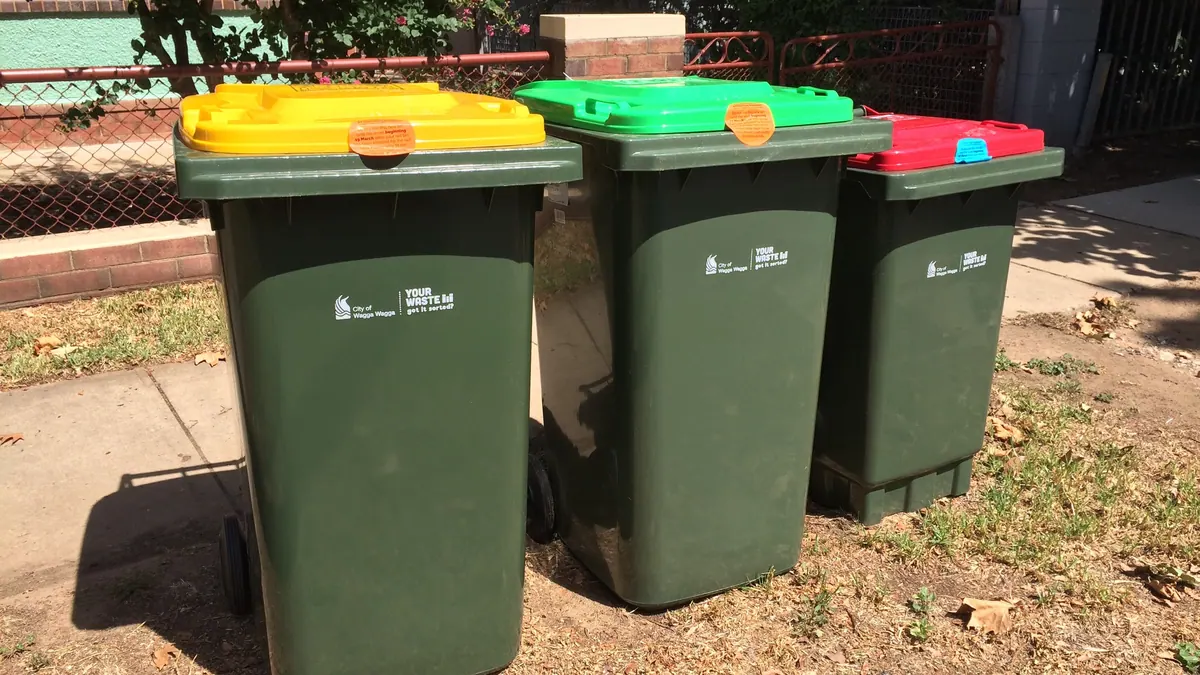

The government of the state of Victoria published in 2020 the ten-year policy “Recycling Victoria: A New Economy”, whose main target is the recovery of 80% of waste by 2030. The strategy also provides for halving the amount of organic waste going to landfill (with an interim step of −20% by 2025) and for introducing a four-bin system in every household.
Four bins
The target system comprises:
- red – general waste,
- yellow – mixed recycling (paper, plastic, metal),
- light green – FOGO, i.e. food together with garden organics,
- purple – glass.
Local governments are to provide separate glass collection by 1 July 2027 and a FOGO service by 2030; in some rural areas, drop-off points were permitted instead of a glass bin.
Why organics is a priority
Organic waste in a landfill decomposes anaerobically and emits methane. That is why the organics reduction target has a climate dimension, not only a waste one. The collected FOGO fraction usually goes to composting plants; the strategy, however, also leaves room for anaerobic digestion where biogas and digestate can be put to use.
Landfill levy
The strategy was tied to raising the landfill levy so that prices in Victoria approach the levels in other states. The press in February 2020 reported that the rate for municipal waste was to rise from about 65.90 to about 125.90 AUD per tonne within three years; the current rate table is worth checking with EPA Victoria.
What this means for Poland
The “four bins” model is similar to Polish separate collection in five fractions, but in Victoria the emphasis was placed on a clear numerical target for organics and on funding from the landfill levy. For Polish biogas plants this means that stable biowaste streams arise where the law enforces collection and at the same time restricts cheaper landfilling.
Financial package
According to state government materials, the strategy envisaged more than 300 million AUD of investment, including 129 million AUD for household collection reforms (support for local governments in introducing new bins), 49.5 million AUD for infrastructure and development of the waste sector (including for organic waste) and 10 million AUD for waste-to-energy technologies. The government also announced a cap of 1 million tonnes a year on residual waste sent to incinerators by 2040, so as not to undermine recycling.
Sources
Related articles