Waste and circular economyEvent
Vietnam: mandatory waste sorting from 1 January 2025. Implementation is slow
Since 1 January 2025 Vietnam has required household waste to be sorted into three fractions. According to the ministry, only 32 of 63 units have launched pilots, and food waste makes up 50–60% of the stream.
Other language versions: polski.
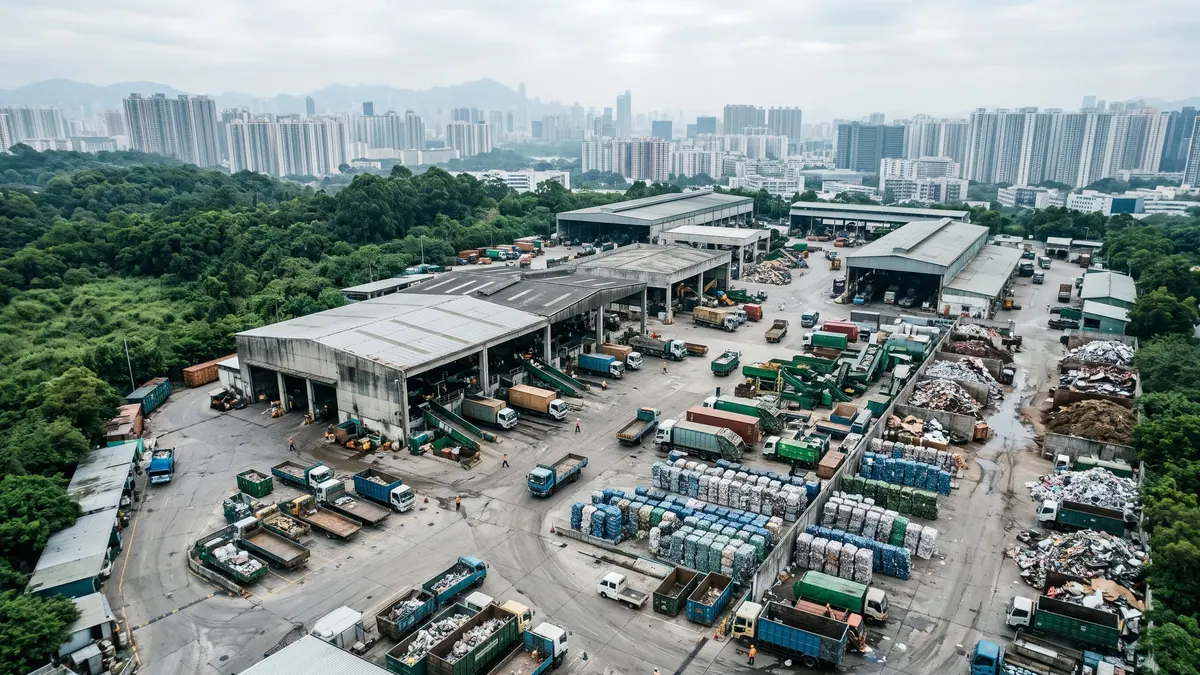
Since 1 January 2025 Vietnam has had a requirement to sort household waste at source, arising from the 2020 Law on Environmental Protection (No. 72/2020/QH14). Implementation is, however, proceeding slowly: according to a ministry briefing of 4 September 2025, only 32 of 63 cities and provinces had carried out sorting pilots, and food waste and other organic fractions make up 50–60% of the mass of household waste.
Legal requirements
Under Article 75(1) of the Law on Environmental Protection, household waste is divided into three groups: waste suitable for reuse and recycling, food waste, and other household waste (as described in the official dispatch of the environment ministry No. 9368/BTNMT-KSONMT of 2 November 2023). The dispatch indicated to the people's committees of provinces and cities that they were to implement household sorting by 31 December 2024 at the latest. According to Viet Nam News of 3 January 2025, entities collecting and transporting waste may refuse to collect from households that do not sort or do not package waste correctly (Article 77(2)), and may report them for inspection. Waste fees are to depend on the quantity of waste, and detailed rates are set by local authorities. According to Viet Nam News, penalties for violators are not fully enforced, and no amounts were given in the September article.
Scale and state of the system
According to the briefing of 4 September 2025, the national quantity of household waste is about 69,400 t per day, including about 37,250 t in cities (processing rate 97.28%) and about 32,150 t in rural areas (80.5%). Overall, 91% is processed. The landfill share is 59.32%, that is 30% less than in 2012 (as the source states, without clarifying whether this means percentage points). Hanoi produces about 7,300 t, and Ho Chi Minh City about 14,000 t per day, together about 31% of the national stream (21.3 of 69.4 thousand t). By comparison, the article of 3 January 2025 stated that waste exceeds 67,800 t per day (38,100 t in cities and 29,700 t in rural areas) and that up to 75% of household waste processing plants use state support.
Obstacles
The deputy director of the environmental protection department, Hồ Kiên Trung, identified as the main obstacle the lack of synchronised infrastructure at all stages: from sorting, through collection and transport, to processing. In addition, the system for recycling and processing food waste is poorly developed, fees for collection, transport and processing are inaccurately estimated and poorly collected (which discourages private investors), and some local authorities do not fully understand the importance of sorting. Information campaigns have not yet changed household habits, and a TGM Research survey showed low interest in sorting among people aged 15–24. Many rural households still manage waste themselves (feeding animals, bedding, burying, open burning). Tuoi Tre wrote in April 2025 that in five Hanoi districts mixed waste abandoned on pavements was still seen.
Plans
In 2025–2026 the ministry plans to clarify regulations and technical guidelines, analyse shortcomings with a view to an amendment, and issue national technical standards for landfills. It is also advising the government to submit to the National Assembly a resolution on strengthening environmental policy and law enforcement, which would allow budget funds to be redirected to modern systems of collection, sorting, transport, recycling and processing. Local authorities would include such projects in their medium-term public investment plans for 2026–2030.
Significance for biogas
The high share of food waste creates potential for anaerobic digestion, but the article indicates that the system for recycling and processing the organic fraction is still poorly developed. Without sorting and dedicated plants, this fraction continues to end up in the general waste stream.
What this means for Poland and Europe
In the EU, since the end of 2023 Member States have had to ensure that biowaste is sorted and recycled at source or collected separately (Directive 2008/98/EC, Article 22). The Vietnamese experience confirms that a regulation alone is not enough — funding, fees and certainty that the separated waste will actually be processed are key.
Sources
- Viet Nam News — Waste sorting at source faces obstacles eight months after nationwide rollout (5.09.2025)
- Viet Nam News — Classifying solid waste at sources mandatory from January 1 (3.01.2025)
- MONRE — Official Dispatch 9368/BTNMT-KSONMT (2.11.2023) on classification of domestic solid waste (Luật Việt Nam)
- Tuoi Tre News — Hanoi residents still not sorting waste months after legal deadline (20.04.2025)
Related articles