Waste and circular economyExplainer
The waste hierarchy (Articles 17 and 18) and the place of anaerobic digestion
Five levels of the hierarchy: prevention, re-use, recycling, other recovery and disposal. We show how Articles 17 and 18 place anaerobic digestion and why this matters in decisions.
Other language versions: polski.
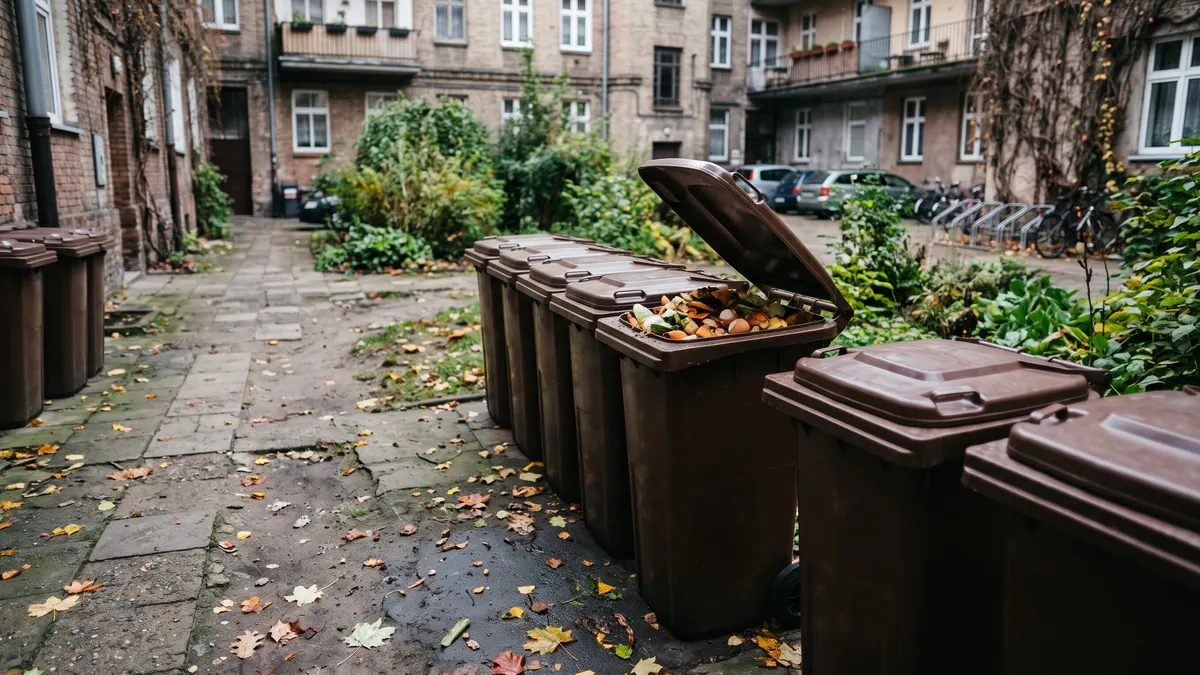
The waste hierarchy is the statutory order of choices: first prevent, then prepare for re-use, then recycle, then other recovery (e.g. energy recovery), and only at the end dispose. Article 17 of the Act on Waste (ustawa o odpadach) lists these five levels, and Article 18 says how to use them. Anaerobic digestion of biodegradable waste — thanks to the definition of organic recycling — is placed on the third level, that is, higher than incineration or landfilling.
Five levels
| Level | Practical meaning | Example for organic waste |
|---|---|---|
| 1. Prevention | do not generate waste | planning purchases, reducing losses in food production |
| 2. Preparation for re-use | checking, cleaning, repair | rare for organic waste, but applies to e.g. packaging and pallets |
| 3. Recycling | including organic recycling | composting, anaerobic digestion with use of the organic matter |
| 4. Other recovery operations | e.g. use of energy | waste incineration with energy recovery |
| 5. Disposal | including landfilling | landfilling, incineration without recovery |
What Article 18 says
- Paragraph 1 requires anyone carrying out activities that generate waste to plan them so as to prevent waste and reduce its quantity in the first place.
- Paragraphs 2–3: waste whose generation could not be prevented must be recovered by the holder; recovery consists first of preparation for re-use or recycling, and if that is impossible for technological reasons or unjustified ecologically or economically — of other recovery operations.
- Paragraph 4: recycling also includes organic recycling — aerobic (including composting) or anaerobic treatment of biodegradable waste under controlled conditions with the participation of microorganisms, producing organic matter or methane. Landfilling is not organic recycling.
- Paragraphs 5–7: waste whose recovery was impossible must be disposed of; only waste that could not be disposed of otherwise may be landfilled; waste is subjected to disposal after the fractions suitable for recovery have been separated out.
Where the biogas plant fits in
For biowaste, waste from the food industry or plant residues, anaerobic digestion is usually a rational choice “after prevention”: it keeps organic matter in circulation (digestate) and yields energy (biogas). How an installation is assessed in recycling statistics is determined by EU and national calculation rules, and what matters in them is what actually goes on to further lawful use (e.g. digestate applied to land). Documenting the fate of the digestate therefore matters beyond the records.
The hierarchy is also an answer to questions such as “is it better to incinerate or to ferment”. Where waste can be fermented or composted in a technologically and economically justified way, it should not be sent directly to an incinerator; for fractions with a high calorific value and a low content of biodegradable parts the answer is sometimes the opposite.
The cascade for food waste
| Step | Action | Notes |
|---|---|---|
| 1 | reducing the generation of surpluses | better planning, managing shelf-life dates |
| 2 | giving food to people | agreements with non-governmental organisations (a statutory requirement for large shops) |
| 3 | organic recycling | composting, fermentation with management of the digestate |
| 4 | energy recovery | where recycling is not justified technologically or economically |
| 5 | disposal | a last resort |
Directive 2008/98/EC allows departures from the hierarchy where a life-cycle approach and an assessment of the overall impacts of waste generation and management so justify. The Polish Act expresses this more conservatively in Article 18(3): the higher level takes precedence unless it is unjustified for technological, or ecological and economic reasons. Both approaches require justification, not intuition.
How to apply the hierarchy in practice
- Prevention before technology. Before you design an installation, check whether waste generation can be reduced — this is also an argument in environmental assessments.
- Justification of a departure. If you choose a level lower than recycling, record the technological, ecological or economic reasons.
- Documentation. In project descriptions and applications show why a given technology was chosen; for thermal treatment installations the Act explicitly requires the permit application to include, among other things, a description of the ways of preventing waste and of the further management of the waste.
- Separation before disposal. Before landfilling or incineration without recovery, remove from the waste the fractions suitable for recovery.
How the permitting authority sees the hierarchy
The hierarchy is not a separate criterion in Article 46, but it translates into two of the grounds for refusing a permit (Article 46(1)(2) and (3); the third is a threat to human life, health or the environment): where the intended method of waste management is inconsistent with waste management plans or with the law. Waste management plans are also built on the hierarchy, so an installation that “skips” levels without justification (e.g. sends to incineration a fraction that could be fermented) may find things harder. On the other hand, Article 19 obliges authorities to support re-use and preparation for re-use, and Article 18(6) states plainly that only what could not be disposed of otherwise may be landfilled.
Common mistakes
- treating the hierarchy as a declaration, without technical evidence;
- omitting prevention and re-use in project descriptions;
- regarding the burning of biogas in cogeneration as “recycling” — that is a different category;
- no plan for the digestate and for the residues after treatment.
This text is for information only and does not constitute legal advice; before an investment or formal decision, check the current wording of the regulations and consult a lawyer or the competent authority.
Sources
Questions and answers
Is a biogas plant recycling or energy recovery?
Both. Producing biogas is energy recovery, but fermentation of biowaste with the digestate used as a fertiliser or soil improver is recognised as organic recycling. What counts is what actually ends up in the soil.
Must the hierarchy always be applied in strict order?
Not absolutely. Article 18(3) allows other recovery processes where recycling is not possible for technological reasons or is not justified for environmental or economic reasons. Such a derogation must, however, be justified.
Related articles