Biogas engine derating: ambient temperature, altitude and gas quality
In summer a CHP unit often fails to reach its rated output. We explain the effect of temperature, altitude, cooling and gas, and how to read the manufacturer derating curve.
Other language versions: Polski, Deutsch, Español, Français, Italiano, Nederlands.
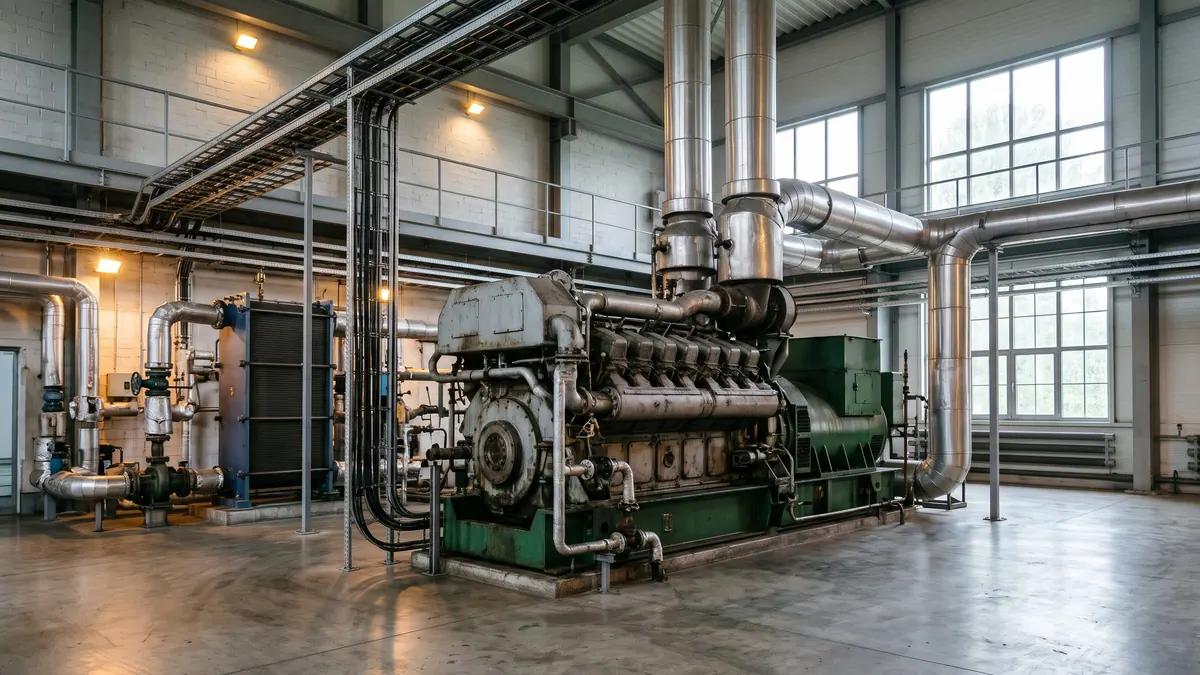
Derating is a reduction of the available engine output relative to the rated output when the temperature, atmospheric pressure or gas quality are worse than the reference conditions. At biogas plants it is most often seen in summer, when the CHP unit suddenly "does not reach" full output despite a sufficient amount of gas. Understanding the mechanism makes it possible to plan production and avoid false diagnoses of a fault.
Reference conditions
Rated output is stated for the conditions defined in the ISO 3046 series of standards (typically an air temperature of about 25°C, a pressure of about 100 kPa and a relative humidity of about 30%; the exact values must be checked in the standard and in the manufacturer datasheet). The manufacturer also publishes its own reference conditions and correction curves. When the actual conditions differ, the available output changes according to these curves.
Why output falls
- Air density. A turbocharged engine draws in a mass of air that depends on density. A higher temperature or altitude means a smaller mass of oxygen and a lower output with the same mixture. As a rough guide, pressure falls by about 1% for every 80–90 m of altitude.
- Coolant and charge air temperature. Mixture coolers and water circuits have a limited capacity. When the ambient temperature rises, the temperature after the cooler rises, and the control system limits output to avoid knocking.
- Calorific value of the gas. A lower methane content (a higher CO2 content) means less energy per unit volume. With a limited capacity of the gas train and fixed set parameters, output falls, and the methane number additionally affects the knock margin.
- Auxiliary limitations. Fouled coolers, air filters, blocked heat exchangers or too low a gas pressure upstream of the gas train reduce output in a similar way to derating.
How to read the manufacturer curve
A typical chart has the air or coolant temperature on the horizontal axis and the relative output (a percentage of rated output) on the vertical axis, often with several curves for different altitudes. Check:
- whether the curve refers to the combustion air temperature or to the ambient temperature,
- what fuel quality it refers to (methane content, methane number, gas pressure),
- what cooling configuration is assumed (standard, extended or tower coolers),
- from what temperature the reduction begins.
Illustrative example. If the curve gives 100% of output up to 35°C and 92% at 40°C, then on a hot day with an air temperature of 40°C at the CHP unit, a 500 kW electrical unit will reach about 460 kW. The difference of 40 kW over 8 hours is 320 kWh per day; in a typical summer with several dozen such days that is several to a dozen or so MWh of lost production per year. The values are hypothetical and depend on the model.
Planning at purchase
- Require the supplier to provide a derating curve for the local maximum temperatures and altitude.
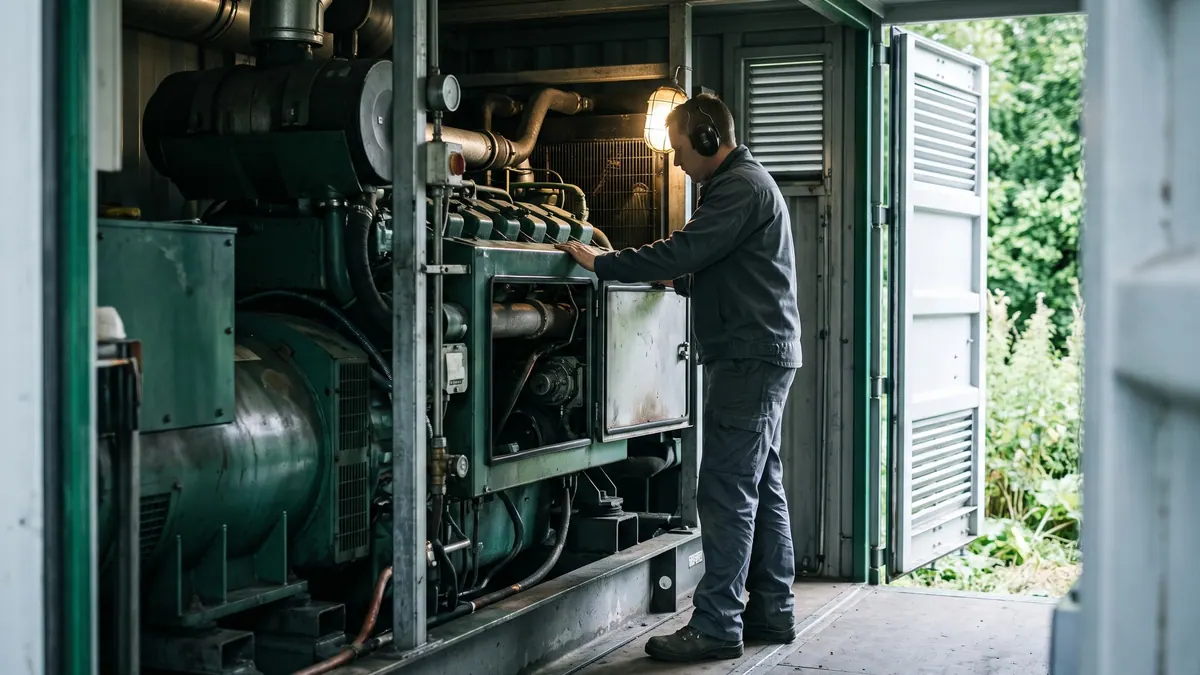
- Ask about the air temperature in the engine room, not only outdoors; the engine room is usually warmer by several to a dozen or so kelvins.
- Calculate annual production from the hourly temperature profile, and not only from the rated output.
- Pay attention to whether the reduction is smooth or occurs in steps after a threshold is exceeded.
What can be done
- Keep the coolers clean (external fins, filters), because a layer of dust reduces heat exchange.
- Ensure a supply of cool air and removal of hot air, without recirculation between the outlet and the inlet; shading the coolers helps in hot weather.
- Increase the cooling capacity (additional modules, adiabatic spraying where permissible and safe for water quality).
- Stabilise the gas composition and the pressure upstream of the gas train.
- Verify that the limitation is not caused by a sensor fault rather than by physics.
Cooling and ventilation of the engine room are described in the article Ventilation of a CHP engine room: combustion air, heat removal and gas detection, and the requirements for the gas supplied to the engine in Fuel specification for a biogas engine. The request for quotation is worth supplementing with a requirement that the supplier state the output at the maximum temperature that has occurred at the site in recent years, and not only at the reference conditions. The difference translates directly into annual revenue.
Diagnostics: derating or a fault
When output falls, start with the data. Record the ambient temperature, the coolant temperature, the air temperature after the mixture cooler, the gas pressure upstream of the gas train and the gas composition. If the limitation appears exactly when the temperature exceeds the threshold from the manufacturer curve and disappears after cooling, it is derating. If output is lower in cool weather, look for mechanical causes: wear, leaks, ignition or contamination. A good habit is to compare the current output with the value from a year earlier in similar conditions.
Summary
Derating is a physical phenomenon, not a fault, if it falls within the manufacturer curve. It is important to distinguish it from a drop in output due to wear or fouling, and to take the real annual production into account in the revenue calculation, and not the maximum catalogue output.
Sources
Related articles