Tanks and membranesGuide
Membrane repair: when to patch and when to replace — decision criteria
Patching a membrane can be cheap and effective, but not always. We show how to assess the damage, the age of the material and the cost of downtime in order to choose repair or replacement.
Other language versions: Polski, Deutsch, Español, Français, Italiano, Nederlands.
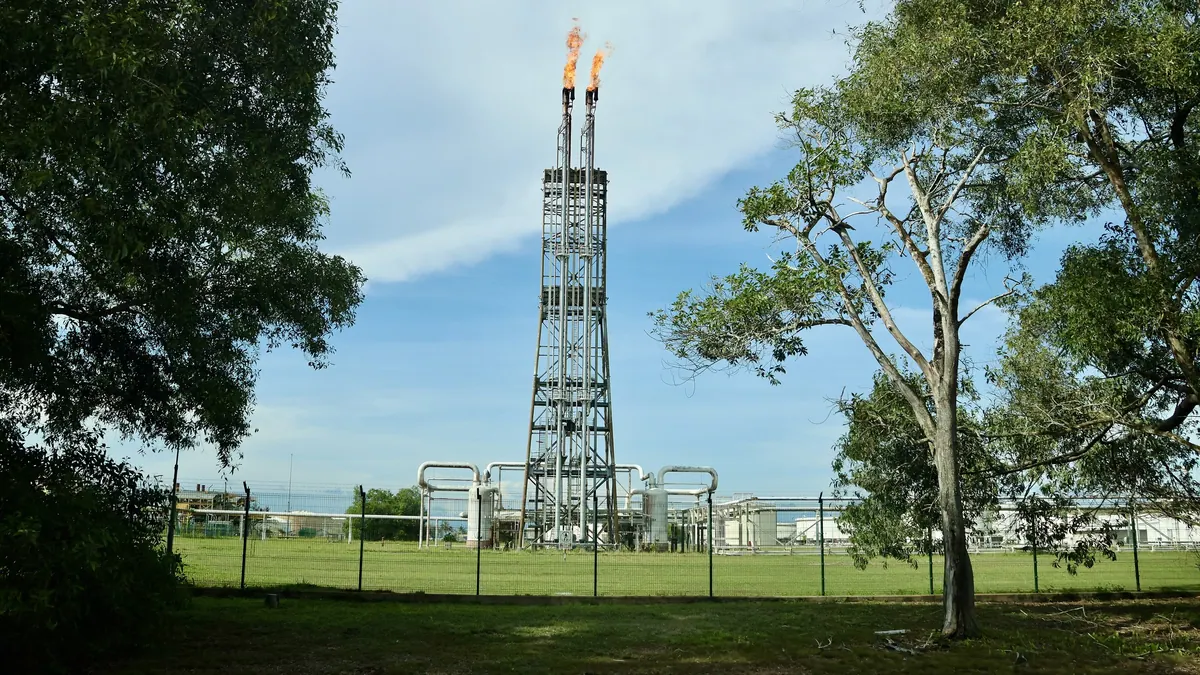

An operator who finds a cut or abrasion on the tank roof faces the question of whether a patch is enough or whether replacement of the entire membrane must be planned. The answer depends on three things: the type of damage, the condition of the remaining material and the cost of the risk entailed by further operation with a repaired roof. The criteria that allow this decision to be put in order are collected below.
Types of damage and their significance
| Damage | Typical cause | Is a patch usually enough? |
|---|---|---|
| Point cut | tool, branch, sharp structural element | yes, if the material around it is sound |
| Abrasion | rubbing against the structure, rope or edge | yes, but the cause of the rubbing must be removed |
| Blisters and delamination of the coating | moisture ingress, ageing, material defect | usually not, because the damage grows |
| Weld crack | stress, weld defect, wind | depends on length and location; main welds are a risk |
| Damage around a penetration or the perimeter | movement, corrosion, loosening | often requires repair of the fixing, not just a patch |
It is always worth establishing the cause. A patch on abrasion caused by rubbing against a rope will fall apart in the same place.
Repair techniques and their limitations
Most often a patch welded with hot air is used, if the membrane material can be welded, or a glued patch using the adhesive recommended by the manufacturer. The durability of the repair depends on:
- cleanliness and preparation of the surface (degreasing, roughening, if the instructions require it);
- overlap of the patch onto sound material, usually with rounded corners, which do not peel off as easily;
- conditions of execution, i.e. a dry surface and a temperature permitted for the adhesive or weld;
- curing time, before the roof is loaded with full pressure.
Roof repair has limitations: a patch will not restore the strength of the material around the damage, and old, hardened plastic often does not give a good joint. For this reason temporary repairs, carried out during operation, are treated as a solution for the time needed to prepare a planned overhaul.
Membrane age and risk
Roof membranes are designed for many years of service, and system manufacturers give indicative service lives, usually counted in years, subject to operating conditions. Ageing is accelerated by UV radiation, temperature fluctuations, condensate and movement of the material. With age the number of damage points per unit area grows, and the material becomes less flexible. When several spots have to be repaired within a single season, further repairs begin to multiply. This is one of the clear signals that it is time to plan replacement.
The cost-risk-downtime calculation
The decision can be put in order with a simple comparison. The example below is hypothetical and serves only to show the logic:
- Cost of a local repair: small, carried out in a few hours.
- Probability of a repeat failure in the season: grows with age and the number of repairs.
- Cost of a failure: loss of gas, shutdown of the CHP, calling out a crew urgently, possible loss of energy revenue.
- Cost of planned replacement: much higher, but carried out at a convenient time, together with an inspection of other components.
If the probable loss from an unplanned failure, multiplied by the growing risk, approaches the cost of planned replacement, replacement pays off. It is also worth taking into account the costs of methane emissions and potential leak inspection requirements.
Safety of work during repair
Repairs on the roof of a tank with biogas are carried out in an explosion hazard zone. This means:
- tools and equipment approved for the given zone;
- a ban on hot work without a written permit and protective measures;
- atmosphere measurement during the work and continuous observation of pressure;
- protection against falling from height and against falling into the membrane, which is not a load-bearing surface;
- determination of who is authorised to carry out the work and who supervises it.
To this is added the rule that welding with hot air in a zone where gas could appear requires a risk analysis and usually a reduction of pressure and separation of the work area. The details are set by the explosion protection document and the supplier's instructions.
How to assess the material before the decision
Before ordering a patch it is worth checking what plastic the membrane is made of, because this determines whether it can be permanently welded or only glued. An overview of materials (PVC, PE, EPDM) is found in the article on biogas membranes. It is good practice to ask the manufacturer for an assessment of the condition of the material, instead of relying solely on visual impression. Such an opinion, attached to the defect register, helps to justify both repair and replacement to the insurer and to the supplier.
Documenting repairs
Every repair should be recorded: date, location, size of the damage, cause, method and material used, person carrying it out, result of the leak check after the repair. Photographs before and after make it possible to assess whether the repair holds. Such data are also useful in a conversation with the supplier about the warranty and in assessing whether the moment of replacement is approaching.
Sources
Related articles