
Tanks and membranesAnalysis
Snow and rainwater loads: effects on the membrane and rim of the tank
Snow and rainwater load a membrane roof with a weight that is easy to compare with the support pressure. Effects on the membrane and rim, and ways of limiting the risk.
Other language versions: Polski, Deutsch, Español, Français, Italiano, Nederlands.
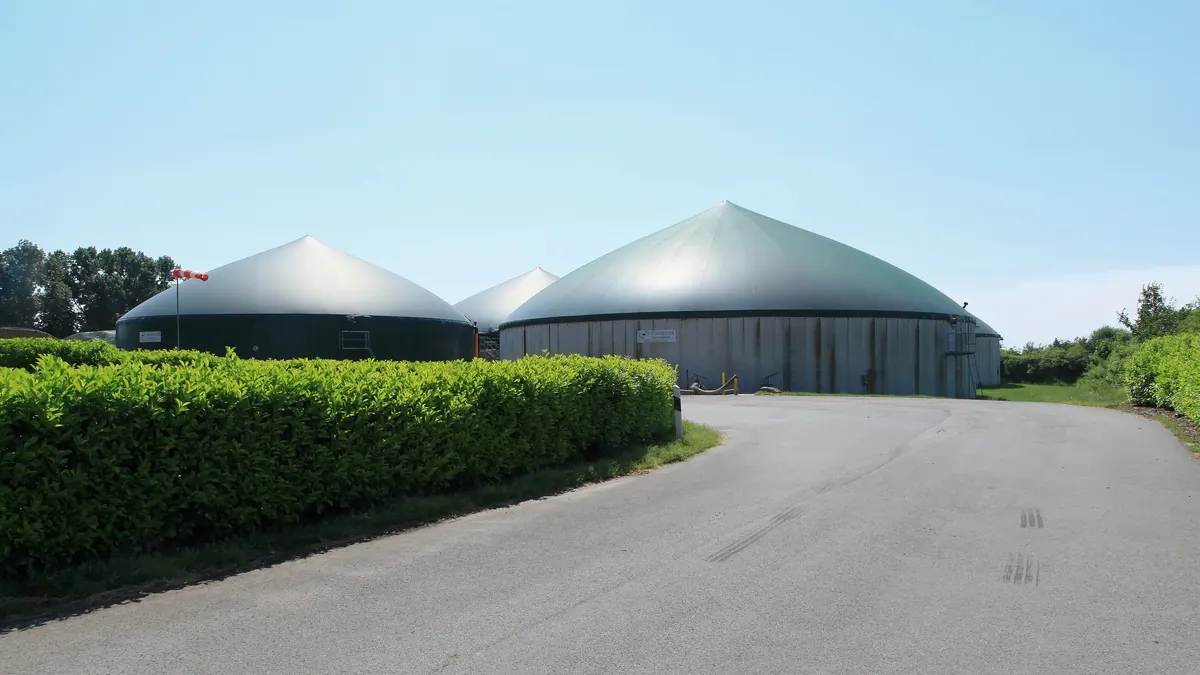
Snow and rainwater load a membrane roof with a weight that translates into a pressure acting on the membrane, and this is easy to see when it is compared with the support air pressure. The calculations are simple: 1 mm of water is 1 kg/m², that is, about 10 Pa, and 1 mbar is 100 Pa. A layer of water 10 mm thick therefore loads the membrane like 1 mbar. Typical support pressures of double-membrane roofs are of the order of single millibars, so even a small pond of water, and still more lying snow, can exceed what the air cushion is able to "lift".
How the roof is built and where the load acts
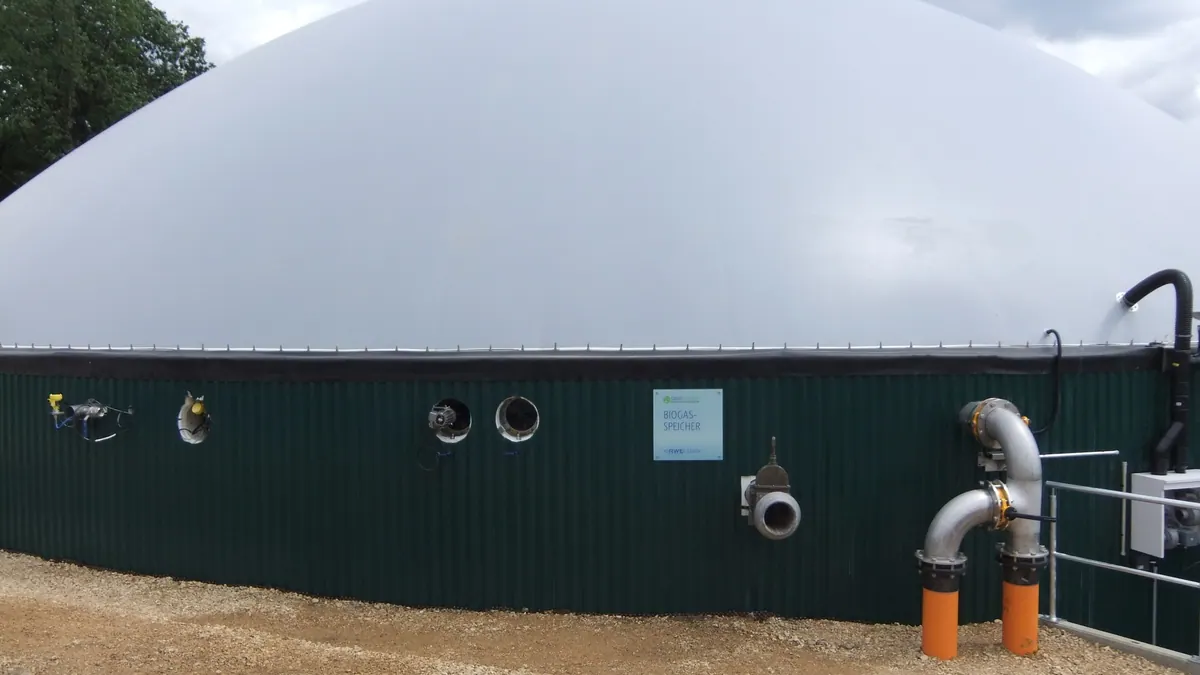
A gas tank with a double-membrane roof consists of an inner (gas) membrane and an outer (protective) membrane. The space between them is kept under overpressure by a blower, which gives the outer membrane its shape and tension. Loads from outside (snow, water, wind) are therefore carried by the tensioned membrane and its fixing at the rim (the tank rim, strip, clamping profile). A description of the construction and safety of the roof is in the article Biogas storage: the double-membrane roof and safety.
Comparison of magnitudes
| Load | Equivalent pressure |
|---|---|
| 10 mm of water (pond) | about 100 Pa = 1 mbar |
| 30 mm of water | about 300 Pa = 3 mbar |
| Snow 1 kN/m² (about 100 kg/m²) | 1000 Pa = 10 mbar |
| Typical support air pressure | of the order of single mbar (per the manufacturer) |
A practical conclusion follows: the support pressure alone is not a safeguard against snow. A pneumatic roof is resistant to snow thanks to its shape (arch, dome), the strength of the membrane and fixing, and the fact that snow tends to slide off. The hazard arises when snow lies, forms an overhang, wet snow has a high density or the roof loses tension.
The most common damage mechanisms
Loss of support pressure. A failure of the blower or power supply, or a leak in the outer membrane, reduces tension, and the outer membrane may sag onto the inner one. Depressions form in which water and snow collect, which further increases the load.
Ponding of water. Depressions (among others around patches, at wrinkles, at folds) collect rain and meltwater. Water once collected increases the deflection, so it collects still more water.
Uneven loading. Snow sliding down on one side, wind-blown drifts, overhangs or slides from neighbouring structures give an asymmetric load, which loads the rim differently from a uniform one.
Ice. Frozen water forms rigid, heavy sheets that cannot be shed. In addition, ice increases the stiffness of the membrane at low temperature and can lead to micro-cracks. Drains and liquid-based safeguards also freeze; see How to choose anti-freeze heating for the protection system.
Overloading of the rim. The load from the roof converges on the rim, the element that fixes the membrane to the wall. The concentration of forces causes the membrane to be pulled out of its fixing, damage to the strip or material fatigue. Water lying at the rim accelerates corrosion and destroys the seals.
What to do in design and operation
- Input data. The snow load for the location is determined from the standard PN-EN 1991-1-3 (snow zones, shape coefficients); the design value should be entered in the roof documentation. The manufacturer's documentation states what load the roof was designed for.
- Control of tension and support pressure. A blower with backup power or a second blower, a pressure drop alarm, regular checking of non-return valves.
- Drainage of water. A roof without depressions, clear drains, inspection after rainfall. Ponds should be reported to the service provider, not "observed".
- Inspection after heavy precipitation and before winter. The condition of seams, fixing, rim, strips, bolts and seals.
- A plan of action in case of heavy precipitation. Who decides on snow clearing, how it is done, how people are protected against falling, how the gas is secured.
Safety of work when removing snow
One does not climb onto the membrane without the manufacturer's express consent and a risk assessment. The risk includes falling, damage to the membrane (loss of tightness, release of gas) and work in an explosion-hazard zone. The scope and method of snow removal should follow from the site instructions and the explosion protection document, and the work is carried out by trained persons with suitable equipment; in the event of damage or suspected loss of tightness, the site's emergency procedure is followed. The principles concerning hazards of safe work in Ex zones are discussed in the article ATEX in a biogas plant.
Summary
Loads from precipitation are usually greater than the forces at the disposal of the support air, so the safety of the roof rests on geometry, tension, the strength of the material and rim, on the blower's power supply and on operating discipline. Checking ponds, fixings and alarms before the winter season is cheaper than repair after a snowfall.
The role of the rim
The rim, the ring fixing the membranes to the tank wall, is the element in which the forces from the whole roof concentrate. It usually includes clamping strips or profiles, bolts, seals and water drainage. Its condition is assessed after every winter: corrosion of bolts, cracks in seals, deformation of the strip and traces of water under the membrane are warning signs. Particularly exposed are places where ponds form right at the rim, because water, and in winter ice, increases the load exactly at the point of greatest stress. If damage is found during an inspection, the repair is carried out according to the manufacturer's instructions, and the tank is taken out of service in the manner provided for by the procedure.
Conclusions for the operating plan
A winter plan for a membrane roof should include: criteria triggering additional inspection (for example the depth of lying snow or forecast heavy precipitation), the persons responsible for decisions, the availability of emergency power for the blower and the rules of communication with the manufacturer's service. It is also worth recording observations (places where water or snow collects), because they make it possible to improve the membrane tension or drainage at the next service visit.
Sources
Questions and answers
Does increasing the support air pressure protect the membrane against snow?
Only to a small extent. Typical support pressures are of the order of single millibars, whereas snow load is tens to hundreds of kg/m², that is, correspondingly higher pressures. Raising the support pressure above the manufacturer's recommendations is not a method of protection and may increase stresses.
Who should remove snow from a membrane roof?
The decision on removal and on the method is made on the basis of the manufacturer's instructions and a risk assessment; work on a membrane roof is dangerous (falls, membrane damage, risk to the gas), so it is carried out by trained persons with suitable equipment.