Coolant in CHP engine circuits: glycol, corrosion inhibitors and quality control
How to choose the glycol concentration, keep an eye on corrosion inhibitors and water quality, and check CHP engine coolant, especially in winter. A checklist.
Other language versions: Polski, Deutsch, Español, Français, Italiano, Nederlands.
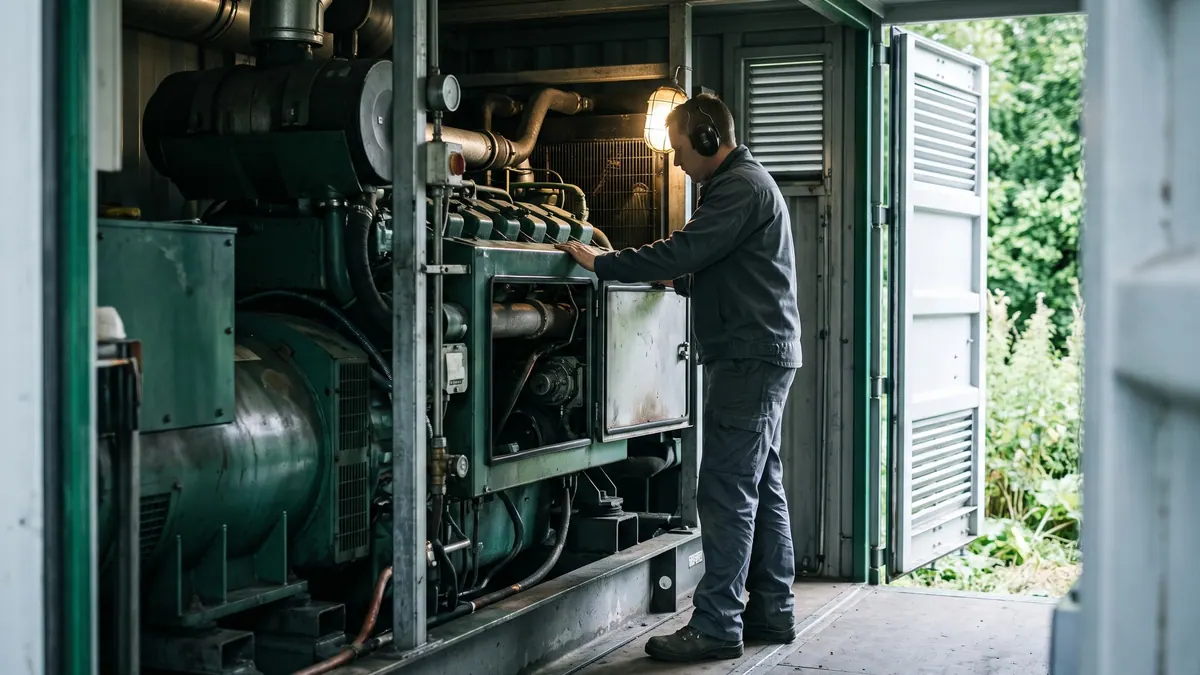
The cooling system of a CHP engine works all year round, over a wide range of temperatures, and is closed only apparently, because it constantly exchanges heat with the engine, the oil, the mixture and the heat consumers. The coolant is usually water with the addition of glycol and a package of corrosion inhibitors, and its condition determines heat transfer, tightness and the service life of pumps, coolers and cylinder heads. This text is a guide for operations. The recommendations of the engine manufacturer always apply; here we give typical ranges. We leave out a description of the HT and LT circuits themselves.
Why glycol and how much to use
Glycol (most often ethylene or propylene) lowers the freezing temperature of water and raises the boiling temperature. Indicatively, for ethylene glycol a freezing point of about -20 °C is provided by a concentration of the order of 35–40% by volume, and about -30 °C by 45–50%. The exact values depend on the type of glycol and additives, which is why we use the fluid manufacturer's table.
The trade-off is always the same. A higher concentration means greater protection against frost, but lower heat capacity, poorer thermal conductivity of the mixture and higher viscosity. Heat transfer worsens by as much as a dozen or so per cent at 50% glycol compared with pure water (an indicative value). It is therefore not worth adding glycol as a precaution, and in internal circuits working in a heated room a lower level of protection is assumed than in external circuits, for example emergency coolers on the roof.
Corrosion inhibitors
Pure glycol is not protection against corrosion. Protection comes only from the additive package: corrosion inhibitors for steel, cast iron, aluminium and copper, pH stabilisers and antifoam agents. Over time they are depleted. The technology types (organic OAT, inorganic IAT and hybrid HOAT) differ in durability and material compatibility, and the engine manufacturer usually indicates which is permitted. A practical rule: do not mix fluids with different inhibitor technologies without the manufacturer's consent. Mixing can cause deposits to precipitate and protection to disappear.
Make-up water
The quality of the water is just as important. Hard water forms scale on hot heat exchanger surfaces, and chlorides and sulphates promote pitting corrosion. The recommended water is demineralised or of limited hardness and low chloride content, in line with the requirements given in the documentation. We do not use water from an unknown source, well water or rainwater. Ready-mixed, diluted concentrates are more expensive but eliminate the risk of a mixing error.
What and how to measure
| Parameter | Tool | What a deviation means |
|---|---|---|
| Glycol concentration | refractometer | dilution through a leak or too much water |
| pH | pH meter or strips | acidification indicates degradation of the glycol or inhibitors |
| Alkalinity reserve | fluid manufacturer's test | depletion of inhibitors |
| Appearance and smell | visual assessment | turbidity, deposits, a burnt smell, oil on the surface |
| System pressure | pressure gauge, expansion tank | leak, leakage of exhaust gases into the fluid |
The sample should be taken from the system at operating temperature, into a clean container, and ideally sent once or twice a year for laboratory analysis together with an assessment of the metal content (iron, copper, aluminium). The trend of the values is more important than a single measurement.
Aeration, venting and pressure
Air in the system promotes corrosion, pump cavitation and local overheating. After any service work the system has to be vented at the points indicated by the manufacturer, and then the static pressure checked after it has cooled. A pressure drop over the following weeks points to a leak, even when no leakage is visible. A pressure rise and bubbles in the expansion tank can indicate exhaust gas leaking through the cylinder head gasket, which requires immediate diagnostics.
Replacing the fluid
The service life of the coolant is given by the manufacturer, usually from several thousand hours to several years, depending on the inhibitor technology. We also replace the fluid earlier when analysis shows depleted inhibitors, contamination or corrosion. Replacement consists of draining the old fluid, flushing the system with a suitable agent or demineralised water and filling it with fresh mixture at the correct concentration. Spent glycol is waste, and its handover must comply with the waste regulations.
Winter as a test of the system
The first frosts reveal errors that are invisible in summer. Before the season it is worth checking the glycol concentration in all circuits, including emergency coolers and sections of heat pipework outside the building, because under-dosing or dilution in them is enough for part of the system to freeze in frost. The operation of auxiliary heating and mixing valves should also be checked. In winter the most common mistake is topping up a loss with plain water, which lowers protection. Other winter hazards, such as the freezing of condensate in gas pipelines, are described in the article Operating a biogas plant in winter: condensate freezing and digester temperature.
Seasonal checklist
- Check the concentration in each circuit with a refractometer and compare it with the target level.
- Measure pH and alkalinity reserve, record the trends.
- Check the level and pressure, vent the system.
- Verify which water and which fluid are used for make-up.
- Send a sample for analysis at least once a year.
- Keep a register of top-ups and replacements with the date and quantity.
Consistent coolant checking is one of the cheapest service tasks and one of the most effective in preventing costly failures of the cooling system.
Sources
Related articles