

BMP testingBioplastics and compostable packaging
Cellulose-based films and packaging — BMP: 10 studies, weighted mean 355 m³ CH₄/t VS
Cellulose films and packaging (cellophane, plates, products containing CaCO₃) are mainly cellulose, so they digest well, but mineral fillers lower the VS share.
rating: goodCH₄ ≈ 51 % (estimate)
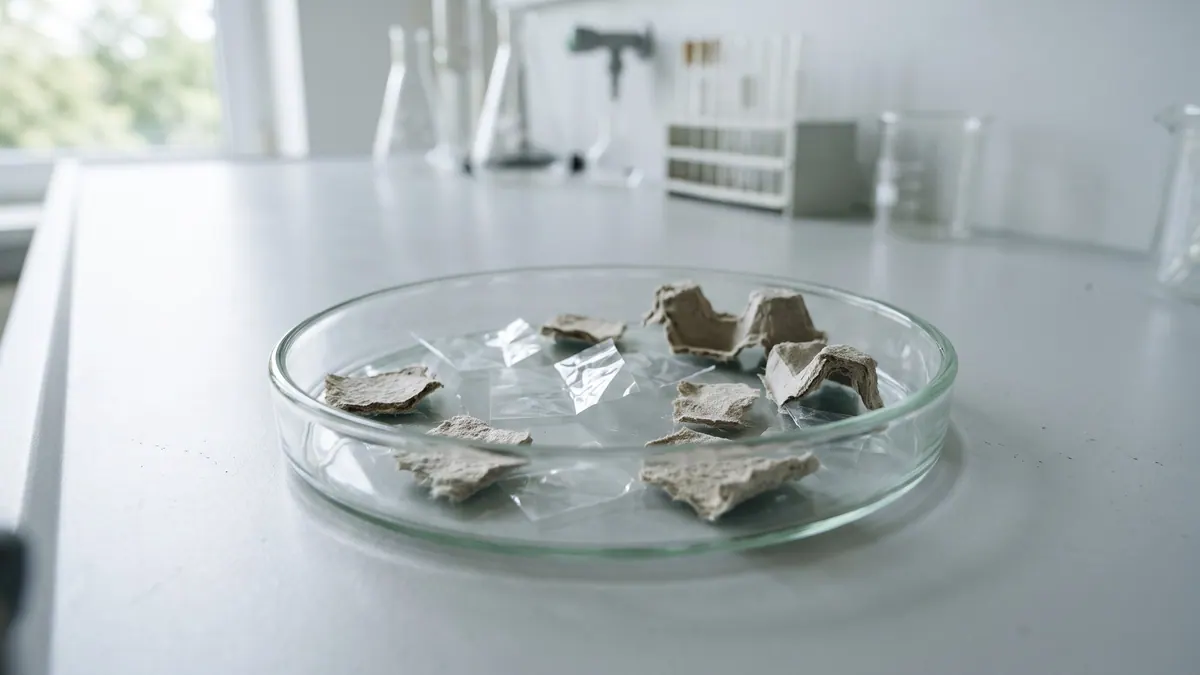
Illustration: FeedstockData (AI, Google Gemini)
- Weighted mean
- 355m³ CH₄/t VS
- Range
- 266–437m³ CH₄/t VS
- Records
- 10studies
- Publications
- 3sources
- Temperatures
- 35 °C, 37 °Cof the test
Methane in biogas
Low methane content · ≈ 5.1 kWh/m³ of biogas
estimate from the substrate type The collected studies contain no measurement. The interval follows from the approximate composition (protein from total nitrogen (N 0 % DM × 6.25)) and the yields of compound groups according to FNR.
Rating for biogas plants
good — editorial rating for biogas plantsStable, usually accepted without a fee
Potential per tonne of fresh matter: very high (254 m³ CH₄/t); no particular threats to stability. Handling costs: fibres, floating layer, slow degradation.
Why? Rating factors
Potential per tonne +3
- +3potential 254 m³ CH₄/t fresh matter (BMP 355 × DM 93.1 % × VS 76.9 %)
Process stability 0
- 0no factors
Handling and costs −1
- −0.5fibres, floating layer — shredding and intensive mixing
- −0.5slow degradation — long retention time
Total points: 2 · thresholds: ≥ 2.5 very good, ≥ 1 good, below — neutral; negative with cumulative process risk.
Add to the co-digestion calculator CSV data
BMP curves from 10 studies
Weighted mean Individual records
Dashed lines are a model curve (first-order kinetics, B(t) = B₀·(1 − e−kt)); the end point comes from the publication. All curves are model curves.
Cumulative methane production over the test [m³ CH₄/t VS]. The thick line is the weighted mean of all records (355); dots mark the end values given in the publications. Point at the chart to read values; click a legend item to hide or show a record.
Records and sources
Download CSV| Source | BMP m³ CH₄/t VS | Temperature | Sample | Curve |
|---|---|---|---|---|
| Calabro’ et al. (2020) DOI | 304 | 35 °C · mesophilic | Cellulosic Plates | end point (model curve) |
| Üveges et al. (2023) · 1 DOI | 266 | — · mesophilic | Cellulose or derivative(s) with CaCO3 | end point (model curve) |
| Üveges et al. (2023) · 2 DOI | 311 | — · mesophilic | Cellulose or derivative(s) with CaCO3 and, | end point (model curve) |
| Üveges et al. (2023) · 3 DOI | 327 | — · mesophilic | Cellulose or derivative(s) with CaCO3 | end point (model curve) |
| Üveges et al. (2023) · 4 DOI | 433 | — · mesophilic | cellulose or derivates | end point (model curve) |
| Üveges et al. (2023) · 5 DOI | 437 | — · mesophilic | Cellulose or derivative(s) with CaCO3 | end point (model curve) |
| Zhang et al. (2018) · 1 DOI | 374 | 37 °C · mesophilic | Cellulose-based metallised film | end point (model curve) |
| Zhang et al. (2018) · 2 DOI | 404 | 37 °C · mesophilic | Cellulose-based high barrier heat-sealable film | end point (model curve) |
| Zhang et al. (2018) · 3 DOI | 410 | 37 °C · mesophilic | Cellulose-based non heat- sealable film | end point (model curve) |
| Zhang et al. (2018) · 4 DOI | 433 | 37 °C · mesophilic | Cellulose-based heat-sealable film | end point (model curve) |
| Weighted mean | 355 | arithmetic mean 370, SD 63 | ||
Typical composition
- Dry matter (DM)
- 93.1% (range 85.9–97.6)
- Volatile solids (VS)
- 76.9 % DM (range 64.7–99.8)
- Nitrogen
- 0 % DM
Median and range of the determinations reported in the publications behind this substrate's BMP records (read from: MY-D); dry matter: 10 determinations, volatile solids: 10 determinations. Samples were tested dried/air-dry – the DM refers to the material in the test, not to fresh material.
Sources: Calabro’ et al. (2020); Üveges et al. (2023); Zhang et al. (2018).
The composition of the raw material varies between batches — for plant calculations use an analysis of your own sample. The calculator inserts typical values automatically.
Process properties
Low confidence: the description is based on general characteristics of the substrate group, not on studies of this material. Treat it as a hint to be verified.
Advantages
- Methane potential in the Substraty.pl BMP dataset: weighted mean 354.7 m³ CH₄/t VS (SD 62.9; 10 records, 3 sources).
- Cellophane and cellulose products are susceptible to anaerobic degradation (Hendriks and Zeeman 2009).
Drawbacks and risks
- Synthetic coatings and mineral fillers remain in the digestate.
Co-digestion — what to combine it with, what to watch out for
- combines well
substrates: high alkalinity (buffer) — e.g. Cattle manure, Pig slurry, Cattle slurry, Duck slurry, Rumen and digestive tract content
Dosing
No source threshold.
Introduce gradually, starting with a small dose and monitoring the process (e.g. FOS/TAC, pH, gas composition).
Practical requirements
- Shred: shredding increases the surface available for degradation and speeds it up, but does not necessarily raise the final gas yield (FNR 2010, Ch. 3 “Triturado”).
Sources of the process data
- Benn, Zitomer (2018). Pretreatment and anaerobic co-digestion of selected PHB and PLA bioplastics. Front. Environ. Sci.
- Hendriks, Zeeman (2009). Pretreatments to enhance the digestibility of lignocellulosic biomass. Bioresour. Technol.
- Narancic et al. (2018). Biodegradable plastic blends create new possibilities for end-of-life management of plastics but they are not a panacea for plastic pollution. Environ. Sci. Technol.
- FNR (2010). Guía sobre el Biogás – Desde la producción hasta el uso (hiszp. wydanie „Leitfaden Biogas”, GIZ 2013)
The co-digestion calculator will assess a specific mixture containing this substrate.
What it is and where it comes from
Cellulose films and packaging are products made of cellulose or its derivatives: cellophane, disposable cellulose plates and tableware, and packaging with added calcium carbonate. They are made from wood fibres or cotton, and are sometimes coated with varnishes or a thin layer of another plastic. They enter the packaging waste stream, and compostable products are sometimes collected together with biowaste.
Properties relevant to digestion
Cellulose is a glucose polymer which, after hydrolysis, gives an easily assimilated sugar, so the theoretical methane potential is high. The limitation is speed: the crystalline structure of cellulose means that hydrolysis is often the limiting step. Cellophane, made from regenerated cellulose, is less crystalline and degrades more readily than paper. In packaging containing calcium carbonate, part of the dry matter is mineral substance, which is not VS. Synthetic plastic coatings remain largely undegraded. The material contributes practically no ammonia or hydrogen sulphide, but being poor in nitrogen it needs supplementing in the mix so as not to upset the C/N ratio.
How to read the spread of results
The results cover several varieties: cellulose plates, packaging with CaCO₃, and products described only as cellulose or its derivatives. Differences stem from the recipe (share of cellulose and fillers), the presence of coatings, the thickness of the material and size reduction. The way of converting to VS also matters, that is, whether ash was taken into account, as does the length of the test, because cellulose degrades with a delay. The compilation brings together different laboratories and inocula of differing cellulolytic activity, which further widens the spread.
In biogas plant practice
Cellulose packaging is not a typical substrate, but as an admixture to biowaste it contributes additional carbon. Before digestion it is worth size-reducing it and mixing it well, to avoid layering and a floating crust in the chamber. Because of the mineral fillers, sediment at the bottom must be expected. Admission to the plant depends on the waste code and the permits held, and each stream must be assessed for the presence of coatings and other impurities.
When assessing such a stream, a simple visual check helps: the presence of metallised layers, laminates with plastics or printing changes both the result and the amount of residue in the digestate. A trial BMP test for the specific batch is also good practice, because the literature data describe other recipes.
Methodology in brief
BMP is the amount of methane obtained from volatile solids (VS) in a batch test, given in m³ CH₄ per tonne of VS (numerically the same as NmL CH₄/g VS in the publications) and converted to normal conditions (0 °C, 101.325 kPa). The weighted mean gives each publication a total weight of 1, split equally between its results for the substrate — a paper testing twenty varieties does not outweigh a paper with a single sample. In inter-laboratory programmes the unit is the laboratory (total weight 1), and within it the weight of a test grows with the number of bottles (replicates). Results after pretreatment (e.g. thermal, chemical, enzymatic) are shown separately and are not included in the mean.
Solid lines are curves measured in the tests. Where a publication gives only the final result, we draw a first-order kinetic model, B(t) = B₀·(1 − e−kt): only the end point comes from the publication, and the shape of the curve serves purely as visualisation — do not read the production on a particular day from it. For this substrate k = 0.091 d−1 was assumed (no kinetic data for the group – the median of all available rate constants k (93 values) was used).
The statistics describe the spread of published results — a descriptive compilation, not a meta-analysis or a guarantee of plant yield.
Bibliography
- Calabro’, P.; Folino, A.; Fazzino, F.; Komilis, D. (2020). Preliminary evaluation of the anaerobic biodegradability of three biobased materials used for the production of disposable plastics. Journal of Hazardous Materials 390, 121653. DOI: 10.1016/j.jhazmat.2019.121653 DOI
- Üveges, Z.; Damak, M.; Klátyik, S.; Ramay, M.W.; Fekete, G.; Varga, Z.; Gyuricza, C.; Székács, A.; Aleksza, L. (2023). Biomethane Potential in Anaerobic Biodegradation of Commercial Bioplastic Materials. Fermentation 9(3), 261. DOI: 10.3390/fermentation9030261 DOI
- Zhang, W.; Heaven, S.; Banks, C.J. (2018). Degradation of some EN13432 compliant plastics in simulated mesophilic anaerobic digestion of food waste. Polymer Degradation and Stability 147, 76–88. DOI: 10.1016/j.polymdegradstab.2017.11.005 DOI
All sources of the site: bibliography.
Other substrates in the group “Bioplastics and compostable packaging”
Starch-based bioplastics — BMP: 10 studies, weighted mean 266 m³ CH₄/t VS
266 m³ CH₄/t VS weighted mean from 10 studies
good — editorial rating for biogas plants≈52 %
PHA (polyhydroxyalkanoates) — BMP: 3 studies, weighted mean 341 m³ CH₄/t VS
341 m³ CH₄/t VS weighted mean from 3 studies
≈52 %
Compostable bags — BMP: 8 studies, weighted mean 119 m³ CH₄/t VS
119 m³ CH₄/t VS weighted mean from 8 studies
neutral — editorial rating for biogas plants≈52 %
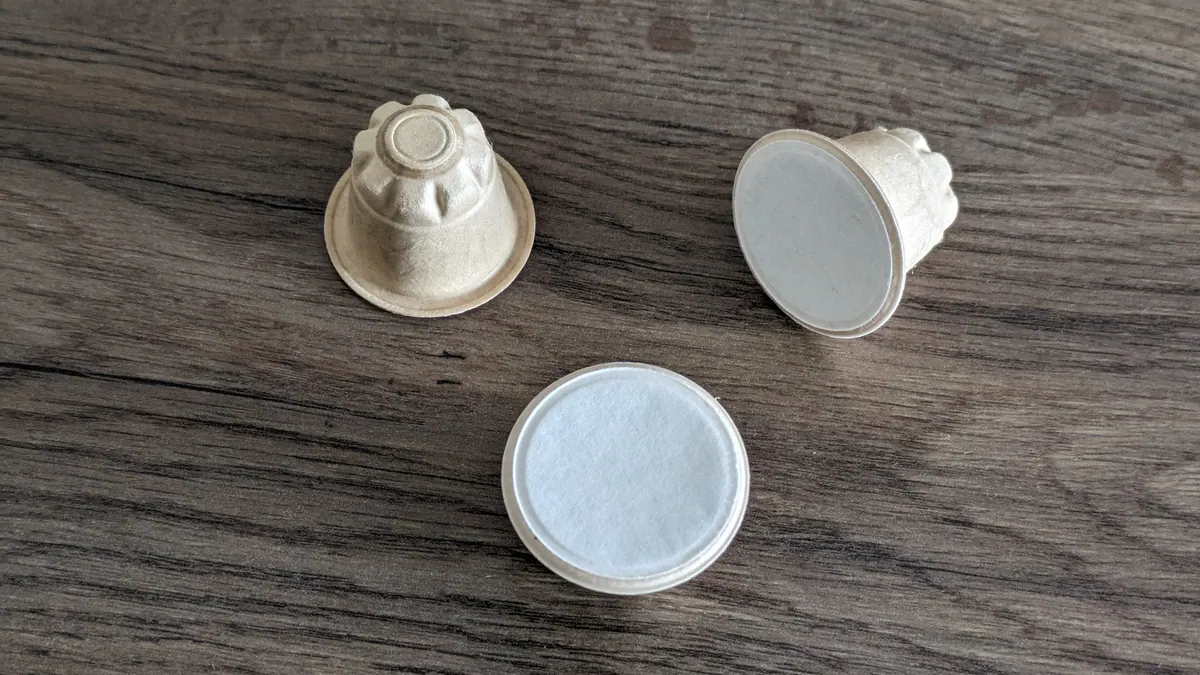
Compostable coffee capsules — BMP: 6 studies, weighted mean 201 m³ CH₄/t VS
201 m³ CH₄/t VS weighted mean from 6 studies
≈52 %