

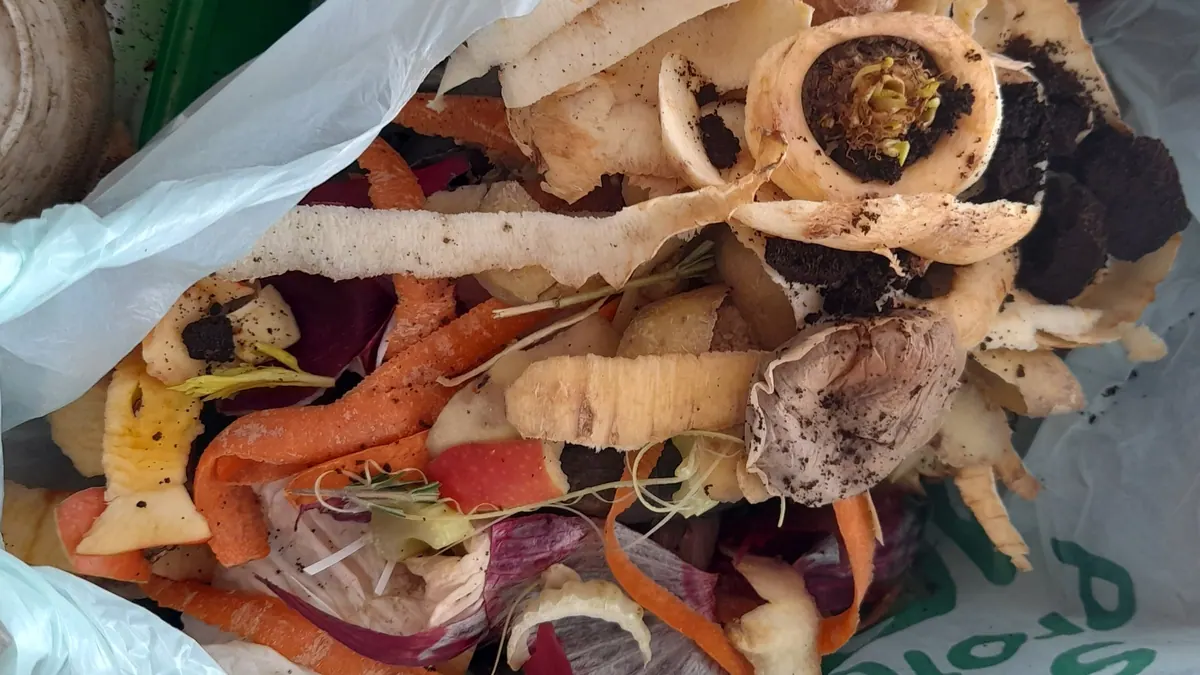
BMP testingBioplastics and compostable packaging
Compostable bags — BMP: 8 studies, weighted mean 119 m³ CH₄/t VS
Compostable bags for biowaste are thin biopolymer films; in BMP tests they degrade partially, and the result depends on the temperature and the bag composition.
rating: neutralCH₄ ≈ 52 % (estimate)
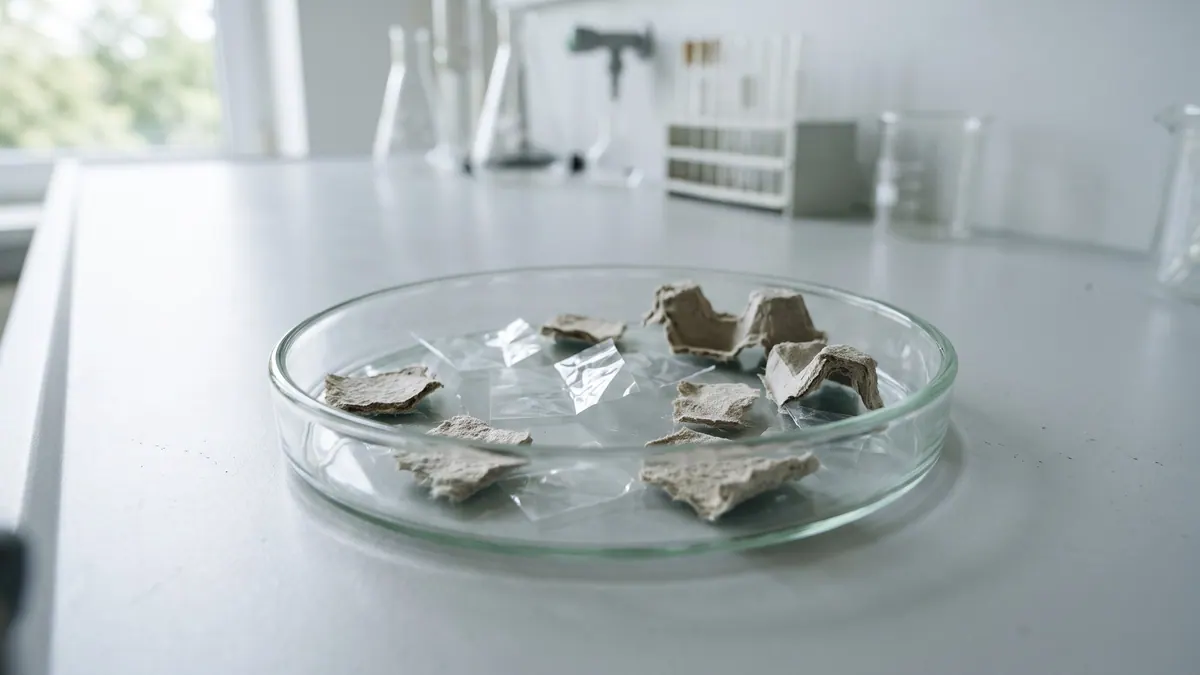
Photo Tek monde / Wikimedia Commons, licence CC BY-SA 4.0, source file; changes: cropping

- Weighted mean
- 119m³ CH₄/t VS
- Range
- 36–205m³ CH₄/t VS
- Records
- 8studies
- Publications
- 2sources
- Temperatures
- 35 °C, 37 °C, 55 °Cof the test
Methane in biogas
Medium methane content · ≈ 5.2 kWh/m³ of biogas
estimate from the substrate type The collected studies contain no measurement. The interval follows from the approximate composition (carbohydrate-dominated (no protein or fat characteristics)) and the yields of compound groups according to FNR.
Rating for biogas plants
neutral — editorial rating for biogas plantsNo clear advantages — worth charging a fee for accepting it
Potential per tonne of fresh matter: moderate, but limited by the poor degradability of the organic matter (116 m³ CH₄/t); no particular threats to stability. Handling costs: physical contaminants (packaging, plastics), slow degradation.
Why? Rating factors
Potential per tonne +1
- +1potential 116 m³ CH₄/t fresh matter (BMP 119 × DM 98.8 % × VS 99.1 %); low degradability of VS (BMP 119 m³ CH₄/t VS) — points capped
Process stability 0
- 0no factors
Handling and costs −1.5
- −1physical contaminants (packaging, plastics) — depackaging and separation
- −0.5slow degradation — long retention time
Total points: −0.5 · thresholds: ≥ 2.5 very good, ≥ 1 good, below — neutral; negative with cumulative process risk.
Add to the co-digestion calculator CSV data
BMP curves from 8 studies
Weighted mean Individual records
Dashed lines are a model curve (first-order kinetics, B(t) = B₀·(1 − e−kt)); the end point comes from the publication. All curves are model curves.
Cumulative methane production over the test [m³ CH₄/t VS]. The thick line is the weighted mean of all records (119); dots mark the end values given in the publications. Point at the chart to read values; click a legend item to hide or show a record.
Records and sources
Download CSV| Source | BMP m³ CH₄/t VS | Temperature | Sample | Curve |
|---|---|---|---|---|
| Calabro’ et al. (2020) · 1 DOI | 42 | 35 °C · mesophilic | raw comp. bags | end point (model curve) |
| Calabro’ et al. (2020) · 2 DOI | 67 | 55 °C · thermophilic | Raw comp. bags | end point (model curve) |
| Calabro’ et al. (2020) · 3 DOI | 111 | 35 °C · mesophilic | Raw comp. bags | end point (model curve) |
| Calabro’ et al. (2020) · 4 DOI | 144 | 35 °C · mesophilic | raw comp. bags | end point (model curve) |
| Calabro’ et al. (2020) · 5 DOI | 152 | 35 °C · mesophilic | Raw comp. bags | end point (model curve) |
| Calabro’ et al. (2020) · 6 DOI | 186 | 55 °C · thermophilic | Raw comp. bags | end point (model curve) |
| Álvarez-Méndez et al. (2023) · 1 DOI | 36 | 37 °C · mesophilic | Fruit selection bag FB2 (PLA/PBAT bag) | end point (model curve) |
| Álvarez-Méndez et al. (2023) · 2 DOI | 205 | 37 °C · mesophilic | Trash bag TB1 (PLA/PBAT bag) | end point (model curve) |
| Weighted mean | 119 | arithmetic mean 118, SD 64 | ||
Typical composition
- Dry matter (DM)
- 98.8% (range 97.7–99.9)
- Volatile solids (VS)
- 99.1 % DM (range 98.7–99.5)
Median and range of the determinations reported in the publications behind this substrate's BMP records (read from: MY-D); dry matter: 2 determinations, volatile solids: 2 determinations. Samples were tested dried/air-dry – the DM refers to the material in the test, not to fresh material.
Sources: Calabro’ et al. (2020).
The composition of the raw material varies between batches — for plant calculations use an analysis of your own sample. The calculator inserts typical values automatically.
Process properties
Advantages
- Methane potential in the Substraty.pl BMP dataset: weighted mean 118.8 m³ CH₄/t VS (SD 64.5; 8 records, 2 sources).
- Thin film has a large contact surface.
Drawbacks and risks
- Commercial PBAT and PLA/PBAT bags degrade poorly anaerobically under mesophilic conditions, and none of those tested met EN 13432 in the anaerobic test (Álvarez-Méndez et al. 2023).
- Film can wrap around agitators.
Co-digestion — what to combine it with, what to watch out for
- combines well
substrates: high alkalinity (buffer) — e.g. Cattle manure, Pig slurry, Cattle slurry, Duck slurry, Rumen and digestive tract content
Dosing
No source-based threshold; treat as a contaminant and remove.
Introduce gradually, starting with a small dose and monitoring the process (e.g. FOS/TAC, pH, gas composition).
Practical requirements
- Shred: shredding increases the surface available for degradation and speeds it up, but does not necessarily raise the final gas yield (FNR 2010, Ch. 3 “Triturado”).
Sources of the process data
- Benn, Zitomer (2018). Pretreatment and anaerobic co-digestion of selected PHB and PLA bioplastics. Front. Environ. Sci.
- Alvarez-Mendez et al. (2023). Anaerobic digestion of commercial PLA and PBAT biodegradable plastic bags. Heliyon
- Narancic et al. (2018). Biodegradable plastic blends create new possibilities for end-of-life management of plastics but they are not a panacea for plastic pollution. Environ. Sci. Technol.
- FNR (2010). Guía sobre el Biogás – Desde la producción hasta el uso (hiszp. wydanie „Leitfaden Biogas”, GIZ 2013)
The co-digestion calculator will assess a specific mixture containing this substrate.
What it is and where it comes from
Compostable bags are used to collect biowaste in homes and catering outlets. They are made from blends of biodegradable polymers, usually starch with aliphatic polyesters, sometimes with PLA and fillers. In municipal biowaste they enter the installation together with the contents. Their share by mass is small, but they affect the operation of screens and separation systems.
Properties relevant to digestion
The starch part of the bag degrades relatively quickly, whereas aliphatic polyesters hydrolyse more slowly, especially at lower temperatures. A thin film has a large specific surface area, which favours contact with enzymes, but shreds of film may wrap around agitators and form layers. The dry matter of the bags often contains a significant inorganic fraction, so the result expressed per VS depends on the formulation. The bags do not bring in high concentrations of nitrogen or sulphur.
How to read the spread of results
The spread is typical of a multi-component material. The set contains tests under mesophilic and thermophilic conditions, with different numbers of replicates. The result is affected by the manufacturer and composition of the bag, film thickness, particle size (whole pieces or ground), test duration, inoculum activity and the way VS is calculated. Low values may mean that the test was too short for slowly degrading polyesters, and not that the bag is resistant to digestion.
In biogas plant practice
The bags usually reach installations as part of separately collected municipal waste. Shredding them, or removing them at the sorting plant if the installation uses mechanical preparation, is recommended. It should not be assumed that a bag will degrade fully in one mesophilic digestion cycle, and residues may end up in the digestate. Biowaste regulations and the installation's permits decide whether such bags may be accepted together with biowaste.
Operators note that in practice the problem is not so much the BMP result of the bags themselves as their mechanical behaviour: the formation of fibrous coils and the clogging of pumps and separators. For this reason the decision on accepting bags concerns the technological layout of the installation more than the methane potential.
Methodology in brief
BMP is the amount of methane obtained from volatile solids (VS) in a batch test, given in m³ CH₄ per tonne of VS (numerically the same as NmL CH₄/g VS in the publications) and converted to normal conditions (0 °C, 101.325 kPa). The weighted mean gives each publication a total weight of 1, split equally between its results for the substrate — a paper testing twenty varieties does not outweigh a paper with a single sample. In inter-laboratory programmes the unit is the laboratory (total weight 1), and within it the weight of a test grows with the number of bottles (replicates). Results after pretreatment (e.g. thermal, chemical, enzymatic) are shown separately and are not included in the mean.
Solid lines are curves measured in the tests. Where a publication gives only the final result, we draw a first-order kinetic model, B(t) = B₀·(1 − e−kt): only the end point comes from the publication, and the shape of the curve serves purely as visualisation — do not read the production on a particular day from it. For this substrate k = 0.091 d−1 was assumed (no kinetic data for the group – the median of all available rate constants k (93 values) was used).
The statistics describe the spread of published results — a descriptive compilation, not a meta-analysis or a guarantee of plant yield.
Bibliography
- Calabro’, P.; Folino, A.; Fazzino, F.; Komilis, D. (2020). Preliminary evaluation of the anaerobic biodegradability of three biobased materials used for the production of disposable plastics. Journal of Hazardous Materials 390, 121653. DOI: 10.1016/j.jhazmat.2019.121653 DOI
- Álvarez-Méndez, S.J.; Ramos-Suárez, J.L.; Ritter, A.; Mata González, J.; Camacho Pérez, Á. (2023). Anaerobic digestion of commercial PLA and PBAT biodegradable plastic bags: Potential biogas production and 1H NMR and ATR-FTIR assessed biodegradation. Heliyon 9(6), e16691. DOI: 10.1016/j.heliyon.2023.e16691 DOI
All sources of the site: bibliography.
Other substrates in the group “Bioplastics and compostable packaging”
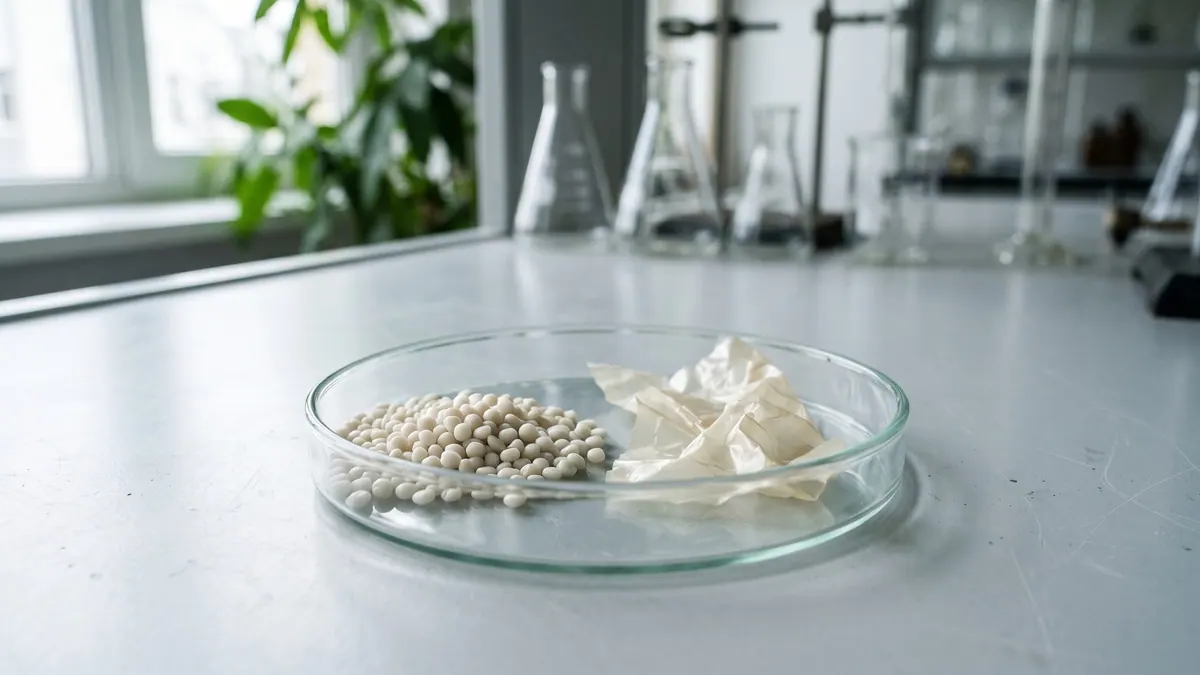
PHA (polyhydroxyalkanoates) — BMP: 3 studies, weighted mean 341 m³ CH₄/t VS
341 m³ CH₄/t VS weighted mean from 3 studies
≈52 %
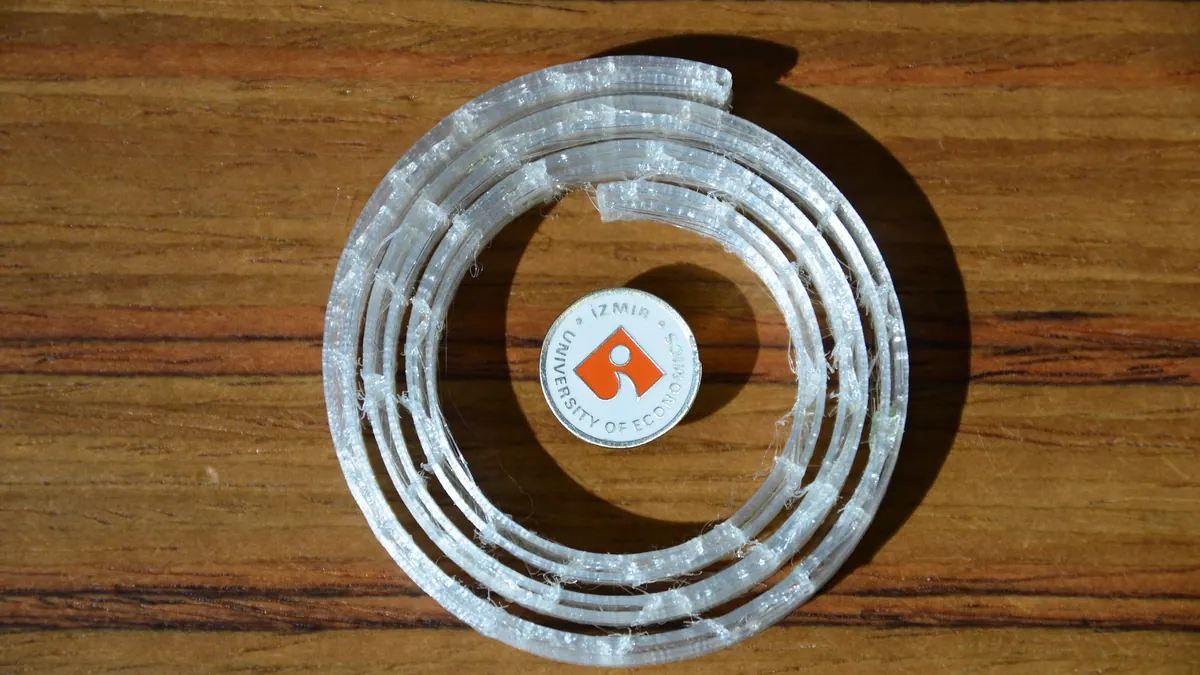
PLA (polylactic acid) — BMP: 8 studies, weighted mean 127 m³ CH₄/t VS
127 m³ CH₄/t VS weighted mean from 8 studies
neutral — editorial rating for biogas plants≈51 %
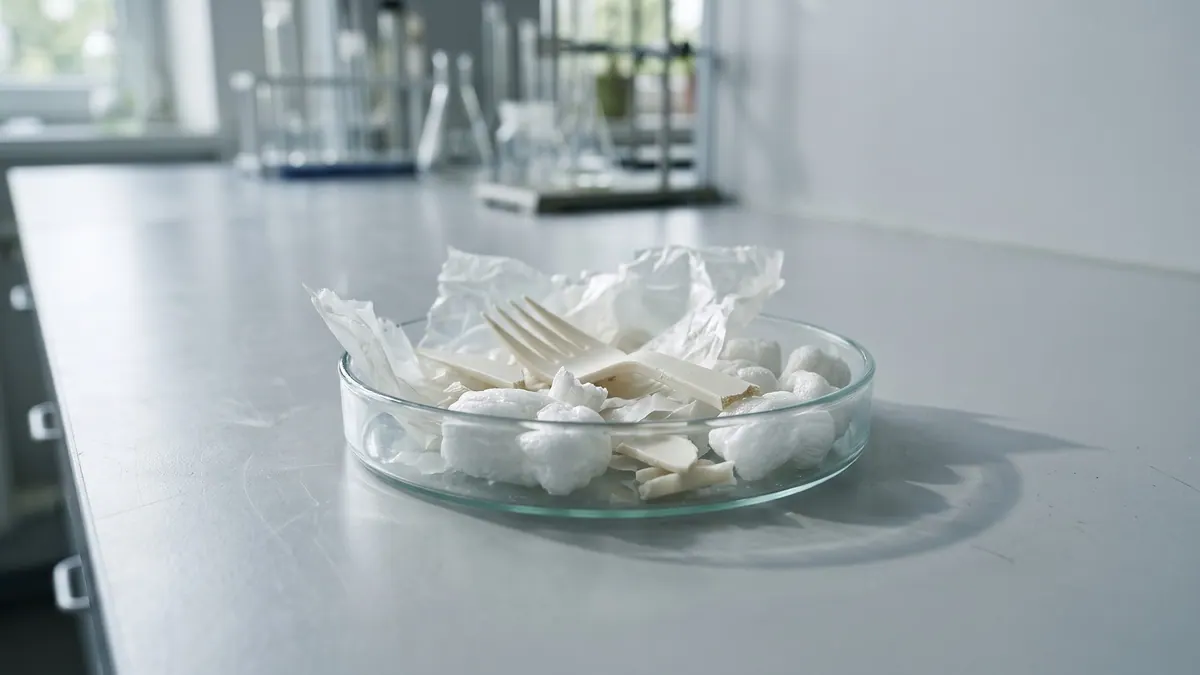
Starch-based bioplastics — BMP: 10 studies, weighted mean 266 m³ CH₄/t VS
266 m³ CH₄/t VS weighted mean from 10 studies
good — editorial rating for biogas plants≈52 %
Cellulose-based films and packaging — BMP: 10 studies, weighted mean 355 m³ CH₄/t VS
355 m³ CH₄/t VS weighted mean from 10 studies
good — editorial rating for biogas plants≈51 %