

BMP testingBioplastics and compostable packaging
PHA (polyhydroxyalkanoates) — BMP: 3 studies, weighted mean 341 m³ CH₄/t VS
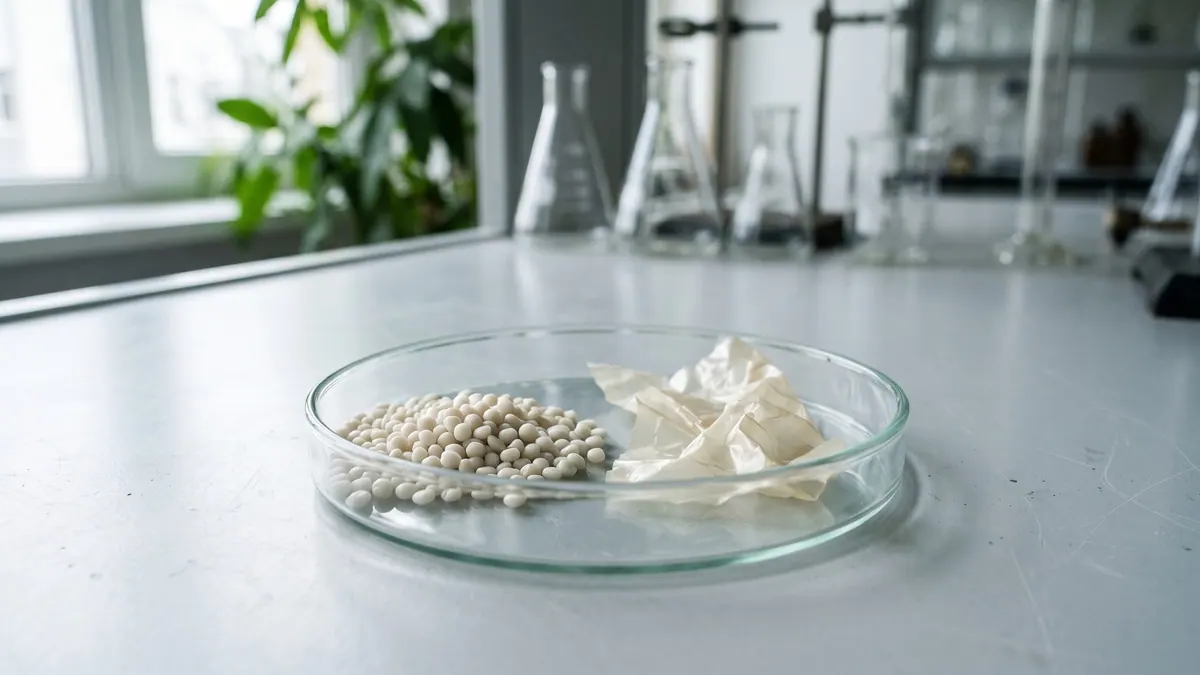
PHA (PHB, PHBV, PHBH) are polyesters produced by bacteria, counted among the biopolymers most amenable to anaerobic degradation, although they have been studied in only a few studies.
Illustration: FeedstockData (AI, Google Gemini)
- Weighted mean
- 341m³ CH₄/t VS
- Range
- 271–484m³ CH₄/t VS
- Records
- 3studies
- Publications
- 2sources
- Temperatures
- 35 °C, 38 °Cof the test
Methane in biogas
Medium methane content · ≈ 5.2 kWh/m³ of biogas
estimate from the substrate type The collected studies contain no measurement. The interval follows from the approximate composition (carbohydrate-dominated (no protein or fat characteristics)) and the yields of compound groups according to FNR.
Rating for biogas plants
not rated — editorial rating for biogas plants
Not rated: no dry matter or volatile solids in the data. We calculate the rating when the dry matter and volatile solids of the material are known.
Add to the co-digestion calculator CSV data
BMP curves from 3 studies
Weighted mean Individual records
Dashed lines are a model curve (first-order kinetics, B(t) = B₀·(1 − e−kt)); the end point comes from the publication. All curves are model curves.
Cumulative methane production over the test [m³ CH₄/t VS]. The thick line is the weighted mean of all records (341); dots mark the end values given in the publications. Point at the chart to read values; click a legend item to hide or show a record.
Records and sources
Download CSV| Source | BMP m³ CH₄/t VS | Temperature | Sample | Curve |
|---|---|---|---|---|
| Wang et al. (2018) · 1 DOI | 338 | 38 °C · mesophilic | PHA-F | end point (model curve) |
| Wang et al. (2018) · 2 DOI | 484 | 38 °C · mesophilic | PHA-S | end point (model curve) |
| Nachod et al. (2021) DOI | 271 | 35 °C · mesophilic | PHBV pellets without food waste (PHBV-35) | end point (model curve) |
| Weighted mean | 341 | arithmetic mean 364, SD 109 | ||
Process properties
Advantages
- Methane potential in the Substraty.pl BMP dataset: weighted mean 340.8 m³ CH₄/t VS (SD 108.9; 3 records, 2 sources).
- Most of the bioplastics tested and their blends degraded thermophilically with a high biogas yield (Narancic et al. 2018).
Drawbacks and risks
- Degradation times 3-6 times longer than the retention time in commercial plants (Narancic et al. 2018).
- Results depend on the composition and shape of the product (Benn and Zitomer 2018).
Co-digestion — what to combine it with, what to watch out for
- combines well
substrates: high alkalinity (buffer) — e.g. Cattle manure, Pig slurry, Cattle slurry, Duck slurry, Rumen and digestive tract content
Dosing
No source threshold.
Introduce gradually, starting with a small dose and monitoring the process (e.g. FOS/TAC, pH, gas composition).
Practical requirements
- Shred: shredding increases the surface available for degradation and speeds it up, but does not necessarily raise the final gas yield (FNR 2010, Ch. 3 “Triturado”).
Sources of the process data
- Benn, Zitomer (2018). Pretreatment and anaerobic co-digestion of selected PHB and PLA bioplastics. Front. Environ. Sci.
- Narancic et al. (2018). Biodegradable plastic blends create new possibilities for end-of-life management of plastics but they are not a panacea for plastic pollution. Environ. Sci. Technol.
- FNR (2010). Guía sobre el Biogás – Desde la producción hasta el uso (hiszp. wydanie „Leitfaden Biogas”, GIZ 2013)
The co-digestion calculator will assess a specific mixture containing this substrate.
What it is and where it comes from
Polyhydroxyalkanoates (PHA) are a family of polyesters synthesised by bacteria, which store them as a reserve material. The best known are polyhydroxybutyrate (PHB), the PHBV copolymer and PHBH. They are produced by fermentation of sugars, oils or organic waste and are used, among other things, for packaging and disposable products. They occur in the waste stream only sporadically, because production is still small compared with other plastics.
Properties relevant to digestion
PHA is degraded enzymatically by depolymerases produced by microorganisms, including anaerobic ones. The products of hydrolysis are hydroxybutyric and hydroxyvaleric acids, which in subsequent stages are converted into acetate, hydrogen and methane. Because PHA is a polyester without nitrogen and sulphur, neither ammonia nor hydrogen sulphide is a risk. The rate of degradation depends on the composition (the share of the valerate unit lowers crystallinity), molecular weight, thickness of the product and additives. Under anaerobic conditions PHA usually degrades better than PLA, but dense and crystalline products may hydrolyse slowly.
How to read the spread of results
The dataset covers several records from several publications, in different forms: PHA samples designated by letters and PHBV pellets. Differences result from the type of copolymer, the shape of the sample (pellets, film, powder), the test time and the activity of the inoculum. It is also important whether the test was run with the addition of another substrate and how the result was converted to VS. With so few records the spread is not a good measure of uncertainty, and individual values may deviate significantly from representative ones.
In biogas plant practice
PHA is not a standard raw material. If it reaches a plant, it is more likely in a mixture with other compostable packaging than on its own. Before digestion size reduction is advisable, as it increases the surface available to enzymes. Because of the possibly slower hydrolysis of thick products, an adequate retention time must be ensured. Legal requirements arise from the classification of the packaging waste and the plant's permits; the material has no specific regulations of its own in the context of digestion.
It is worth remembering that real PHA products often contain additives: fillers, plasticisers and nucleating agents. These affect crystallinity, and hence the rate of hydrolysis, so the result for the pure polymer does not always carry over to a finished package.
Methodology in brief
BMP is the amount of methane obtained from volatile solids (VS) in a batch test, given in m³ CH₄ per tonne of VS (numerically the same as NmL CH₄/g VS in the publications) and converted to normal conditions (0 °C, 101.325 kPa). The weighted mean gives each publication a total weight of 1, split equally between its results for the substrate — a paper testing twenty varieties does not outweigh a paper with a single sample. In inter-laboratory programmes the unit is the laboratory (total weight 1), and within it the weight of a test grows with the number of bottles (replicates). Results after pretreatment (e.g. thermal, chemical, enzymatic) are shown separately and are not included in the mean.
Solid lines are curves measured in the tests. Where a publication gives only the final result, we draw a first-order kinetic model, B(t) = B₀·(1 − e−kt): only the end point comes from the publication, and the shape of the curve serves purely as visualisation — do not read the production on a particular day from it. For this substrate k = 0.091 d−1 was assumed (no kinetic data for the group – the median of all available rate constants k (93 values) was used).
The statistics describe the spread of published results — a descriptive compilation, not a meta-analysis or a guarantee of plant yield.
Bibliography
- Wang, S.; Lydon, K.A.; White, E.M.; Grubbs, J.B.; Lipp, E.K.; Locklin, J.; Jambeck, J.R. (2018). Biodegradation of Poly(3-hydroxybutyrate-co-3-hydroxyhexanoate) Plastic under Anaerobic Sludge and Aerobic Seawater Conditions: Gas Evolution and Microbial Diversity. Environmental Science & Technology 52(10), 5700–5709. DOI: 10.1021/acs.est.7b06688 DOI
- Nachod, B.; Keller, E.; Hassanein, A.; Lansing, S. (2021). Assessment of Petroleum-Based Plastic and Bioplastics Degradation Using Anaerobic Digestion. Sustainability 13(23), 13295. DOI: 10.3390/su132313295 DOI
All sources of the site: bibliography.
Other substrates in the group “Bioplastics and compostable packaging”
PLA (polylactic acid) — BMP: 8 studies, weighted mean 127 m³ CH₄/t VS
127 m³ CH₄/t VS weighted mean from 8 studies
neutral — editorial rating for biogas plants≈51 %
Compostable coffee capsules — BMP: 6 studies, weighted mean 201 m³ CH₄/t VS
201 m³ CH₄/t VS weighted mean from 6 studies
≈52 %
Cellulose-based films and packaging — BMP: 10 studies, weighted mean 355 m³ CH₄/t VS
355 m³ CH₄/t VS weighted mean from 10 studies
good — editorial rating for biogas plants≈51 %
Compostable bags — BMP: 8 studies, weighted mean 119 m³ CH₄/t VS
119 m³ CH₄/t VS weighted mean from 8 studies
neutral — editorial rating for biogas plants≈52 %