

BMP testingAnimal excreta (slurry, manure, poultry litter)
Pig slurry — BMP: 15 studies, weighted mean 260 m³ CH₄/t VS
Pig slurry has low dry matter and a lot of ammonium nitrogen; its methane potential is moderate and depends strongly on the feed and storage.
rating: very goodCH₄ ≈ 55 % (estimate)
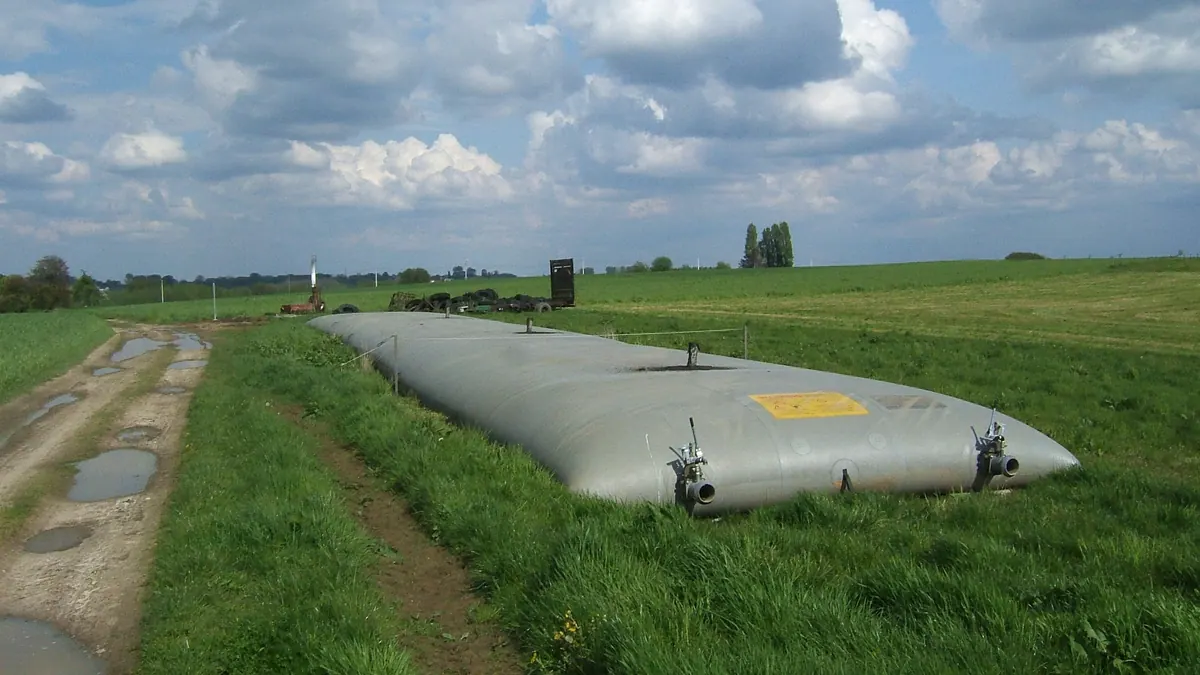
Photo Peter Van den Bossche / Wikimedia Commons, licence CC BY-SA 2.0, source file; changes: cropping

- Weighted mean
- 260m³ CH₄/t VS
- Range
- 38–516m³ CH₄/t VS
- Records
- 15studies
- Publications
- 7sources
- Temperatures
- 30 °C, 35 °C, 36 °C, 37 °Cof the test
Methane in biogas
Medium methane content · ≈ 5.5 kWh/m³ of biogas
estimate from the substrate type The collected studies contain no measurement. The interval follows from the approximate composition (protein from total nitrogen (N 2.8 % DM × 6.25; in manure part of the N is ammonium nitrogen)) and the yields of compound groups according to FNR.
Rating for biogas plants
very good — editorial rating for biogas plantsWorth accepting even for free or with a payment to the supplier
Potential per tonne of fresh matter: low (13 m³ CH₄/t); process risk: protein / nitrogen, inhibitors, sulphur. No additional handling requirements.
editorial correction algorithm result: neutral; Role of diluent and base buffer of the feed (operating practice of a biogas plant operator): slurry is a very good base for the feed and a diluent, provided it contains no residues of antibiotics or chemicals (disinfection, detergents). The algorithm rates it low because it counts only the potential per tonne of fresh matter.
Why? Rating factors
Potential per tonne 0
- ±0potential 13 m³ CH₄/t fresh matter (BMP 260 × DM 6.5 % × VS 74 %)
Process stability −0.25
- −1protein / nitrogen: risk of ammonia inhibition at higher shares
- −0.5inhibitors: natural or residues (e.g. limonene, polyphenols, antibiotics, metals)
- −0.25sulphur: H₂S in the biogas (toxicity to bacteria, corrosion, desulphurisation)
- +1.5high alkalinity — stabilises the pH of the mixture
Handling and costs 0
- 0no factors
Total points: −0.25 · thresholds: ≥ 2.5 very good, ≥ 1 good, below — neutral; negative with cumulative process risk.
Add to the co-digestion calculator CSV data
BMP curves from 15 studies
Weighted mean Individual records
Dashed lines are a model curve (first-order kinetics, B(t) = B₀·(1 − e−kt)); the end point comes from the publication. All curves are model curves.
Cumulative methane production over the test [m³ CH₄/t VS]. The thick line is the weighted mean of all records (260); dots mark the end values given in the publications. Point at the chart to read values; click a legend item to hide or show a record.
Show the remaining records in the legend (3)
Records and sources
Download CSV| Source | BMP m³ CH₄/t VS | Temperature | Sample | Curve |
|---|---|---|---|---|
| Browne et al. (2013) · 1 DOI | 38 | 37 °C · mesophilic | pig slurry · pretreatment: particle size reduction/sample preparation (MY-D: physical treatment) | end point (model curve) |
| Browne et al. (2013) · 2 DOI | 70 | 37 °C · mesophilic | pig slurry · pretreatment: particle size reduction/sample preparation (MY-D: physical treatment) | end point (model curve) |
| Kouas et al. (2017) DOI | 106 | 35 °C · mesophilic | manure | end point (model curve) |
| Luna-delRisco et al. (2011) | 317 | 36 °C · mesophilic | pig slurry | end point (model curve) |
| Nogueira et al. (2026) DOI | 438 | — | Pig slurry (PS), mono-digestion | end point (model curve) |
| Renggaman et al. (2021) · 1 DOI | 310 | — | Swine slurry (SS), S/I 1 | end point (model curve) |
| Renggaman et al. (2021) · 2 DOI | 516 | — | Swine slurry (SS), S/I 0.5 | end point (model curve) |
| Vedrenne et al. (2008) · 1 DOI | 255 | 30 °C · mesophilic | pig slurry | end point (model curve) |
| Vedrenne et al. (2008) · 2 DOI | 265 | 30 °C · mesophilic | pig slurry | end point (model curve) |
| Vedrenne et al. (2008) · 3 DOI | 270 | 30 °C · mesophilic | pig slurry | end point (model curve) |
| Vedrenne et al. (2008) · 4 DOI | 275 | 30 °C · mesophilic | pig slurry | end point (model curve) |
| Vedrenne et al. (2008) · 5 DOI | 280 | 30 °C · mesophilic | pig slurry | end point (model curve) |
| Vedrenne et al. (2008) · 6 DOI | 314 | 30 °C · mesophilic | pig slurry | end point (model curve) |
| Vedrenne et al. (2008) · 7 DOI | 330 | 30 °C · mesophilic | pig slurry | end point (model curve) |
| Pham et al. (2013) DOI | 208 | 35 °C · mesophilic | Pig manure (VDI 4630) | end point (model curve) |
| Weighted mean | 260 | arithmetic mean 266, SD 126 | ||
Typical composition
- Dry matter (DM)
- 6.5% (range 4.7–7)
- Volatile solids (VS)
- 74 % DM (range 70–74.9)
- Nitrogen
- 2.8 % DM
- C/N ratio
- 14.2
Median and range of the determinations reported in the publications behind this substrate's BMP records (read from: MY-D); dry matter: 3 determinations, volatile solids: 3 determinations. C/N was calculated as the ratio of C and N content (% DM) from the same source.
Sources: Browne et al. (2013); Luna-delRisco et al. (2011).
The composition of the raw material varies between batches — for plant calculations use an analysis of your own sample. The calculator inserts typical values automatically.
Process properties
Advantages
- Methane potential in the Substraty.pl BMP set: weighted mean 260.0 m³ CH₄/t VS (SD 126.2; 15 records, 7 sources).
- Supplies alkalinity and ammonium N, co-digests stably with glycerol (Astals et al. 2012, 2013) and DAF (Creamer et al. 2010).
- Addition of glycerol to pig slurry increased biogas production mainly through an increase in loading and an improved C/N (Astals et al. 2012).
- from practice slurry, both pig and cattle, is a very good diluent and base for the feed, provided it is free of residues of antibiotics and chemicals (disinfection, detergents); biogas from pig slurry has over 60% methane in both varieties described below.
- from practice after long storage the solid fraction is sometimes separated from the liquid; it then has over 22% DM and a yield of over 90 m³ of biogas/t of fresh matter (operating data, not a BMP mean).
Drawbacks and risks
- High N-NH4: ammonia inhibition at large shares and at thermophilic temperature (Hansen et al. 1998; Angelidaki and Ahring 1993).
- from practice slurry from farrowing houses and from sows is low in calorific value: DM at most about 5%, which gives no more than about 30 m³ of biogas/m³ of fresh matter; slurry from fattening houses (a different form of feed) has up to about 9% DM and up to about 48 m³ of biogas/m³ (operating data, not a result of BMP tests).
- from practice the "inhibitors" tag for pig slurry concerns residues of antibiotics, drugs and chemicals (disinfection, detergents) in the slurry, not the slurry itself; without such residues it is good for digestion.
Co-digestion — what to combine it with, what to watch out for
- combines well
Glycerol refining residues (MONG, distillation residue)
Carbon from glycerol balances the C/N of slurry; the improvement in yield is described for crude glycerol.[1][2]
- caution
substrates: protein-rich — e.g. Food waste, Municipal sewage sludge (mixed), Poultry manure, Organic fraction of municipal solid waste, Grass clippings
Dosing
No general limit. As a base for glycerol: in mesophilic studies 4% glycerol (FM) in a mixture with slurry and 3% w/w thermophilically (Astals et al. 2012, 2013). From practice: at low DM (about 5-9%) slurry acts as a diluent of the feed, not as a source of energy; before accepting a batch it is worth confirming with the supplier the absence of antibiotics and chemicals.
Practical requirements
- ABP cat. 2 (Art. 9 of Reg. 1069/2009): manure, slurry and digestive tract content may be digested without prior sterilisation if the authority does not recognise a risk of spreading a serious transmissible disease (Art. 13(e)(ii)); in that case a minimum of 70 °C for a minimum of 60 min applies (Reg. 142/2011, Annex V Ch. III Section 1), and where they are the only material of animal origin in the installation, the authority may approve other requirements (Section 2 point 3).
- from practice before accepting slurry, establish with the supplier whether antibiotics or chemicals (disinfection, detergents) were used on the farm; it is these, not the slurry itself, that can inhibit digestion.
- from practice with long storage the solid fraction separates from the liquid: account for it and dose it separately (over 22% DM, over 90 m³ of biogas/t of fresh matter), and when mixing the tank remember the difference in density.
Items marked “from practice” are biogas plant operator experience (operating data), not BMP study results — they are not part of the BMP mean or its statistics.
Sources of the process data
- Astals et al. (2012). Anaerobic co-digestion of pig manure and crude glycerol at mesophilic conditions. Bioresour. Technol.
- Astals et al. (2013). Thermophilic co-digestion of pig manure and crude glycerol: process performance and digestate quality. J. Biotechnol.
- Hansen, Angelidaki, Ahring (1998). Anaerobic digestion of swine manure: inhibition by ammonia. Water Res.
- A critical review on inhibition of anaerobic digestion process by excess ammonia
- Angelidaki, Ahring (1993). Thermophilic anaerobic digestion of livestock waste: the effect of ammonia. Appl. Microbiol. Biotechnol.
- Creamer et al. (2010). Stable thermophilic anaerobic digestion of dissolved air flotation (DAF) sludge by co-digestion with swine manure. Bioresour. Technol.
- Chen, Cheng, Creamer (2008). Inhibition of anaerobic digestion process: A review. Bioresour. Technol.
- Rozporządzenie (WE) nr 1069/2009 określające przepisy sanitarne dotyczące produktów ubocznych pochodzenia zwierzęcego (art. 9, 10, 12–14, 24)
- Rozporządzenie Komisji (UE) nr 142/2011 wykonujące rozporządzenie (WE) nr 1069/2009 (zał. IV rozdz. III, zał. V rozdz. I i III)
- Praktyka eksploatacyjna — redakcja Substraty.pl (2026): doświadczenie operatora biogazowni (dane eksploatacyjne, nie wynik badań BMP; bez adresu publikacji)
The co-digestion calculator will assess a specific mixture containing this substrate.
What it is and where it comes from
Pig slurry is a mixture of faeces, urine and water from unbedded pig houses. Poland has extensive pig production, so the raw material is available in many regions, although the size of herds and their concentration have changed in recent years. The dataset contains records from several countries and systems, including a sample of excreta with 4% dry matter, classified as slurry, and variants with different substrate-to-inoculum ratios.
Properties relevant to digestion
The dry matter of pig slurry is low, and the organic material consists of undigested feed components, bacteria and sloughed epithelium. The nitrogen content is high, mainly in ammonium form, so the buffering capacity is large, but there is a risk of ammonia inhibition at higher doses and under thermophilic conditions. Feed additives such as copper and zinc, and residues of antibiotics, may in some farms affect the microflora. The slurry also contains sulphur, which translates into hydrogen sulphide in the biogas.
How to read the spread of results
The spread of results in the dataset is very large. It results from differences in feed and feeding strategy, the age of the animals (piglets, fatteners, sows), dilution with water, storage time and conditions, and the methods used: temperature, inoculum, the substrate-to-inoculum ratio and test length. Slurry stored for a long time in a tank emits methane earlier and loses part of its potential. In addition, some records come from experiments in which slurry was added to other materials or tested at different S/I ratios, which widens the range.
In biogas plant practice
Pig slurry is a commonly used co-substrate in agricultural biogas plants, usually in a mixture with carbohydrate-rich materials, which balances the nitrogen. It is worth monitoring ammonium nitrogen, pH and hydrogen sulphide. The raw material should be sent for digestion as quickly as possible in order to limit emissions from tanks. As a natural fertiliser it is subject to the fertilisation regulations, and in the context of ABP it is a Category 2 material and may be used in a biogas plant under the conditions set out in EU and national regulations.
For comparison with cattle slurry, pig slurry degrades more readily, but at the cost of a higher nitrogen-related risk. In practice it is therefore often used in smaller doses or diluted.
Methodology in brief
BMP is the amount of methane obtained from volatile solids (VS) in a batch test, given in m³ CH₄ per tonne of VS (numerically the same as NmL CH₄/g VS in the publications) and converted to normal conditions (0 °C, 101.325 kPa). The weighted mean gives each publication a total weight of 1, split equally between its results for the substrate — a paper testing twenty varieties does not outweigh a paper with a single sample. In inter-laboratory programmes the unit is the laboratory (total weight 1), and within it the weight of a test grows with the number of bottles (replicates). Results after pretreatment (e.g. thermal, chemical, enzymatic) are shown separately and are not included in the mean.
Solid lines are curves measured in the tests. Where a publication gives only the final result, we draw a first-order kinetic model, B(t) = B₀·(1 − e−kt): only the end point comes from the publication, and the shape of the curve serves purely as visualisation — do not read the production on a particular day from it. For this substrate k = 0.393 d−1 was assumed (median of rate constants k reported in the sources and/or fitted to the mean measured curves).
The statistics describe the spread of published results — a descriptive compilation, not a meta-analysis or a guarantee of plant yield.
Bibliography
- Browne, J.D.; Allen, E.; Murphy, J.D. (2013). Evaluation of the biomethane potential from multiple waste streams for a proposed community scale anaerobic digester. Environmental Technology 34(13-14), 2027–2038. DOI: 10.1080/09593330.2013.812669 DOI
- Kouas, M.; Torrijos, M.; Sousbie, P.; Steyer, J.P.; Sayadi, S.; Harmand, J. (2017). Robust assessment of both biochemical methane potential and degradation kinetics of solid residues in successive batches. Waste Management 70, 59–70. DOI: 10.1016/j.wasman.2017.09.001 DOI
- Luna-delRisco, M.; Normak, A.; Orupõld, K. (2011). Biochemical methane potential of different organic wastes and energy crops from Estonia. Agronomy Research 9(1–2), 331–342. https://www.semanticscholar.org/paper/25cf2d7bba4758136830a9a02caf3ecd997173bb source
- Nogueira, M.; Popich, M.R.; Sousa, C.C.; Fragoso, R. (2026). Anaerobic Co-Digestion of Gerbera Flower Residues, Non-Marketable Apples and Pig Slurry: Biochemical Methane Potential, Synergistic Effects and Kinetic Modelling. Energies 19(17), 3946. DOI: 10.3390/en19173946 DOI
- Renggaman, A.; Choi, H.L.; Sudiarto, S.I.A.; Febrisiantosa, A.; Ahn, D.H.; Choung, Y.W.; Suresh, A. (2021). Biochemical Methane Potential of Swine Slaughter Waste, Swine Slurry, and Its Codigestion Effect. Energies 14(21), 7103. DOI: 10.3390/en14217103 DOI
- Vedrenne, F.; Béline, F.; Dabert, P.; Bernet, N. (2008). The effect of incubation conditions on the laboratory measurement of the methane producing capacity of livestock wastes. Bioresource Technology 99(1), 146–155. DOI: 10.1016/j.biortech.2006.11.043 DOI
- Pham, C.H.; Triolo, J.M.; Cu, T.T.T.; Pedersen, L.; Sommer, S.G. (2013). Validation and Recommendation of Methods to Measure Biogas Production Potential of Animal Manure. Asian-Australasian Journal of Animal Sciences 26(6), 864–873. DOI: 10.5713/ajas.2012.12623 DOI
All sources of the site: bibliography.
Other substrates in the group “Animal excreta (slurry, manure, poultry litter)”
Horse manure — BMP: 36 studies, weighted mean 156 m³ CH₄/t VS
156 m³ CH₄/t VS weighted mean from 36 studies
neutral — editorial rating for biogas plants≈52 %

Duck slurry — BMP: 6 studies, weighted mean 395 m³ CH₄/t VS
395 m³ CH₄/t VS weighted mean from 6 studies
neutral — editorial rating for biogas plants≈55 %
Pig manure (solid) — BMP: 5 studies, weighted mean 293 m³ CH₄/t VS
293 m³ CH₄/t VS weighted mean from 5 studies
good — editorial rating for biogas plants≈54 %
Cattle slurry — BMP: 14 studies, weighted mean 236 m³ CH₄/t VS
236 m³ CH₄/t VS weighted mean from 14 studies
very good — editorial rating for biogas plants≈54 %