

BMP testingMunicipal and green waste, paper and textiles
Grass clippings — BMP: 13 studies, weighted mean 272 m³ CH₄/t VS
Mown lawn grass is a green waste with good digestibility, but highly seasonal and quick to lose quality after cutting.
rating: neutralCH₄ ≈ 52 % (estimate)
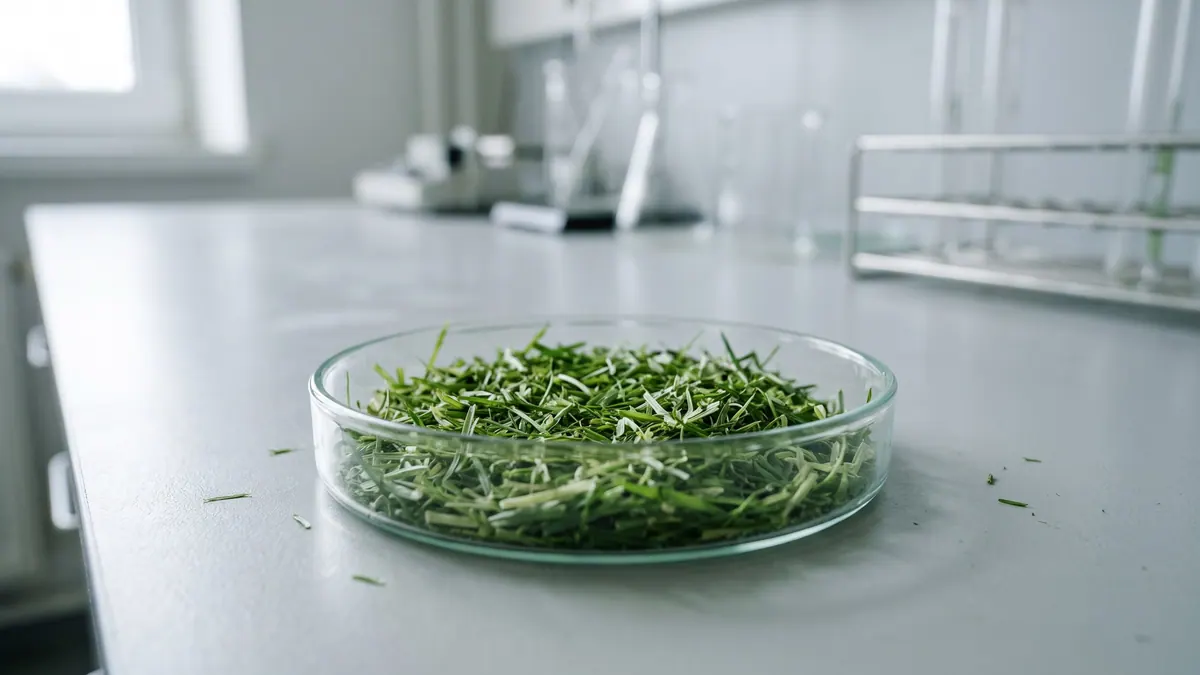
Illustration: FeedstockData (AI, Google Gemini)
- Weighted mean
- 272m³ CH₄/t VS
- Range
- 199–340m³ CH₄/t VS
- Records
- 13studies
- Publications
- 7sources
- Temperatures
- 35 °Cof the test
Methane in biogas
Low methane content · ≈ 5.2 kWh/m³ of biogas
estimate from the substrate type The collected studies contain no measurement. The interval follows from the approximate composition (protein from total nitrogen (N 0.7 % DM × 6.25)) and the yields of compound groups according to FNR.
Rating for biogas plants
neutral — editorial rating for biogas plantsNo clear advantages — worth charging a fee for accepting it
Potential per tonne of fresh matter: high (51 m³ CH₄/t); process risk: protein / nitrogen. Handling costs: fibres, floating layer.
Why? Rating factors
Potential per tonne +2
- +2potential 51 m³ CH₄/t fresh matter (BMP 272 × DM 21.5 % × VS 88.1 %)
Process stability −1
- −1protein / nitrogen: risk of ammonia inhibition at higher shares
Handling and costs −0.5
- −0.5fibres, floating layer — shredding and intensive mixing
Total points: 0.5 · thresholds: ≥ 2.5 very good, ≥ 1 good, below — neutral; negative with cumulative process risk.
Add to the co-digestion calculator CSV data
BMP curves from 13 studies
Weighted mean Individual records
Dashed lines are a model curve (first-order kinetics, B(t) = B₀·(1 − e−kt)); the end point comes from the publication. All curves are model curves.
Cumulative methane production over the test [m³ CH₄/t VS]. The thick line is the weighted mean of all records (272); dots mark the end values given in the publications. Point at the chart to read values; click a legend item to hide or show a record.
Show the remaining records in the legend (1)
Records and sources
Download CSV| Source | BMP m³ CH₄/t VS | Temperature | Sample | Curve |
|---|---|---|---|---|
| Lehtomaki (2006) | 300 | 35 °C · mesophilic | Lawn | end point (model curve) |
| Chynoweth et al. (1993) · 1 DOI | 247 | 35 °C · mesophilic | Turf grass | end point (model curve) |
| Chynoweth et al. (1993) · 2 DOI | 332 | 35 °C · mesophilic | Turf grass | end point (model curve) |
| Nallathambi Gunaseelan (1997) DOI | 209 | 35 °C · mesophilic | grass from municipal waste (cuttings) (orig.: “Grass”): value quoted in a literature review | end point (model curve) |
| Kouas et al. (2017) DOI | 243 | 35 °C · mesophilic | grass cuttings | end point (model curve) |
| Nitsche et al. (2017) · 1 DOI | 221 | — | Silage from urban roadside verges | end point (model curve) |
| Nitsche et al. (2017) · 2 DOI | 292 | — | Silage from sports fields grass cuttings | end point (model curve) |
| Antonopoulou et al. (2020) DOI | 340 | 35 °C · mesophilic | Untreated GL (grass lawn waste) | end point (model curve) |
| Prabhudessai et al. (2013) · 1 DOI | 199 | — | Grass from lawn cuttings | end point (model curve) |
| Prabhudessai et al. (2013) · 2 DOI | 250 | — | Grass from lawn cuttings | end point (model curve) |
| Prabhudessai et al. (2013) · 3 DOI | 256 | — | Grass from lawn cuttings | end point (model curve) |
| Prabhudessai et al. (2013) · 4 DOI | 284 | — | Grass from lawn cuttings | end point (model curve) |
| Prabhudessai et al. (2013) · 5 DOI | 332 | — | Grass from lawn cuttings | end point (model curve) |
| Weighted mean | 272 | arithmetic mean 270, SD 48 | ||
Typical composition
- Dry matter (DM)
- 21.5% (range 21.5–21.5)
- Volatile solids (VS)
- 88.1 % DM (range 88.1–88.1)
- Nitrogen
- 0.7 % DM
- C/N ratio
- 71
Median and range of the determinations reported in the publications behind this substrate's BMP records (read from: CROPGEN D4, MY-D); dry matter: 1 determination, volatile solids: 1 determination. DM from a single determination – indicative value.
Sources: Lehtomaki (2006); Nallathambi Gunaseelan (1997).
The composition of the raw material varies between batches — for plant calculations use an analysis of your own sample. The calculator inserts typical values automatically.
Process properties
Low confidence: the description is based on general characteristics of the substrate group, not on studies of this material. Treat it as a hint to be verified.
Advantages
- Methane potential in the Substraty.pl BMP dataset: weighted mean 271.7 m³ CH₄/t VS (SD 47.6; 13 records, 7 sources).
- Young grass has lower lignin and degrades quickly (Weiland 2010).
Drawbacks and risks
- Protein -> ammonia at high doses (Rajagopal et al. 2013).
Co-digestion — what to combine it with, what to watch out for
- combines well
substrates: high alkalinity (buffer) — e.g. Cattle manure, Pig slurry, Cattle slurry, Duck slurry, Rumen and digestive tract content
Dosing
No source threshold.
Introduce gradually, starting with a small dose and monitoring the process (e.g. FOS/TAC, pH, gas composition).
Practical requirements
- Ensiling makes it possible to store seasonal biomass; properly ensiled plants (in the study maize, sorghum, forage rye, triticale) can be stored for up to a year without loss of methane production (Herrmann et al. 2011).
Sources of the process data
- Hagos et al. (2017). Anaerobic co-digestion process for biogas production: progress, challenges and perspectives. Renew. Sustain. Energy Rev.
- Weiland (2010). Biogas production: current state and perspectives. Appl. Microbiol. Biotechnol.
- Rajagopal, Masse, Singh (2013). A critical review on inhibition of anaerobic digestion process by excess ammonia. Bioresour. Technol.
- Herrmann et al. (2011). Effects of ensiling, silage additives and storage period on methane formation of biogas crops. Bioresour. Technol.
The co-digestion calculator will assess a specific mixture containing this substrate.
What it is and where it comes from
Mown lawn grass is the cut from parks, squares, sports pitches, roadside verges and gardens, collected regularly during the growing season. For towns and municipalities it is a large stream of green waste. The dataset contains samples of turf, grass from municipal waste (a value from a review), lawn cuttings and silage from the cut of urban roadside verges. Cuttings from road verges are sometimes contaminated with litter and sand.
Properties relevant to digestion
Frequent mowing yields young, green biomass with a lower lignin content than grass from meadows cut at full maturity, rich in protein and soluble sugars. As a result, degradation is rapid and the methane potential relatively high among green wastes. However, the high protein content means ammonia release at larger doses. The cut contains a lot of water, and after mowing it quickly heats up, which causes losses of readily available components. Ensiling allows the shelf life of the material to be extended. Foreign contaminants require screening out.
How to read the spread of results
The spread results from the grass species and their mixtures, the frequency of mowing (a younger cut degrades better), the time of year, fertilisation, moisture content, the form of preservation (fresh, ensiled) and the time between mowing and the test. To this are added methodological differences: chopping, temperature, inoculum, the substrate-to-inoculum ratio and the length of incubation. Values from several sources reflect this variability well, although some come from reviews.
In biogas plant practice
Mown grass is a valuable co-substrate in season. For stable supplies, ensiling in clamps or bales is used, and before feeding the grass requires chopping. At large doses it is worth monitoring ammonia. Grass from green areas is a waste (group 20), and accepting it requires the plant's permit; grass from the farmer's own meadows and pastures may be agricultural biomass. Cuttings from roadside verges may contain contaminants, which must be removed.
For designing the mix it is important that lawn grass is mostly younger than grass for silage, so it usually has a higher protein share. This is an energy advantage, but at the same time a challenge for the nitrogen balance. In practice it is combined with low-nitrogen materials such as straw or manure with bedding.
Methodology in brief
BMP is the amount of methane obtained from volatile solids (VS) in a batch test, given in m³ CH₄ per tonne of VS (numerically the same as NmL CH₄/g VS in the publications) and converted to normal conditions (0 °C, 101.325 kPa). The weighted mean gives each publication a total weight of 1, split equally between its results for the substrate — a paper testing twenty varieties does not outweigh a paper with a single sample. In inter-laboratory programmes the unit is the laboratory (total weight 1), and within it the weight of a test grows with the number of bottles (replicates). Results after pretreatment (e.g. thermal, chemical, enzymatic) are shown separately and are not included in the mean.
Solid lines are curves measured in the tests. Where a publication gives only the final result, we draw a first-order kinetic model, B(t) = B₀·(1 − e−kt): only the end point comes from the publication, and the shape of the curve serves purely as visualisation — do not read the production on a particular day from it. For this substrate k = 0.110 d−1 was assumed (median of rate constants k reported in the sources and/or fitted to the mean measured curves).
The statistics describe the spread of published results — a descriptive compilation, not a meta-analysis or a guarantee of plant yield.
Bibliography
- Lehtomaki, A. Viinikainen, T.A. Rintala, J.A (2006). Screening boreal energy crops and crop residues for methane biofuel production. Submitted to Biomass and Bioenergy.
- Chynoweth, D.; Turick, C.; Owens, J.; Jerger, D.; Peck, M. (1993). Biochemical methane potential of biomass and waste feedstocks. Biomass and Bioenergy 5(1), 95–111. DOI: 10.1016/0961-9534(93)90010-2 DOI
- Nallathambi Gunaseelan, V. (1997). Anaerobic digestion of biomass for methane production: A review. Biomass and Bioenergy 13(1-2), 83–114. DOI: 10.1016/s0961-9534(97)00020-2 DOI
- Kouas, M.; Torrijos, M.; Sousbie, P.; Steyer, J.P.; Sayadi, S.; Harmand, J. (2017). Robust assessment of both biochemical methane potential and degradation kinetics of solid residues in successive batches. Waste Management 70, 59–70. DOI: 10.1016/j.wasman.2017.09.001 DOI
- Nitsche, M.; Hensgen, F.; Wachendorf, M. (2017). Using Grass Cuttings from Sports Fields for Anaerobic Digestion and Combustion. Energies 10(3), 388. DOI: 10.3390/en10030388 DOI
- Antonopoulou, G.; Vayenas, D.; Lyberatos, G. (2020). Biogas Production from Physicochemically Pretreated Grass Lawn Waste: Comparison of Different Process Schemes. Molecules 25(2), 296. DOI: 10.3390/molecules25020296 DOI
- Prabhudessai, V.; Ganguly, A.; Mutnuri, S. (2013). Biochemical Methane Potential of Agro Wastes. Journal of Energy 2013, 1–7. DOI: 10.1155/2013/350731 DOI
All sources of the site: bibliography.
Other substrates in the group “Municipal and green waste, paper and textiles”

Cotton textiles (incl. denim) — BMP: 7 studies, weighted mean 239 m³ CH₄/t VS
239 m³ CH₄/t VS weighted mean from 7 studies
neutral — editorial rating for biogas plants≈51 %
Organic fraction of municipal solid waste — BMP: 13 studies, weighted mean 187 m³ CH₄/t VS
187 m³ CH₄/t VS weighted mean from 13 studies
neutral — editorial rating for biogas plants≈58 %

Office paper — BMP: 9 studies, weighted mean 314 m³ CH₄/t VS
314 m³ CH₄/t VS weighted mean from 9 studies
good — editorial rating for biogas plants≈51 %
Mixed paper waste (corrugated board + tissue) — BMP: 5 studies, weighted mean 301 m³ CH₄/t VS
301 m³ CH₄/t VS weighted mean from 5 studies
≈52 %