

BMP testingGrasses, green forage and fodder plantssingle study (2 samples)
Faba bean, whole crop — BMP: 2 studies, weighted mean 296 m³ CH₄/t VS
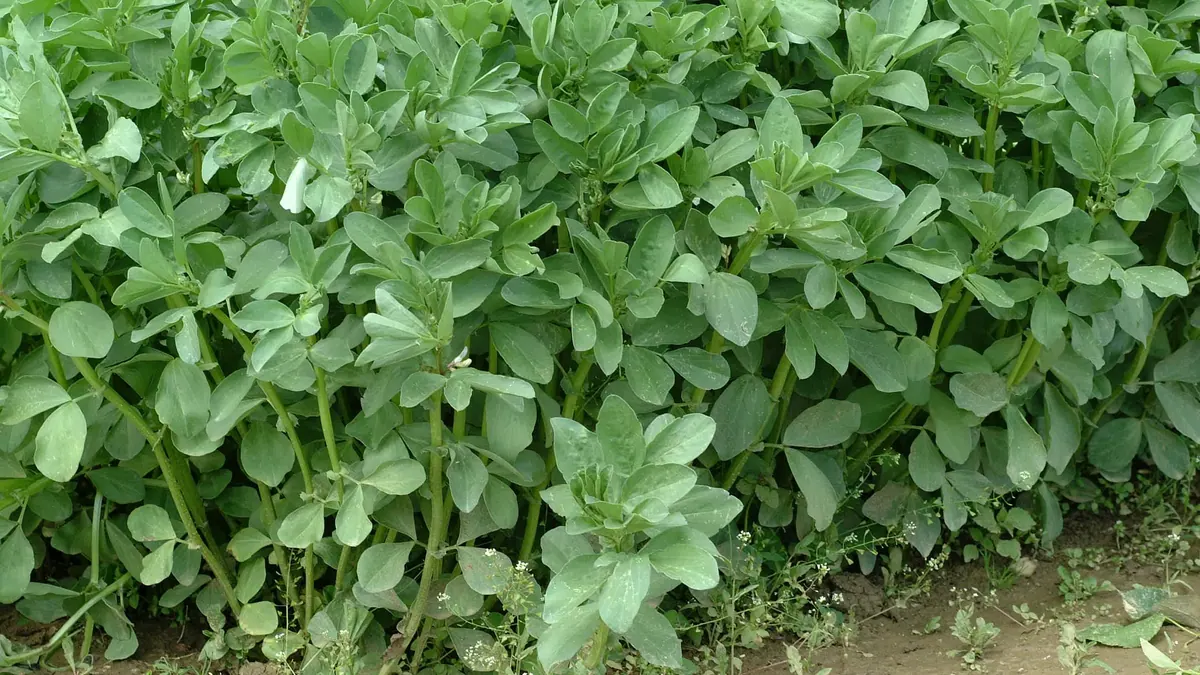
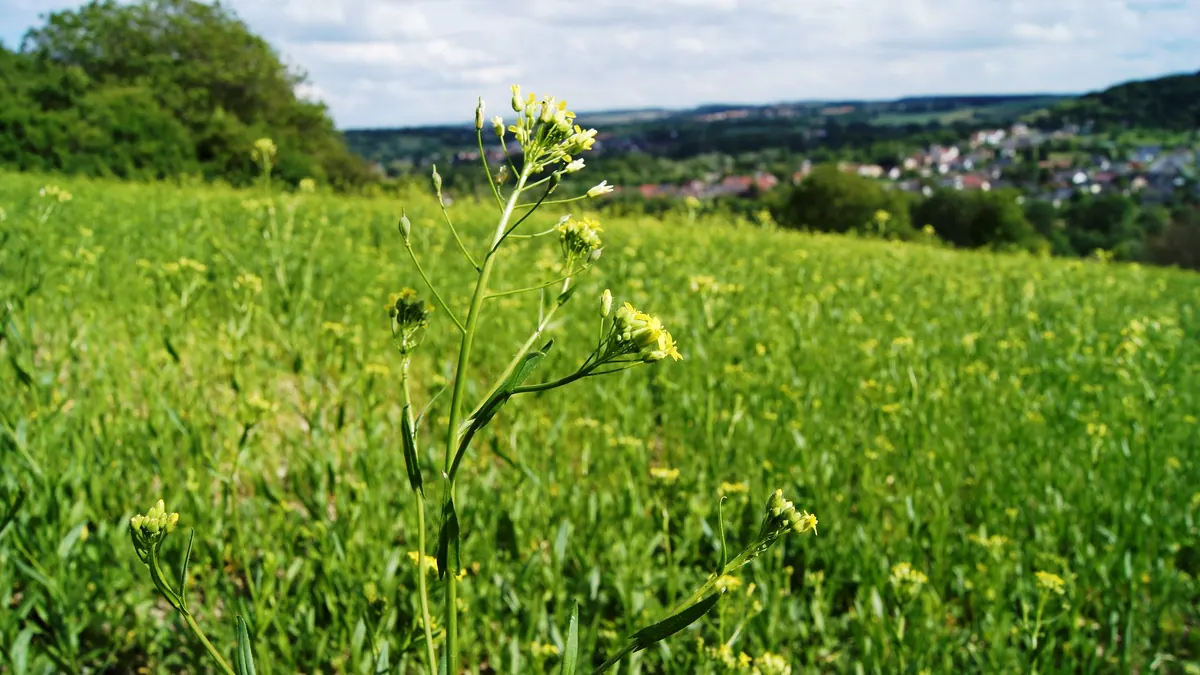
Faba bean as a whole plant is green forage or silage from a leguminous plant with a higher protein content than grasses. In this compilation it is described by pilots from Finland.
Photo Schlaghecken Josef / Wikimedia Commons, licence CC BY-SA 4.0, source file; changes: cropping

- Weighted mean
- 296m³ CH₄/t VS
- Range
- 272–320m³ CH₄/t VS
- Records
- 2single study (2 samples)
- Publications
- 1source
- Temperatures
- 37 °Cof the test
Methane in biogas
Medium methane content · ≈ 5.2 kWh/m³ of biogas
estimate from the substrate type The collected studies contain no measurement. The interval follows from the approximate composition (carbohydrate-dominated (no protein or fat characteristics)) and the yields of compound groups according to FNR.
Rating for biogas plants
not rated — editorial rating for biogas plants
Not rated: no dry matter or volatile solids in the data. We calculate the rating when the dry matter and volatile solids of the material are known.
Add to the co-digestion calculator CSV data
BMP curves from 2 studies
Weighted mean Individual records
Dashed lines are a model curve (first-order kinetics, B(t) = B₀·(1 − e−kt)); the end point comes from the publication. All curves are model curves.
Cumulative methane production over the test [m³ CH₄/t VS]. The thick line is the weighted mean of all records (296); dots mark the end values given in the publications. Point at the chart to read values; click a legend item to hide or show a record.
Records and sources
Download CSV| Source | BMP m³ CH₄/t VS | Temperature | Sample | Curve |
|---|---|---|---|---|
| Pyykkönen et al. (2023) · 1 DOI | 272 | 37 °C · mesophilic | Whole crop fava bean (FB), pilot I | end point (model curve) |
| Pyykkönen et al. (2023) · 2 DOI | 320 | 37 °C · mesophilic | Whole crop fava bean (FB), pilot II | end point (model curve) |
| Weighted mean | 296 | arithmetic mean 296, SD 34 | ||
Process properties
Advantages
- Methane potential in the database: weighted mean 296 m³ CH₄/t VS (median 296; range 272-320; 2 records from 1 source).
- In dry digestion in leach-bed reactors, a mixture of whole faba bean plants with horse manure achieved 94% and 116% of the methane potential of the solid substrates at pilot scale (Pyykkönen 2023).
Drawbacks and risks
- Mono-digestion of faba bean gave only 57-59% of the methane potential in the same study: faba bean requires a co-substrate (Pyykkönen 2023).
- High nitrogen losses were recorded when digestate was stored in a clamp under a tarpaulin in summer (Pyykkönen 2023).
Co-digestion — what to combine it with, what to watch out for
- combines well
In the leach-bed reactors a mixture of faba bean with horse manure achieved 94-116% of the potential, and faba bean alone only 57-59% (Pyykkönen 2023).[1]
Dosing
The source does not give a maximum share. Pyykkönen 2023 tested a mixture of faba bean with horse manure in leach-bed reactors (133 days); proportions are in the full text of the paper.
Practical requirements
- Longer retention time: in the leach-bed reactors digestion lasted about 133 days (Pyykkönen et al. 2023).
- Store the digestate so as to limit nitrogen losses: at farm scale, high N losses were recorded with storage under a tarpaulin in summer (Pyykkönen et al. 2023).
Sources of the process data
The co-digestion calculator will assess a specific mixture containing this substrate.
What it is and where it comes from
Faba bean (Vicia faba) is a leguminous plant grown in Poland mainly for feed seed. In biogas research, harvesting the whole plant as green forage or silage is considered, which fits the idea of diversifying energy crops. The compilation contains several records from a single Finnish publication, designated pilot I and pilot II.
Properties relevant to digestion
Leguminous plants usually have a higher protein content than grasses, which lowers the C to N ratio and improves the nutrient balance in a mixture with nitrogen-poor material, for example straw. However, protein breakdown releases ammonia, so with a large share of legumes its concentration must be controlled. The fibre content depends on the development stage: as the plant matures, the share of woody structures rises and digestibility falls. Ensiling legumes is more difficult than ensiling grasses because of their higher buffering capacity and lower sugar content, so additives or wilting are used.
How to read the spread of results
Records from a single study describe different pilots, so they differ in the conditions under which the experiment was conducted, not only in the material. In reality the result is affected by the faba bean variety, the development stage at harvest (flowering, pod set, maturity), the share of pods and seeds, the form of the material (fresh, silage, dried) and the growing conditions. There are also differences in sample size reduction, inoculum and the substrate-to-inoculum ratio.
In biogas plant practice
In a biogas plant, faba bean is a plant-based supplement and not a primary substrate: its profitability depends on the green mass yield and competition with other uses, for example protein feeds. Silage is suitable for storage, best in a mixture with plants of higher sugar content. In the ration, a possible rise in ammonia must be taken into account and matched to the other substrates. Because the data are based on a single publication, it is worth carrying out a BMP test on your own batch before introducing it into the mix. Since faba bean is grown mainly for seed and not for green forage, in practice it will rarely be available in large quantities. Its role lies rather in diversifying crop rotation than in replacing the main energy substrates.
Methodology in brief
BMP is the amount of methane obtained from volatile solids (VS) in a batch test, given in m³ CH₄ per tonne of VS (numerically the same as NmL CH₄/g VS in the publications) and converted to normal conditions (0 °C, 101.325 kPa). The weighted mean gives each publication a total weight of 1, split equally between its results for the substrate — a paper testing twenty varieties does not outweigh a paper with a single sample. In inter-laboratory programmes the unit is the laboratory (total weight 1), and within it the weight of a test grows with the number of bottles (replicates). Results after pretreatment (e.g. thermal, chemical, enzymatic) are shown separately and are not included in the mean.
Solid lines are curves measured in the tests. Where a publication gives only the final result, we draw a first-order kinetic model, B(t) = B₀·(1 − e−kt): only the end point comes from the publication, and the shape of the curve serves purely as visualisation — do not read the production on a particular day from it. For this substrate k = 0.091 d−1 was assumed (no kinetic data for the group – the median of all available rate constants k (93 values) was used).
The statistics describe the spread of published results — a descriptive compilation, not a meta-analysis or a guarantee of plant yield.
Bibliography
- Pyykkönen, V.; Winquist, E.; Seppänen, A.M.; Vainio, M.; Virkkunen, E.; Koppelmäki, K.; Rasi, S. (2023). Anaerobic Digestion of Solid Agricultural Biomass in Leach-Bed Reactors. Bioengineering 10(4), 433. DOI: 10.3390/bioengineering10040433 DOI
All sources of the site: bibliography.
Other substrates in the group “Grasses, green forage and fodder plants”
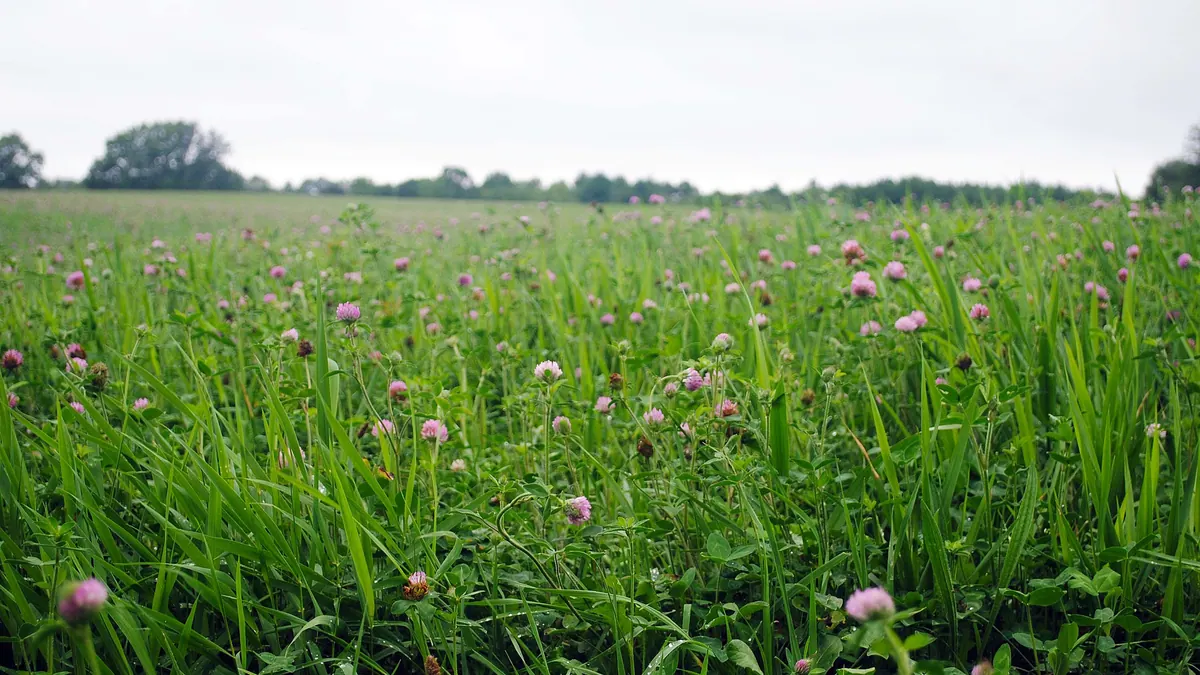
Clover — BMP: 5 studies, weighted mean 394 m³ CH₄/t VS
394 m³ CH₄/t VS weighted mean from 5 studies
neutral — editorial rating for biogas plants59 %
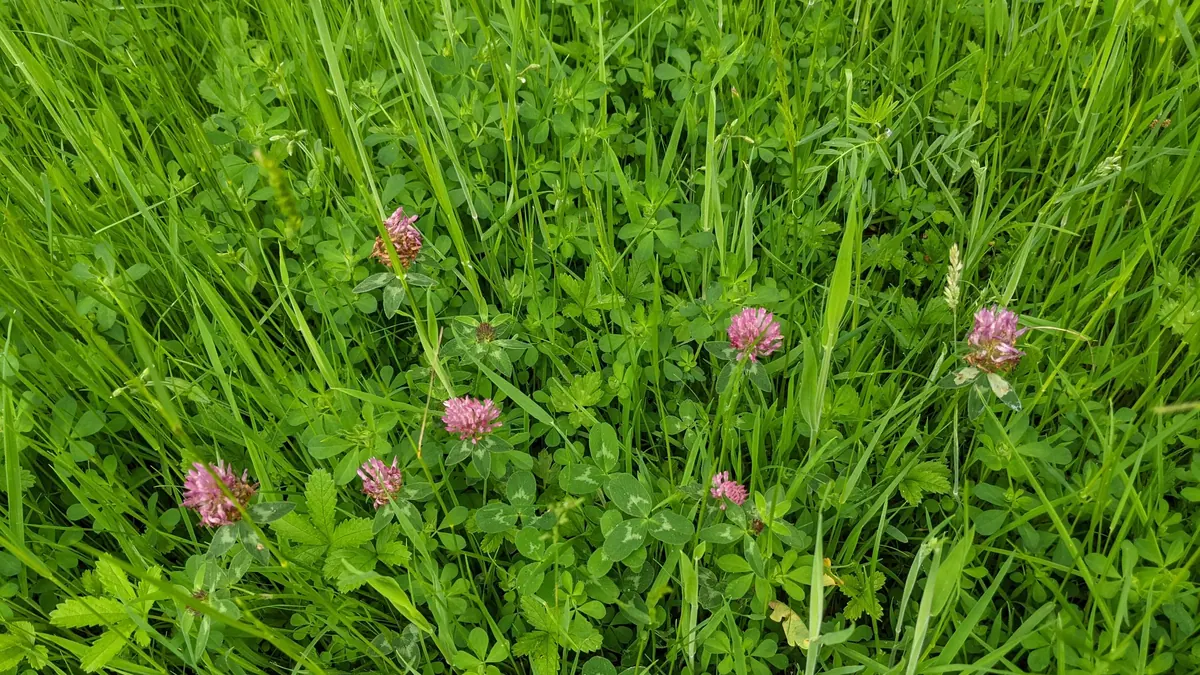
Clover-grass silage — BMP: 2 studies, weighted mean 296 m³ CH₄/t VS
296 m³ CH₄/t VS weighted mean from 2 studies
≈52 %
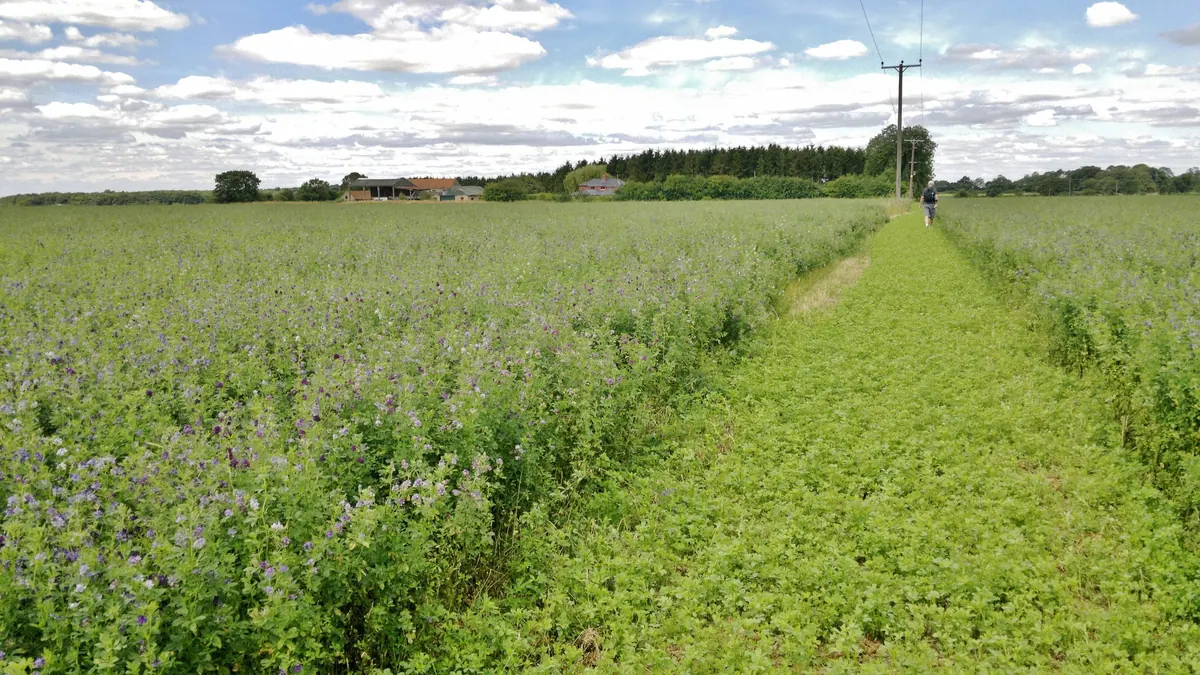
Lucerne (alfalfa) — BMP: 7 studies, weighted mean 366 m³ CH₄/t VS
366 m³ CH₄/t VS weighted mean from 7 studies
neutral — editorial rating for biogas plants66 %
Cereal/pea and camelina mixtures — BMP: 5 studies, weighted mean 282 m³ CH₄/t VS
282 m³ CH₄/t VS weighted mean from 5 studies
good — editorial rating for biogas plants≈52 %