

BMP testingWood and woody biomass
Lignin-rich hydrolysis residue — BMP: 2 studies, weighted mean 105 m³ CH₄/t VS
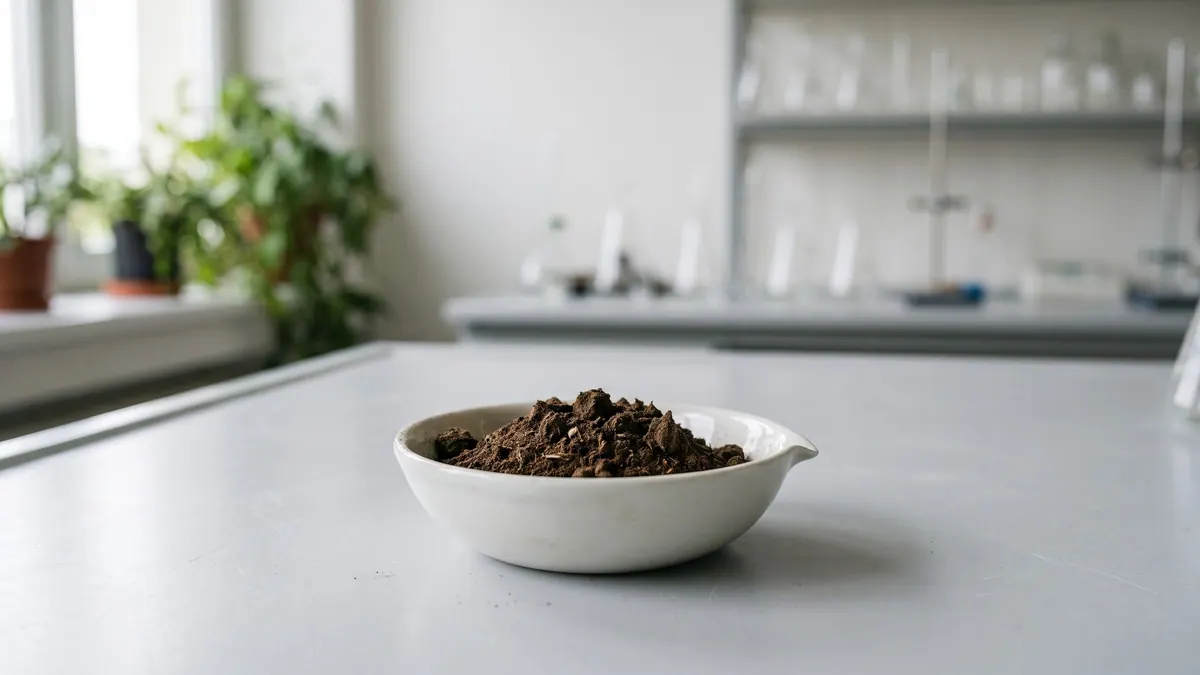
Hydrolytic lignin from birch is the solid residue left after wood hydrolysis, from which most of the readily available sugars have been removed, so it digests poorly.
Illustration: FeedstockData (AI, Google Gemini)
- Weighted mean
- 105m³ CH₄/t VS
- Range
- 85–125m³ CH₄/t VS
- Records
- 2studies
- Publications
- 2sources
- Temperatures
- 37 °Cof the test
Methane in biogas
Medium methane content · ≈ 5.2 kWh/m³ of biogas
estimate from the substrate type The collected studies contain no measurement. The interval follows from the approximate composition (carbohydrate-dominated (no protein or fat characteristics)) and the yields of compound groups according to FNR.
Rating for biogas plants
not rated — editorial rating for biogas plants
Not rated: no dry matter or volatile solids in the data. We calculate the rating when the dry matter and volatile solids of the material are known.
Add to the co-digestion calculator CSV data
BMP curves from 2 studies
Weighted mean Individual records
Dashed lines are a model curve (first-order kinetics, B(t) = B₀·(1 − e−kt)); the end point comes from the publication. All curves are model curves.
Cumulative methane production over the test [m³ CH₄/t VS]. The thick line is the weighted mean of all records (105); dots mark the end values given in the publications. Point at the chart to read values; click a legend item to hide or show a record.
Records and sources
Download CSV| Source | BMP m³ CH₄/t VS | Temperature | Sample | Curve |
|---|---|---|---|---|
| Mulat et al. (2018) DOI | 125 | 37 °C · mesophilic | Hydrolysis lignin from birch (HL birch) | end point (model curve) |
| Costa et al. (2019) DOI | 85 | — | Lignin-rich residue from birch (LRR birch) | end point (model curve) |
| Weighted mean | 105 | arithmetic mean 105, SD 28 | ||
Process properties
Advantages
- Methane potential in the database: weighted mean 105 m³ CH₄/t VS (median 105; range 85-125; 2 records from 2 sources).
- A by-product of wood hydrolysis, available in large quantities at biorefineries; the set contains microbiological data from the study by Mulat 2018.
Drawbacks and risks
- Lignin is practically non-degradable anaerobically; the result comes almost entirely from residual polysaccharides (review by Hendriks 2009).
- Residues after hydrolysis may contain phenolic compounds and other degradation products, potentially inhibitory (a topic discussed in the study by Mulat 2018).
Co-digestion — what to combine it with, what to watch out for
- combines well
group: Animal excreta (slurry, manure, poultry litter)
Excreta supply a diverse microflora and trace elements, easing adaptation.[1][2]
Dosing
No source dose limits; in practice consider only as a limited additive after a BMP test and monitoring of volatile acids.
Introduce gradually, starting with a small dose and monitoring the process (e.g. FOS/TAC, pH, gas composition).
Practical requirements
- Shred: shredding increases the surface available for degradation and speeds it up, but does not necessarily raise the final gas yield (FNR 2010, Ch. 3 “Triturado”).
Sources of the process data
- Mulat, D.G.; Dibdiakova, J.; Horn, S.J. (2018) Microbial biogas production from hydrolysis lignin: insight into lignin structural changes. Biotechnology for Biofuels 11(1), 61
- Weiland, P. (2010) Biogas production: current state and perspectives. Applied Microbiology and Biotechnology
- Chen, Y.; Cheng, J.J.; Creamer, K.S. (2008) Inhibition of anaerobic digestion process: A review. Bioresource Technology
- Hendriks, A.T.W.M.; Zeeman, G. (2009) Pretreatments to enhance the digestibility of lignocellulosic biomass. Bioresource Technology
- Costa, T.H.F.; Eijsink, V.G.H.; Horn, S.J. (2019) The use of lytic polysaccharide monooxygenases in anaerobic digestion of lignocellulosic materials. Biotechnology for Biofuels 12(1), 270
- FNR (2010). Guía sobre el Biogás – Desde la producción hasta el uso (hiszp. wydanie „Leitfaden Biogas”, GIZ 2013)
The co-digestion calculator will assess a specific mixture containing this substrate.
What it is and where it comes from
Hydrolytic lignin is the solid fraction remaining after the hydrolysis of lignocellulose, once cellulose and hemicelluloses have been converted into sugars, for example in the production of second-generation ethanol or biochemicals. The dataset contains several records from birch wood: lignin from hydrolysis and a lignin-rich residue after steam explosion and hydrolysis. It is an industrial material, not an agricultural one, so it does not occur on the scale typical of biogas plants.
Properties relevant to digestion
By definition, the material consists mainly of lignin, a complex phenolic polymer that is degraded only to a negligible extent under anaerobic conditions. Methane is formed from residual, unseparated carbohydrates. Steam or acid treatment can generate inhibitory compounds (furfural, hydroxymethylfurfural, phenols), which at higher concentrations reduce the activity of microorganisms, although in the residue after hydrolysis their amount depends on washing. The nitrogen content is low. The material is hard and not very reactive, so size reduction is crucial.
How to read the spread of results
The dataset contains several records from different sources and processes, so the spread results from differences in the method of producing the residue: the degree to which sugars were separated, the intensity of the treatment (e.g. steam explosion) and the lignin content. The inoculum, temperature and test duration also have an effect. With so few records, a reliable typical range cannot be determined, and individual values reflect a specific process rather than the material "in general".
In biogas plant practice
Hydrolytic lignin is not used as a biogas plant substrate. In the technological model it is a waste from a biorefinery process, which is usually burned for energy recovery. Using it in digestion would make sense at most as an auxiliary component of a mix and after checking for the presence of inhibitors. Its legal status depends on its origin (industrial waste), and managing it requires an appropriate permit. The information in this dataset is indicative only.
For comparison with other lignocellulosic residues, it is important that lignin from a biorefinery is also a feedstock for further chemical processing and for solid fuel, which is usually more cost-effective than methane fermentation.
Before any attempt at digestion, it is worth carrying out an analysis of the composition (content of lignin, residual sugars and phenolic compounds) and a BMP test for the specific batch.
Methodology in brief
BMP is the amount of methane obtained from volatile solids (VS) in a batch test, given in m³ CH₄ per tonne of VS (numerically the same as NmL CH₄/g VS in the publications) and converted to normal conditions (0 °C, 101.325 kPa). The weighted mean gives each publication a total weight of 1, split equally between its results for the substrate — a paper testing twenty varieties does not outweigh a paper with a single sample. In inter-laboratory programmes the unit is the laboratory (total weight 1), and within it the weight of a test grows with the number of bottles (replicates). Results after pretreatment (e.g. thermal, chemical, enzymatic) are shown separately and are not included in the mean.
Solid lines are curves measured in the tests. Where a publication gives only the final result, we draw a first-order kinetic model, B(t) = B₀·(1 − e−kt): only the end point comes from the publication, and the shape of the curve serves purely as visualisation — do not read the production on a particular day from it. For this substrate k = 0.039 d−1 was assumed (median of rate constants k reported in the sources and/or fitted to the mean measured curves).
The statistics describe the spread of published results — a descriptive compilation, not a meta-analysis or a guarantee of plant yield.
Bibliography
- Mulat, D.G.; Dibdiakova, J.; Horn, S.J. (2018). Microbial biogas production from hydrolysis lignin: insight into lignin structural changes. Biotechnology for Biofuels 11(1), 61. DOI: 10.1186/s13068-018-1054-7 DOI
- Costa, T.H.F.; Eijsink, V.G.H.; Horn, S.J. (2019). The use of lytic polysaccharide monooxygenases in anaerobic digestion of lignocellulosic materials. Biotechnology for Biofuels 12(1), 270. DOI: 10.1186/s13068-019-1611-8 DOI
All sources of the site: bibliography.
Other substrates in the group “Wood and woody biomass”
Poplar — BMP: 9 studies, weighted mean 282 m³ CH₄/t VS
282 m³ CH₄/t VS weighted mean from 9 studies
good — editorial rating for biogas plants≈52 %
Sawdust and wood chips — BMP: 6 studies, weighted mean 130 m³ CH₄/t VS
130 m³ CH₄/t VS weighted mean from 6 studies
≈52 %
Olive and vine prunings — BMP: 2 studies, weighted mean 55 m³ CH₄/t VS
55 m³ CH₄/t VS weighted mean from 2 studies
≈52 %
Wood residues from paper industry — BMP: 2 studies, weighted mean 144 m³ CH₄/t VS
144 m³ CH₄/t VS weighted mean from 2 studies
≈52 %