

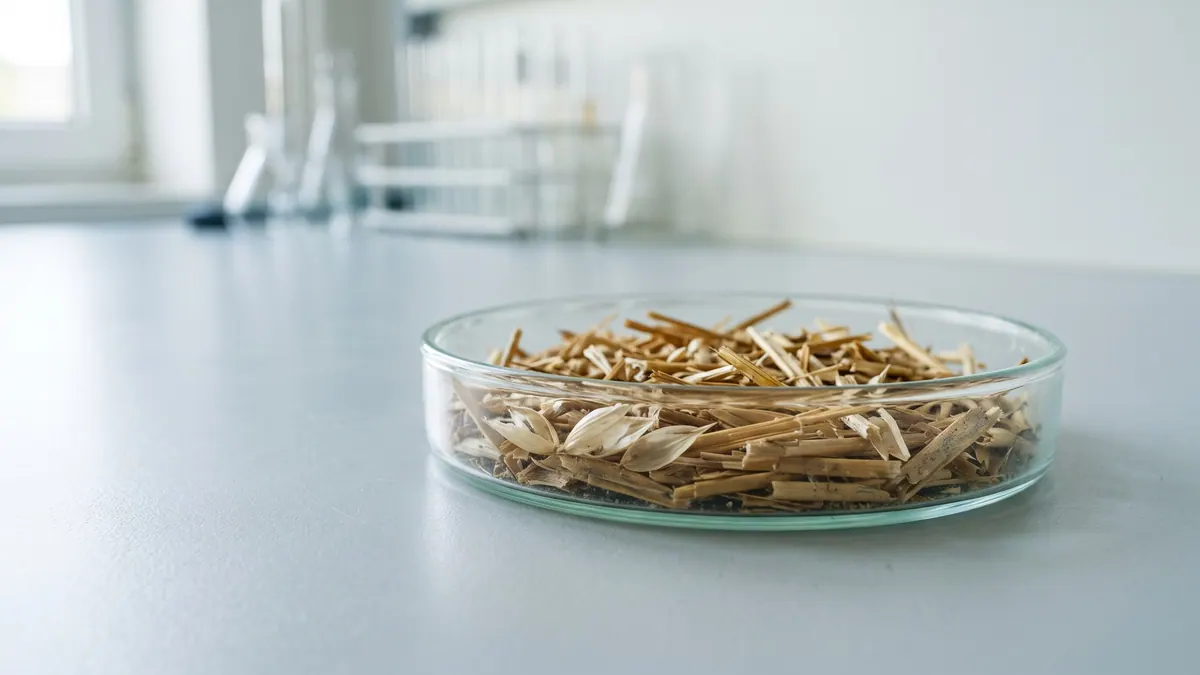
BMP testingStraws and crop residues
Oat straw — BMP: 2 studies, weighted mean 275 m³ CH₄/t VS
Oat straw is a lignocellulosic post-harvest waste with a high C/N ratio, available in small quantities. The dataset rests on a small number of records, so the result is indicative.
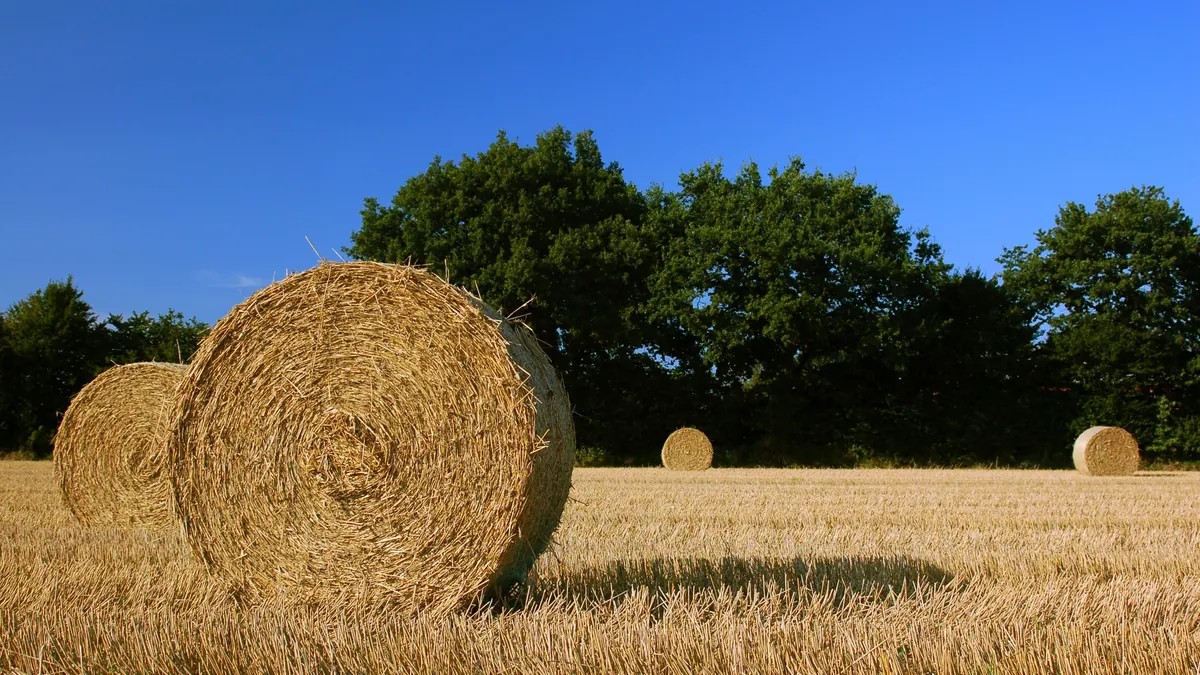
Illustration: FeedstockData (AI, Google Gemini)
- Weighted mean
- 275m³ CH₄/t VS
- Range
- 230–320m³ CH₄/t VS
- Records
- 2studies
- Publications
- 2sources
- Temperatures
- 35 °Cof the test
Methane in biogas
Medium methane content · ≈ 5.2 kWh/m³ of biogas
estimate from the substrate type The collected studies contain no measurement. The interval follows from the approximate composition (carbohydrate-dominated (no protein or fat characteristics)) and the yields of compound groups according to FNR.
Rating for biogas plants
not rated — editorial rating for biogas plants
Not rated: no dry matter or volatile solids in the data. We calculate the rating when the dry matter and volatile solids of the material are known.
Add to the co-digestion calculator CSV data
BMP curves from 2 studies
Weighted mean Individual records
Dashed lines are a model curve (first-order kinetics, B(t) = B₀·(1 − e−kt)); the end point comes from the publication. All curves are model curves.
Cumulative methane production over the test [m³ CH₄/t VS]. The thick line is the weighted mean of all records (275); dots mark the end values given in the publications. Point at the chart to read values; click a legend item to hide or show a record.
Records and sources
Download CSV| Source | BMP m³ CH₄/t VS | Temperature | Sample | Curve |
|---|---|---|---|---|
| Lehtomaki (2006) | 320 | 35 °C · mesophilic | Straw of oats | end point (model curve) |
| Lehtomaki (2004) | 230 | 35 °C · mesophilic | Straw of Oats | end point (model curve) |
| Weighted mean | 275 | arithmetic mean 275, SD 64 | ||
Typical composition
- Dry matter (DM)
- 76.5% (range 63.4–89.6)
- Nitrogen
- 0.7 % DM
- C/N ratio
- 95
Median and range of the determinations reported in the publications behind this substrate's BMP records (read from: CROPGEN D4); dry matter: 2 determinations, volatile solids: 0 determinations.
Sources: Lehtomaki (2006); Lehtomaki (2004).
The composition of the raw material varies between batches — for plant calculations use an analysis of your own sample. The calculator inserts typical values automatically.
Process properties
Advantages
- Methane potential in the database: weighted mean 275 m³ CH₄/t VS (median 275; range 230–320; 2 records from 2 sources).
Drawbacks and risks
- Lignin limits degradation; floating crust (review by Hendriks 2009).
Dosing
No source-based dose limits; like other cereal straws.
Practical requirements
- Shred: shredding increases the surface available for degradation and speeds it up, but does not necessarily raise the final gas yield (FNR 2010, Ch. 3 “Triturado”).
Sources of the process data
- Lehtomaki, A. Viinikainen, T.A. Rintala, J.A (2006) Screening boreal energy crops and crop residues for methane biofuel production. Submitted to Biomass and Bioenergy
- Lehtomaki, A. Viinikainen, T.A. Ronkainen, O.M. Alen, R. Rintala, J.A. (2004) Effect of pretreatments on methane production potential of energy crops and crop residues. Proceedings Anaerobic Digestion Conference 1016-1021
- Dahunsi, S. (2019) Mechanical pretreatment of lignocelluloses for enhanced biogas production: Methane yield prediction from biomass structural components. Bioresource Technology 280, 18–26
- Hendriks, A.T.W.M.; Zeeman, G. (2009) Pretreatments to enhance the digestibility of lignocellulosic biomass. Bioresource Technology
- Weiland, P. (2010) Biogas production: current state and perspectives. Applied Microbiology and Biotechnology
- FNR (2010). Guía sobre el Biogás – Desde la producción hasta el uso (hiszp. wydanie „Leitfaden Biogas”, GIZ 2013)
The co-digestion calculator will assess a specific mixture containing this substrate.
What it is and where it comes from
Oat straw is the residue left after the threshing of common oats (Avena sativa). Oats are grown in Poland on a smaller scale than wheat or rye, so there is less straw too. It is valued as bedding and roughage, which limits its availability to biogas plants. The dataset rests on a small number of records from several publications, carried out under mesophilic conditions.
Properties relevant to digestion
Like other straws, oat straw consists mainly of cellulose, hemicelluloses and lignin, with a low protein content and a high C to N ratio. Biological degradation is slow, particularly in the initial hydrolysis phase. The material is easy to store dry, but prone to dampening and mould. In the digester it tends to form scum, so it requires chopping and effective mixing. The influence of variety and growing conditions on digestibility is significant, but cannot be assessed from so small a number of records.
How to read the spread of results
The dataset contains few records, so the spread does not capture the full variability of the material. The result is affected by oat variety, the year and conditions of the growing season, harvest date and straw moisture, the way the sample was prepared (cutting, milling, drying) and the test parameters: inoculum, substrate-to-inoculum ratio and incubation time. With slowly degradable straws the length of the test is often key, and results from different studies are not always comparable.
In biogas plant practice
At agricultural plants, oat straw can be an occasional component of the mix when the farm has a surplus of it. Its share in the ration should be moderate because of scum and the need for mixing. Before use it should be chopped, and storage ensured in dry conditions. Because of competing uses, such as bedding, the economic balance often favours other destinations. Yield data should be supplemented with a test of your own batch. If there are doubts about the quality of a batch, for example dampness or mould, it is better not to use it, because biologically spoiled material lowers process stability and is sometimes a source of foaming problems. A simple visual inspection and moisture measurement at each delivery help.
Methodology in brief
BMP is the amount of methane obtained from volatile solids (VS) in a batch test, given in m³ CH₄ per tonne of VS (numerically the same as NmL CH₄/g VS in the publications) and converted to normal conditions (0 °C, 101.325 kPa). The weighted mean gives each publication a total weight of 1, split equally between its results for the substrate — a paper testing twenty varieties does not outweigh a paper with a single sample. In inter-laboratory programmes the unit is the laboratory (total weight 1), and within it the weight of a test grows with the number of bottles (replicates). Results after pretreatment (e.g. thermal, chemical, enzymatic) are shown separately and are not included in the mean.
Solid lines are curves measured in the tests. Where a publication gives only the final result, we draw a first-order kinetic model, B(t) = B₀·(1 − e−kt): only the end point comes from the publication, and the shape of the curve serves purely as visualisation — do not read the production on a particular day from it. For this substrate k = 0.136 d−1 was assumed (median of rate constants k reported in the sources and/or fitted to the mean measured curves).
The statistics describe the spread of published results — a descriptive compilation, not a meta-analysis or a guarantee of plant yield.
Results after pretreatment (24) — excluded from the mean
| Source | BMP m³ CH₄/t VS | Pretreatment | Sample |
|---|---|---|---|
| Lehtomaki (2004) | 150 | — | Straw of Oats |
| Lehtomaki (2004) | 190 | — | Straw of Oats |
| Lehtomaki (2004) | 150 | — | Straw of Oats |
| Lehtomaki (2004) | 70 | — | Straw of Oats |
| Lehtomaki (2004) | 200 | — | Straw of Oats |
| Lehtomaki (2004) | 200 | — | Straw of Oats |
| Lehtomaki (2004) | 210 | — | Straw of Oats |
| Lehtomaki (2004) | 140 | — | Straw of Oats |
| Lehtomaki (2004) | 90 | — | Straw of Oats |
| Lehtomaki (2004) | 140 | — | Straw of Oats |
| Lehtomaki (2004) | 190 | — | Straw of Oats |
| Lehtomaki (2004) | 110 | — | Straw of Oats |
| Lehtomaki (2004) | 220 | — | Straw of Oats |
| Lehtomaki (2004) | 170 | — | Straw of Oats |
| Lehtomaki (2004) | 160 | — | Straw of Oats |
| Lehtomaki (2004) | 160 | — | Straw of Oats |
| Lehtomaki (2004) | 120 | — | Straw of Oats |
| Lehtomaki (2004) | 180 | — | Straw of Oats |
| Lehtomaki (2004) | 160 | — | Straw of Oats |
| Lehtomaki (2004) | 160 | — | Straw of Oats |
| Lehtomaki (2004) | 200 | — | Straw of Oats |
| Lehtomaki (2004) | 240 | — | Straw of Oats |
| Lehtomaki (2004) | 210 | — | Straw of Oats |
| Lehtomaki (2004) | 210 | — | Straw of Oats |
Bibliography
- Lehtomaki, A. Viinikainen, T.A. Rintala, J.A (2006). Screening boreal energy crops and crop residues for methane biofuel production. Submitted to Biomass and Bioenergy.
- Lehtomaki, A. Viinikainen, T.A. Ronkainen, O.M. Alen, R. Rintala, J.A. (2004). Effect of pretreatments on methane production potential of energy crops and crop residues. Proceedings Anaerobic Digestion Conference 1016-1021.
All sources of the site: bibliography.
Other substrates in the group “Straws and crop residues”
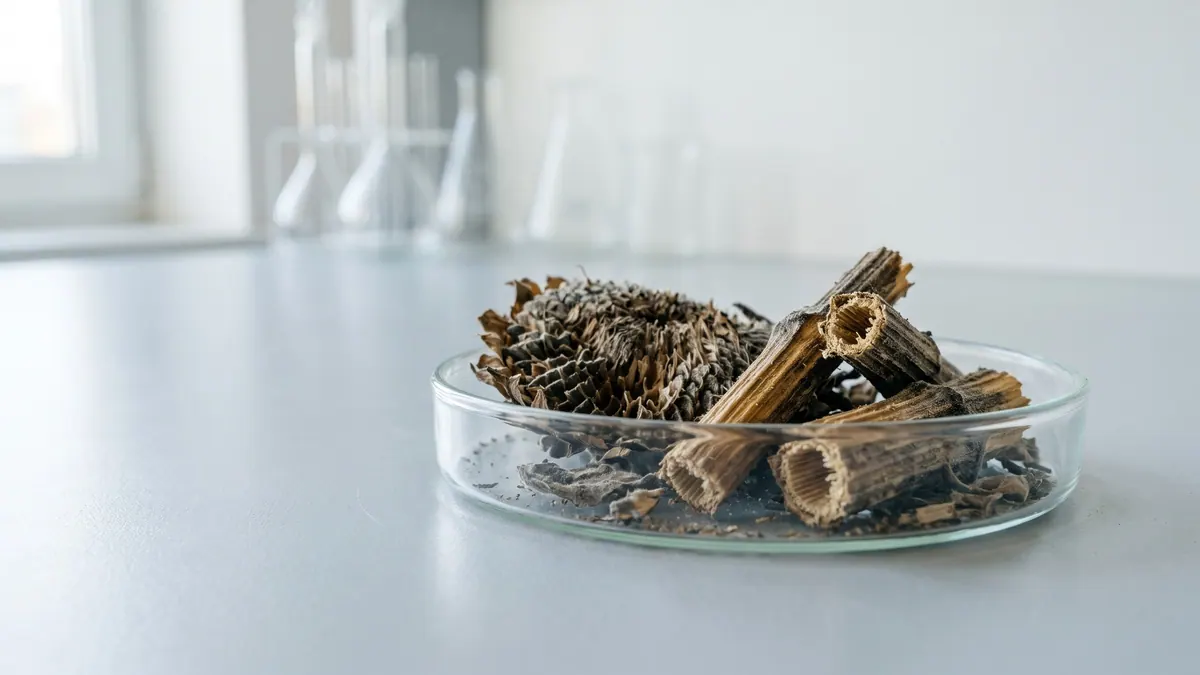
Sunflower residues (heads, stalks) — BMP: 2 studies, weighted mean 169 m³ CH₄/t VS
169 m³ CH₄/t VS weighted mean from 2 studies
≈52 %
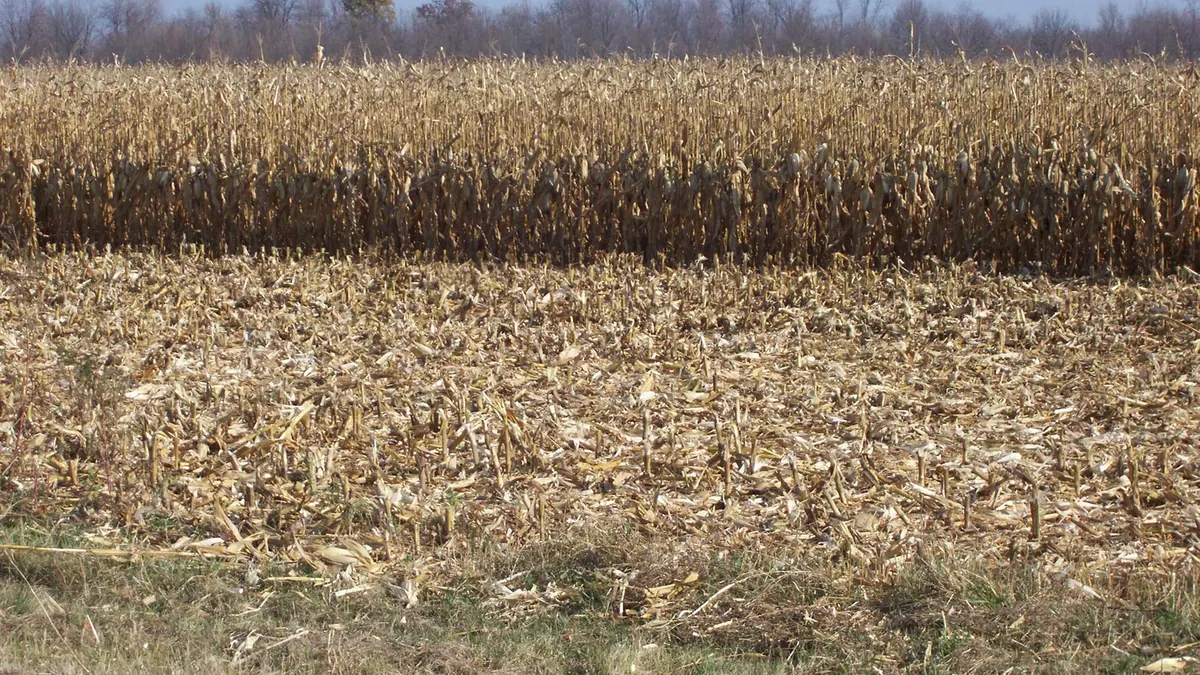
Maize stover — BMP: 10 studies, weighted mean 298 m³ CH₄/t VS
298 m³ CH₄/t VS weighted mean from 10 studies
good — editorial rating for biogas plants≈52 %
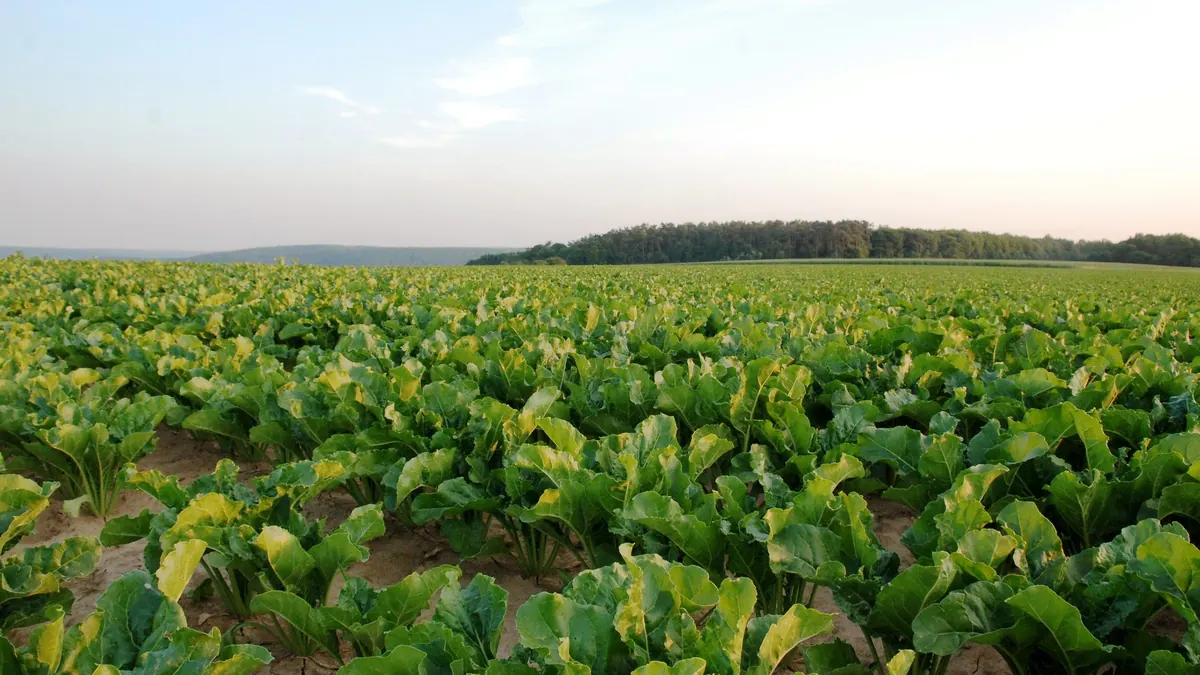
Beet leaves and tops — BMP: 18 studies, weighted mean 308 m³ CH₄/t VS
308 m³ CH₄/t VS weighted mean from 18 studies
neutral — editorial rating for biogas plants68 %
Cereal straw (unspecified) — BMP: 25 studies, weighted mean 268 m³ CH₄/t VS
268 m³ CH₄/t VS weighted mean from 25 studies
good — editorial rating for biogas plants≈51 %