BiohydrogenExplainer
Dark fermentation: hydrogen from organic waste – yield and limitations
In dark fermentation anaerobic bacteria produce H₂ from sugars without light. We discuss the microorganisms, process conditions, realistic yields and why the technology is still at the research stage.
Other language versions: polski.
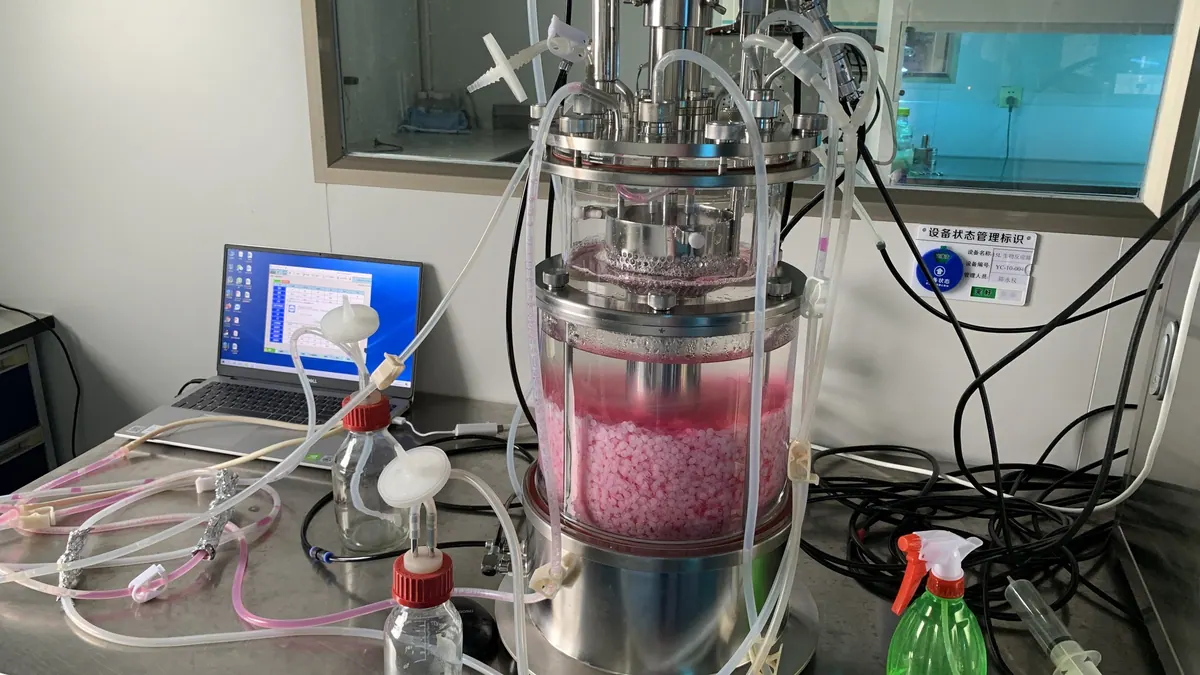

Dark fermentation is an anaerobic process in which bacteria break down sugars from biomass or organic waste into hydrogen, carbon dioxide and organic acids, without the involvement of light. Unlike classical methane fermentation, the process stops at the acidogenesis stage: volatile acids (acetic, butyric) form and no methane is produced, because the methanogens are inhibited. In theory a maximum of 4 moles of H₂ can be obtained from 1 mole of glucose (the acetate pathway), but in practice yields are several times lower, which is why the technology remains at the research and pilot stage.
Process chemistry
Two main metabolic pathways:
- Acetate pathway: C₆H₁₂O₆ + 2H₂O → 2CH₃COOH + 2CO₂ + 4H₂ (max. 4 moles H₂/mole of glucose).
- Butyrate pathway: C₆H₁₂O₆ → CH₃CH₂CH₂COOH + 2CO₂ + 2H₂ (2 moles H₂/mole of glucose).
In real mixed cultures a set of products forms (acetate, butyrate, ethanol, lactate), and the hydrogen yield is usually in the range of 1–2.5 moles of H₂ per mole of hexose. The formation of propionate or lactate lowers the yield even further.
Microorganisms
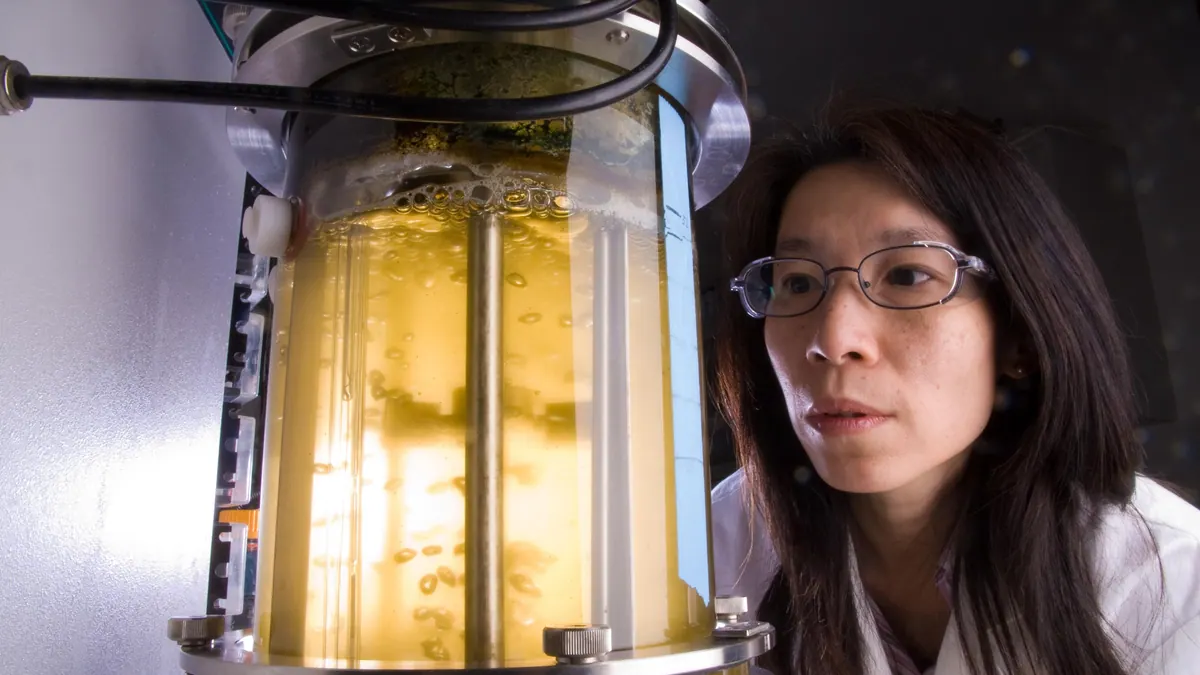
Hydrogen production is mainly carried out by bacteria of the genus Clostridium (capable of forming spores) and enterobacteria (e.g. Enterobacter). In mixed sludge cultures, inoculum pretreatment is used, e.g. brief heating or lowering the pH, to eliminate methanogens and hydrogen-consuming bacteria and to leave the spore-forming bacteria.
Process parameters
| Parameter | Typical range in studies |
|---|---|
| pH | about 5.0–6.5 (too low inhibits the bacteria, too high favours methanogens) |
| Temperature | mesophilic (about 35–37°C) or thermophilic (about 55°C) |
| Retention time | from several to several dozen hours |
| Substrate | easily assimilable carbohydrates: sugars, starch, whey, fruit waste |
It is crucial to keep the partial pressure of hydrogen low; excess H₂ in solution shifts metabolism towards acids and inhibits hydrogen production. Intensive mixing or sparging with an inert gas improves the yield, but complicates purification.
By-products
Dark fermentation uses only part of the substrate's energy. The remainder – fatty acids and alcohols – contains most of the energy and has to be dealt with: in a second stage of methane fermentation (a two-stage system), in photofermentation or in microbial electrolysis cells. For this reason the process is rarely considered on its own; hybrid systems make more sense.
Worked example
Assumptions: whey from a dairy contains 45 g/l of lactose (a disaccharide of ~342 g/mol); for simplicity we assume that after hydrolysis it gives 2 moles of hexose per mole of lactose. Per 1 m³ of whey: 45 kg of lactose is 45,000 g / 342 g/mol ≈ 131.6 moles, i.e. about 263 moles of hexose. At a yield of 1.5 moles of H₂/mole of hexose: ≈ 395 moles of H₂ ≈ 0.79 kg H₂ ≈ 8.9 m³ of H₂ (normal conditions, 22.4 l/mol). The energy of this hydrogen (LHV 33.3 kWh/kg) is about 26 kWh per m³ of whey. For comparison, the same whey in methane fermentation would give many times more energy in the form of methane, because it uses all the organic matter. The calculation illustrates why dark fermentation is usually the first stage and not the whole process.
Technological maturity
Dark fermentation processes have been tested in laboratories and pilot installations of various scales. The main barriers are: low yields, instability of mixed cultures, the cost of purifying the gas mixture (H₂/CO₂, and sometimes trace H₂S), and economics competing with electrolysis and reforming. It should therefore be treated as a development technology, not a ready commercial solution.
Where it makes sense
- in food processing plants with homogeneous sugar streams (whey, pomace, molasses);
- as part of two-stage H₂+CH₄ fermentation (so-called biohythane), where the first stage improves hydrolysis;
- in biorefinery research projects in which acids are a raw material for further products.
Purification of hydrogen biogas
Gas from dark fermentation usually contains 30–60% H₂ (the rest being mainly CO₂), with an admixture of hydrogen sulphide and water vapour. Separating hydrogen of fuel quality requires adsorption (PSA), membranes or scrubbers, and compression and storage of hydrogen consume additional energy. This part of the chain is sometimes omitted in publications that focus on the reactor yield, and in the economic analysis it can be as important as the bioreactor itself.
Summary
Dark fermentation is an interesting direction that makes it possible to use carbohydrate waste to produce hydrogen without light (although the installation requires auxiliary energy), but the limited yield and the need to deal with the acids make it for now a research technology and an element of hybrid systems.
Sources
Related articles