Process biology and start-upGuide
Digestate recirculation to the digester: water savings and the risk of ammonia and salt accumulation
Returning liquid after separation replaces water, but raises the concentration of NH4-N, potassium and sodium in the circuit. A simple balance shows the scale of the effect and ways of limiting it.
Other language versions: Polski, Deutsch, Español, Français, Italiano, Nederlands.
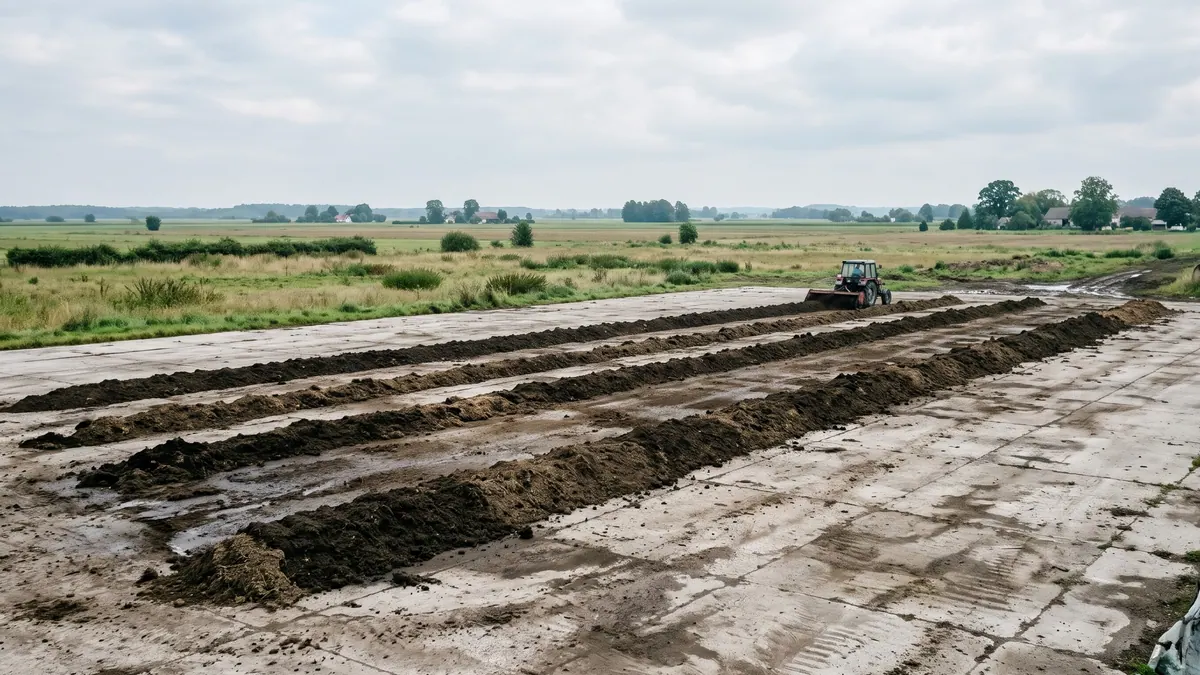
Digestate recirculation means returning to the digester part of the liquid after separation (or unseparated digestate) in place of process water, in order to obtain the required dry matter content in the feedstock. It brings water savings and improves pumpability, but creates a closed circuit in which components that do not degrade accumulate. The article presents the biological perspective; fertiliser matters and separation techniques are covered in separate texts in the digestate section.
Why liquid is returned
Substrates with a high dry matter content (maize silage, grass, straw) require dilution so that the mix is pumpable and mixable. The source of water can be the mains, rainwater or liquid from the separator. Using the latter:
- reduces the consumption of fresh water and the volume of digestate to be managed,
- supplies biomass and inoculum (useful when the mix changes),
- supplies trace elements and buffer,
- reduces the cost of haulage and storage.
The price of these benefits is a shift in the balance of components.
How the concentration builds up: a simple balance
At steady state, ammonia and salts leave the installation only with the net digestate stream. The gas takes away a small amount and only volatile compounds; potassium, sodium and chlorides essentially do not leave with the gas. Recirculate does not add components by itself, but it replaces water that "diluted" the net stream.
Assumptions (illustrative):
- daily substrate dose: 50 t,
- process water needed to set the dry matter of the feedstock: 20 t/d,
- daily production of NH4-N from mineralisation of proteins and from the ammonium nitrogen of the substrates: 200 kg/d,
- for simplicity, the whole stream leaving the installation is treated as a liquid with a concentration equal to that in the digester, and the loss of mass with the biogas is ignored.
Variant without recirculation: fresh water. Net stream = 50 + 20 = 70 t/d. NH4-N concentration ≈ 200 kg / 70 t ≈ 2.9 kg/t, i.e. approx. 2.9 g/l.
Variant with full replacement of water by recirculate: net stream = 50 t/d (20 t returns to the feedstock). Concentration ≈ 200 kg / 50 t = 4.0 g/l, i.e. approx. 40% more.
Potassium, sodium and chlorides rise in exactly the same way; the conductivity of the liquid follows them. In reality part of the components leaves the installation with the solid fraction, so the effect is somewhat smaller, but the direction is the same. The build-up is exponential in time with a time constant of about several HRT, so the final state shows itself after weeks.
For comparison: Chen et al. (2008) compile inhibitory values of total ammonia across a wide range, from approx. 1.7 to 14 g N/l, strongly dependent on adaptation, pH and temperature. At the 4 g/l mentioned we may therefore be in the risk zone for non-adapted biomass, especially at thermophilic temperature or at higher pH.
Permissible share of recirculate
There is no single figure, because it depends on the mix:
| Mix | Nitrogen content | Possible share of recirculate |
|---|---|---|
| Maize, grass, silages | low | high, limited mainly by salts and suspended solids |
| Mixed with cattle slurry | medium | moderate, requires monitoring |
| Pig slurry, slaughterhouse waste | high | low to very low |
| Poultry manure | very high | minimal, often replaced by water |
A practical rule: the share is set on the basis of the trend of concentrations in the liquid, not solely from a recipe for the water dose.
Monitoring
- NH4-N or TAN in liquid from the digester weekly or more often after a change of mix; together with pH and temperature it allows NH3 to be estimated.
- Electrical conductivity as a quick indicator of salts (a rise without a change in NH4-N points to K, Na, Cl).
- K and Na in an analysis of the liquid monthly or quarterly.
- FOS/TAC and VFA for detecting the first symptoms (see FOS/TAC).
- Gas production and composition as aggregate indicators.
Keep a trend chart: a steady rise in concentrations with an unchanged mix means that the balance is not closed.
Relief strategies
- Dilution with fresh water. Reducing the share of recirculate immediately limits the inflow; the effect is visible after several HRT.
- Discharge of part of the stream. Removing part of the liquid from the circuit to storage (with the possibility of use as a fertiliser) lowers the level of salts and ammonia. It requires tank capacity and fertiliser application deadlines.
- Change of mix. Reducing the share of substrates with a high nitrogen content.
- Adaptation. Slowly increasing the concentration allows the biomass to adapt (see generation times and kinetics), but it does not remove the limit.
- Removing nitrogen from the liquid. Ammonia recovery technologies lower its concentration in the circuit, but they require investment and a separate economic assessment.
Common mistakes
- Adding recirculate "by eye" without measuring the concentration.
- Assuming that the liquid is "water", although it contains several grams of ammonium nitrogen per litre.
- Changing the share of recirculate at the same time as changing the mix, which makes it impossible to diagnose the cause.
- Ignoring sodium and potassium, which do not degrade and may be inhibitory at high concentrations.
Recirculation is a good tool if it remains an element managed by the balance of components, and not a permanent habit.
Sources
Related articles