Process biology and start-upExplainer
Struvite, calcium carbonate and deposits in the digester: what precipitates, where and how it affects the biology
In a digester with a lot of ammonia and high alkalinity, struvite and calcium carbonate precipitate. We explain the chemistry, where deposits form and what they do to the process.
Other language versions: Polski, Deutsch, Español, Français, Italiano, Nederlands.
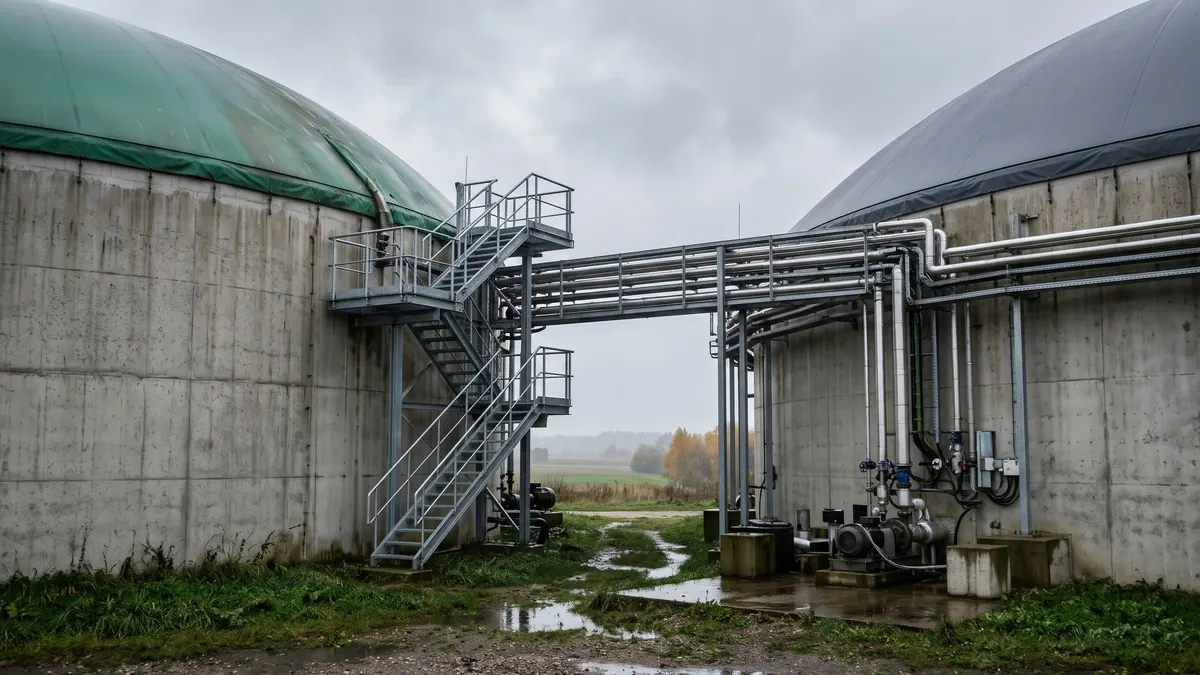
Struvite is magnesium ammonium phosphate hexahydrate, MgNH4PO4·6H2O, a sparingly soluble salt that precipitates from a liquid containing magnesium, ammonia and phosphates when pH and concentrations exceed the solubility product. A digester is a favourable environment for it: the NH4-N concentration usually reaches several grams per litre, the pH is slightly alkaline, and phosphates are released from the decomposing biomass. Alongside struvite there are calcium carbonate and calcium phosphates. For operation this is a real problem, for the biology usually a secondary one, but it is worth understanding when that is not the case. Deliberate recovery of phosphorus as struvite is covered in the article on phosphorus recovery from digestate, and deposits in heat exchangers in the text on digester heating. Here we describe the chemistry and the consequences for the process.
Where the components of the deposit come from
The high ammonium nitrogen content results from the breakdown of proteins and urea, especially in mixes with slurry, poultry manure and protein wastes. Phosphorus comes from cells, bones, fertilisers and excreta. Magnesium and calcium are supplied by mineral feed additives, make-up water and the substrates themselves (for example bones and shells in slaughterhouse or kitchen waste). Alkalinity, i.e. the bicarbonate buffer, rises in the digester together with ammonia, and this raises the pH.
The struvite reaction in simplified form: Mg2+ + NH4+ + PO4 3- + 6H2O → MgNH4PO4·6H2O. The solubility of this salt falls sharply as pH rises in the range of about 7-9, so places where the pH locally increases are prone to precipitation.
Calcium carbonate: Ca2+ + CO3 2- → CaCO3. Its solubility decreases with temperature (unlike most salts), so heating surfaces are particularly exposed. Calcium phosphates (including hydroxyapatite) form more slowly, but the deposit is hard and difficult to remove.
Why pH rises locally
Biogas contains about 40-45% CO2, which maintains the bicarbonate buffer in the digester. When the liquid passes through a point of pressure drop, for example a valve, a pump or a constriction, part of the CO2 escapes. The result is a local rise in pH, and this triggers the precipitation of struvite and CaCO3. A similar effect is caused by rapid heating of the liquid on the surface of a heat exchanger. In circuits containing recirculate, additional concentration of salts occurs, which also increases supersaturation.
Where to look for deposits
| Place | Mechanism | Consequence |
|---|---|---|
| Delivery pipes and reducers | CO2 degassing, pH rise | reduced cross-section, higher delivery pressure |
| Pumps (impellers, seals) | pressure drop, cavitation | wear, loss of capacity |
| Heat exchangers | high wall temperature | reduced heat transfer, increased energy consumption |
| Screens and separators | rapid dewatering, pH change | clogging, poorer separation |
| Digester bottom and dead zones | settling of heavy particles and crystals | smaller active volume, accumulation of sand (see scum and bottom sediments) |
| Digestate-to-storage pipelines | further degassing | hard deposits, often struvite |
Effect on the biology
The deposits are not directly toxic, since they are solid salts. The effect is indirect.
- Active volume. Deposits on the bottom and in dead zones reduce the effective volume, so the actual HRT is shorter than calculated from the geometry. This matters especially for digesters operating close to the lower limit of retention time (more on this parameter in the article on HRT and SRT).
- Mixing. A reduced cross-section and blocked nozzles impair homogenisation, which favours local acid overloads.
- Heat transfer. Deposit on the exchanger lowers heating capacity; the digester temperature falls or heat consumption rises, and temperature fluctuations stress the methanogens.
- Availability of nutrients. Precipitation binds magnesium and, to a lesser extent, trace elements that co-precipitate or sorb onto the crystals. Phosphorus is usually not in short supply in agricultural digesters, so a P deficiency due to struvite is unlikely; limited Mg is possible in mixes poor in that element. If you suspect deficiencies, start with an analysis of the liquid, not with adding supplements.
- Ammonia. Struvite precipitation removes part of the NH4-N from solution, but quantitatively this is a small loss compared with the total nitrogen pool, so do not treat it as a method of protection against ammonia inhibition.
General principles of limiting deposits
Without going into dosing recipes, which depend on the local composition of the liquid, general practices can be indicated:
- Keep pH and alkalinity within the range dictated by the biology; avoid uncontrolled raising of pH with alkaline additives.
- Design and operate the routes so as to avoid sudden constrictions and degassing points; ensure a flow velocity that does not allow sedimentation.
- Provide cleaning ports, access to exchangers and the possibility of flushing. Mechanical removal of deposits is usually more effective than chemical removal, and using acid requires an assessment of material compatibility and neutralisation.
- Inspect pumps and exchangers periodically, comparing the trend of delivery pressure and the temperature difference across the exchanger as indicators of deposit build-up.
- When returning liquid, monitor conductivity and salt concentration, because recirculation increases supersaturation.
When a deposit is a warning sign
Rapidly growing deposits indicate a high concentration of NH4-N and phosphates at elevated pH, and therefore conditions close to ammonia inhibition. It is then worth checking the trend of NH4-N, pH and VFA. On the other hand, a change in the composition of the deposit (more CaCO3, less struvite) may indicate a change in the mix or in the process water. Treat deposits as diagnostic data: photographs, dates and removal locations will help to link problems with the dosing history and with changes of substrates.
Sources
Related articles