Process biology and start-upGuide
Changing the digester operating temperature: how to move from mesophilic to thermophilic and back
Adapting the population when moving from 37–42 °C to 52–55 °C takes time. We describe the pace of change, thermal shock, the drop in production and the ammonia risk.
Other language versions: Polski, Deutsch, Español, Français, Italiano, Nederlands.
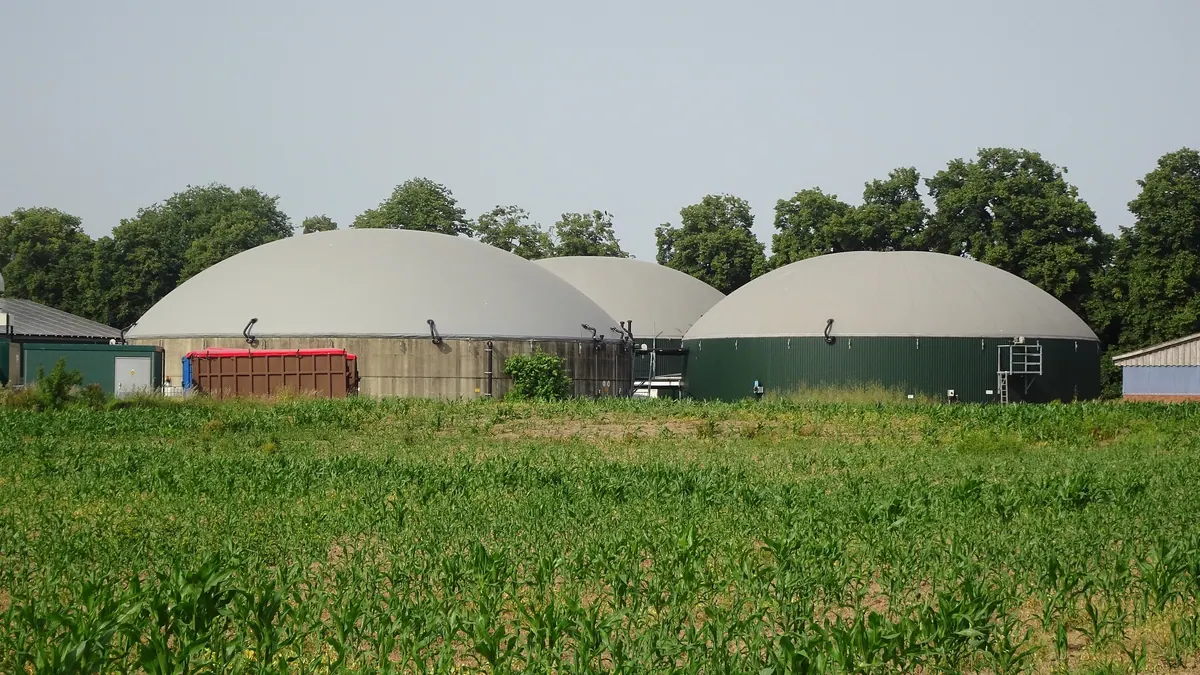

Changing the digester operating temperature is an adaptation process in which we do not merely heat the contents but change the composition of the microbial community. The advantages and disadvantages of the two modes are described in a separate comparison; here we discuss only the transition itself, because it is the transition that most often ends in a process disturbance.
Why raising the setpoint is not enough
Mesophilic and thermophilic microorganisms are in large part different groups. Bacteria and archaea with an optimum of 35–40 °C begin to die off when the temperature exceeds approx. 45 °C, while thermophiles develop only from approx. 50 °C. In the intermediate zone (approx. 43–50 °C) the process is often at its weakest, because neither group has comfortable conditions there. That is why this zone should not be "sat out": either you pass through it at a controlled pace, or not at all.
Methanogens, as a slower-growing group, adapt for longer than acid-forming bacteria. During the change a temporary imbalance arises: acids are produced faster than they are consumed. This explains the typical picture after heating too quickly: VFA rise, pH falls, methane content falls.
Pace of change
Operating practice points to two approaches:
- Continuous change: raising by approx. 1 °C per day. The range 37–40 → 52–55 °C then takes approx. 2–3 weeks of heating alone.
- Stepwise change: jumps of up to approx. 2 °C, each followed by a stabilisation period of 2–4 days or until biogas production and VFA have stabilised.
Faster heating is possible in some systems, but it increases the risk of thermal shock; the literature describes both successful fast transitions and disturbances after a change of a few degrees within a day. The ranges depend on the history of the biomass and the composition of the substrates, so this is not a rule, only a starting point. Lowering the temperature (returning to mesophilic operation) is done in a similar way, usually at a pace of no more than 1–2 °C per day.
During the change, neither the composition of the feedstock nor the feed rate should be changed at the same time. One variable at a time makes it possible to identify the cause of any problems.
The thermal shock window and behaviour of the indicators
When moving to thermophilic operation, the typical course looks as follows (a qualitative description, because the course depends on the plant):
- First days: an increase in the rate of hydrolysis and acidogenesis, an increase in biogas production with a higher CO₂ content.
- Days 3–10: a temporary drop in methane content and production, a rise in VFA, including propionic acid; a possible drop in pH.
- Following weeks: a gradual return to balance, rising methane production; full stabilisation usually takes several weeks, sometimes longer if the biomass was previously disturbed.
During this time it is worth reducing the feed rate (e.g. to 60–80% of the pre-change value) and keeping it there until FOS/TAC and VFA stop rising. The details of FOS/TAC measurement and VFA interpretation are needed for this assessment.
Monitoring during the change
It is worth taking measurements more often than usual: temperature at several points daily, pH and biogas composition daily, FOS/TAC every 1–2 days, the VFA breakdown every few days or at any worrying symptom. Conditions for stopping the change should be set in advance: e.g. a rise in FOS/TAC by more than a set percentage within a day, or a drop in pH below an alarm value. In such a case the temperature is held at the level reached (not abruptly reversed) and you wait for stabilisation.
Ammonia risk in thermophilic operation
The share of free ammonia (NH₃) in total ammonium nitrogen rises with temperature and pH. At the same NH₄-N concentration and pH, a higher temperature means a clearly higher NH₃ concentration, which is the more strongly inhibiting form. In practice this means that a substrate that was safe in mesophilic operation (e.g. poultry slurry) can lead to inhibition in thermophilic operation. Before the transition, the ammonium nitrogen concentration should be checked and the share of protein substrates possibly changed. The mechanism and thresholds are discussed in the article on ammonia in the digester.
At the same time, thermophilic operation has consequences for heat management (higher heat consumption) and for biogas dehydration (more water vapour), which is worth taking into account in the plan.
When the change makes no sense
Moving to thermophilic operation can be tempting because of the shorter retention time and better sanitisation, but it is not always beneficial. Giving it up makes sense when:
- a nitrogen-rich feedstock gives a high NH₄-N (typically above a few g/l),
- the plant has an insufficient heat reserve,
- the biomass is unstable and will not withstand an additional disturbance,
- there is no clear purpose (e.g. sanitisation or a required retention time).
A change in the other direction (from thermophilic to mesophilic) is easier, but it too requires a gradual lowering; a sudden chill from 55 to 38 °C is one of the most common reasons for a process to stop.
Sources
Related articles