InnovationAnalysis
Small-scale biomethane plants: containerised modules and economics at flows of up to several hundred Nm³/h
Containerised modules lower the entry barrier to biomethane, but unit cost depends strongly on flow. An illustrative calculation with explicit assumptions.
Other language versions: Polski, Deutsch, Español, Français, Italiano, Nederlands.
A small biomethane plant makes sense when the gas has a reliable buyer nearby and the flow is stable enough for the module to run most of the year, but the economics deteriorate faster than linear scaling of capacity would suggest. Below are a definition of small scale, the strengths and weaknesses of containerised modules, and an illustrative calculation. It is an exercise with assumed parameters, not a valuation of a specific investment.
What we call small scale
We assume raw biogas in the range of about 100–500 Nm³/h. At a methane content of about 52–55%, this gives 55–270 Nm³/h of biomethane, or about 0.45–2.2 million Nm³ per year at 8000 hours of operation. For comparison, a typical agricultural biogas plant with an electrical capacity of 1 MW produces about 450–500 Nm³/h of biogas, and sewage and rendering plants often fall in the lower part of the range.
Containerised modules: what we gain
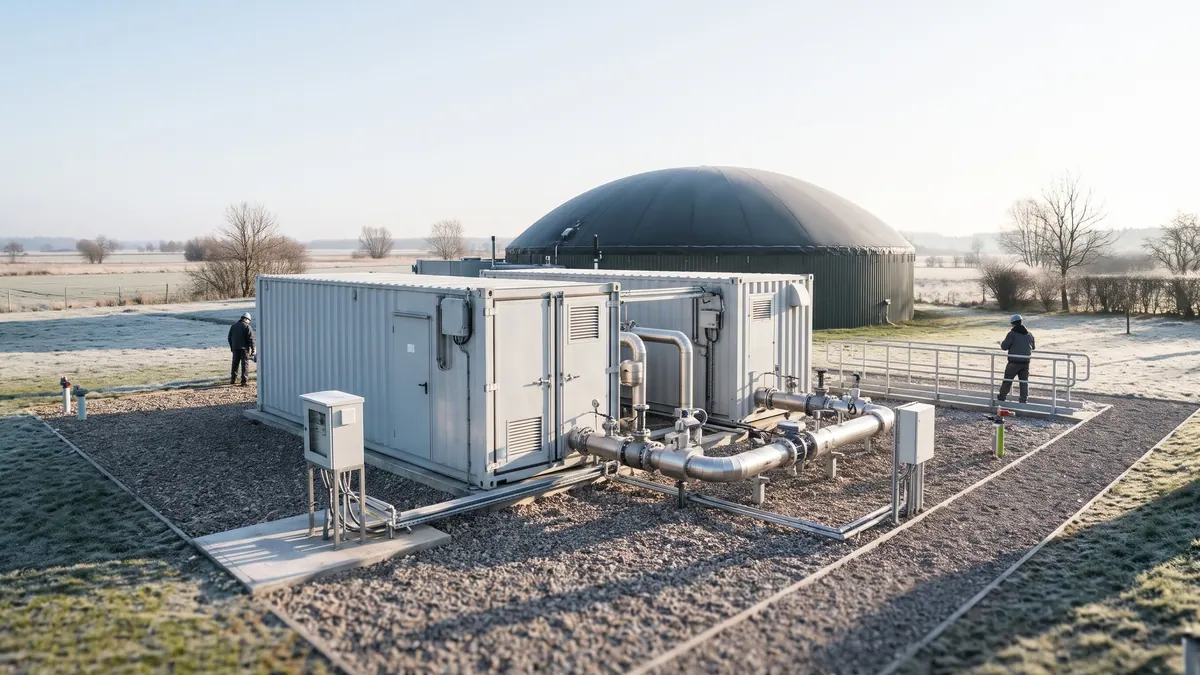
A containerised module is usually a compressor, membrane stages, drying and preliminary gas cleaning, automation and an analyser, factory-assembled in one or several containers. The advantages are concrete:
- delivery time: work on site is limited to foundations, connections and commissioning, which in practice shortens the schedule by months compared with a system built on site;
- repeatability: standardisation makes service and spare parts easier and reduces the risk of design errors;
- modularity: the installation can be expanded with another module as biogas production grows;
- membranes: the technology scales down well, because it does not require extensive liquid-handling infrastructure like an amine scrubber.
Drawbacks and costs that do not scale down
On the cost side, some items are independent of flow: the grid connection and the metering and settlement station, design, permits, gas quality analysis, a possible heater and odorisation. At a small flow they are spread over fewer cubic metres. The second weakness is methane slip: in a single-stage membrane system it can be significant, and the losses must be combusted or recycled, which adds complexity to the system. The third is electricity consumption, on the order of about 0.2–0.35 kWh per Nm³ of raw biogas (depending on pressure, number of stages and efficiency).
Illustrative calculation
Assumptions, for the example only: the installed cost of the system (module, connection, metering, design) is taken as PLN 6 million for 500 Nm³/h and PLN 4.2 million for 150 Nm³/h (that is, PLN 12 thousand per Nm³/h versus PLN 28 thousand per Nm³/h); depreciation over 12 years, cost of capital 7%, operation for 8000 h/year, service and energy costs proportional to flow with a fixed component added.
The annual annuity for PLN 6 million is about PLN 0.76 million, and for PLN 4.2 million about PLN 0.53 million. Biomethane volumes are about 2.0 million Nm³ per year (500 Nm³/h) versus about 0.6 million Nm³ (150 Nm³/h). The capital component alone is therefore about PLN 0.38/Nm³ versus about PLN 0.88/Nm³. The more than twofold difference results solely from scale, before operating costs are added. It is worth repeating the calculation on your own offers; the order of magnitude of the difference matters more than individual figures. A full discussion of the methodology is in the article The cost of producing biomethane: LCOE, a worked example and sensitivity.
Sales options
- Gas grid: the simplest offtake if a gas pipeline is nearby; the connection cost is often decisive. The choice of technology is described in the upgrading decision matrix.
- bioCNG: a station at the farm or nearby, provided there are enough fleet customers; details in the article on bioCNG as a fuel.
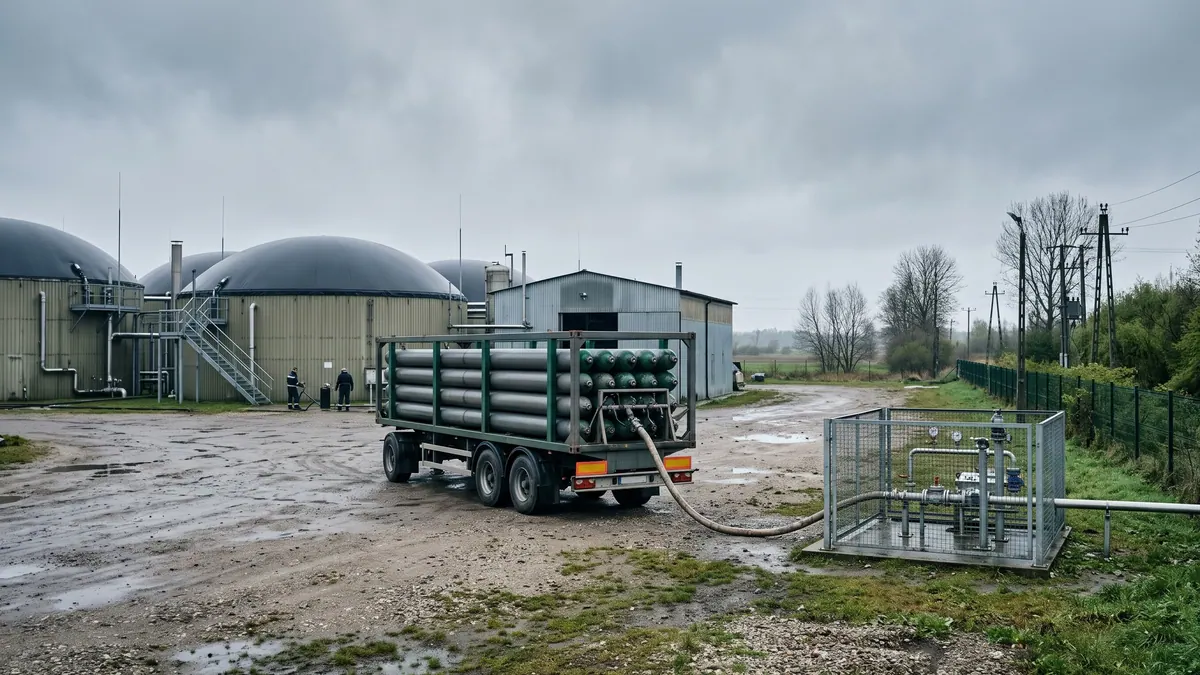
- Virtual pipeline: cylinders or tankers travel to a drop-off point; logistics costs rise with distance, as in the analysis of the virtual pipeline.
When small scale wins
Against CHP it wins when the heat from cogeneration has no buyer, and support for electricity expires or is less profitable than the biomethane price and guarantees of origin; the conversion is described in the post on retrofits. Against a cluster it wins where the biogas plants are a dozen or more kilometres apart, because a raw biogas pipeline (low-pressure, with drying) over that distance often costs more than the benefit of scale.
A cluster makes sense when three or four installations lie within a radius of a few kilometres and are under one owner or linked by an agreement. Then a combined flow of 800–1500 Nm³/h allows a system with a lower unit cost to be used, and there is a single management.
Conclusions
Small scale is technically feasible, but economically it requires a secure offtake, a low connection cost and discipline in limiting methane slip. Before deciding, it is worth calculating three options: staying with CHP, a local module and participation in a cluster.
Sources
Related articles