BiomethaneExplainer
Virtual pipeline: how to deliver biomethane without a grid in tankers and cylinder sets
A virtual pipeline is the delivery of compressed or liquefied biomethane by road. We explain the arrangement, capacities, transport costs per kilometre and the profitability limit.
Other language versions: polski.
A virtual pipeline is a way of delivering gas without a pipeline: biomethane is compressed to about 200–250 bar and loaded into cylinder sets on trailers (bioCNG), or liquefied and carried in cryogenic tankers (bioLNG). At the customer the gas is expanded and fed into an industrial installation, a boiler house, a local grid or a refuelling station. The solution works where connection to the grid is impossible or too costly, but the customer is several dozen kilometres from the biomethane plant.
What it looks like in practice
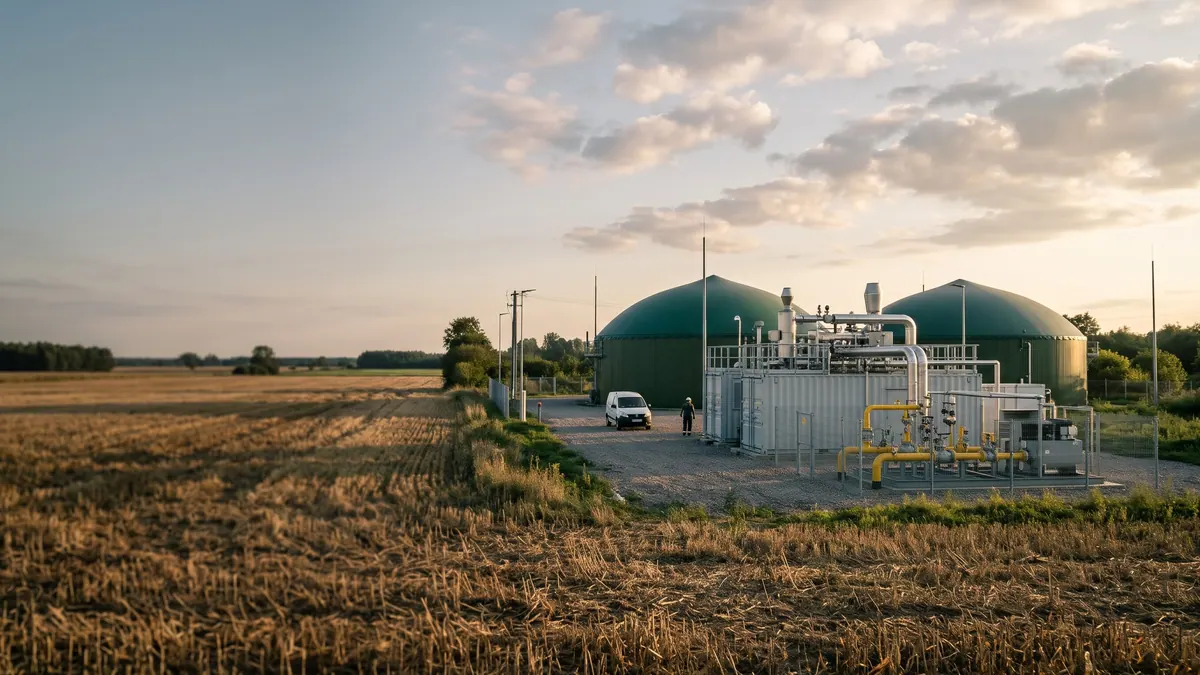
- At the producer: after upgrading, the biomethane goes to a compression station (multistage compressors with cooling) and then to the trailer filling point. The alternative is a liquefier.
- Transport: a trailer with cylinders (steel or composite) on a tractor unit. The transport capacity is usually a few thousand m³ of gas per trailer, depending on the pressure and the type of cylinders.
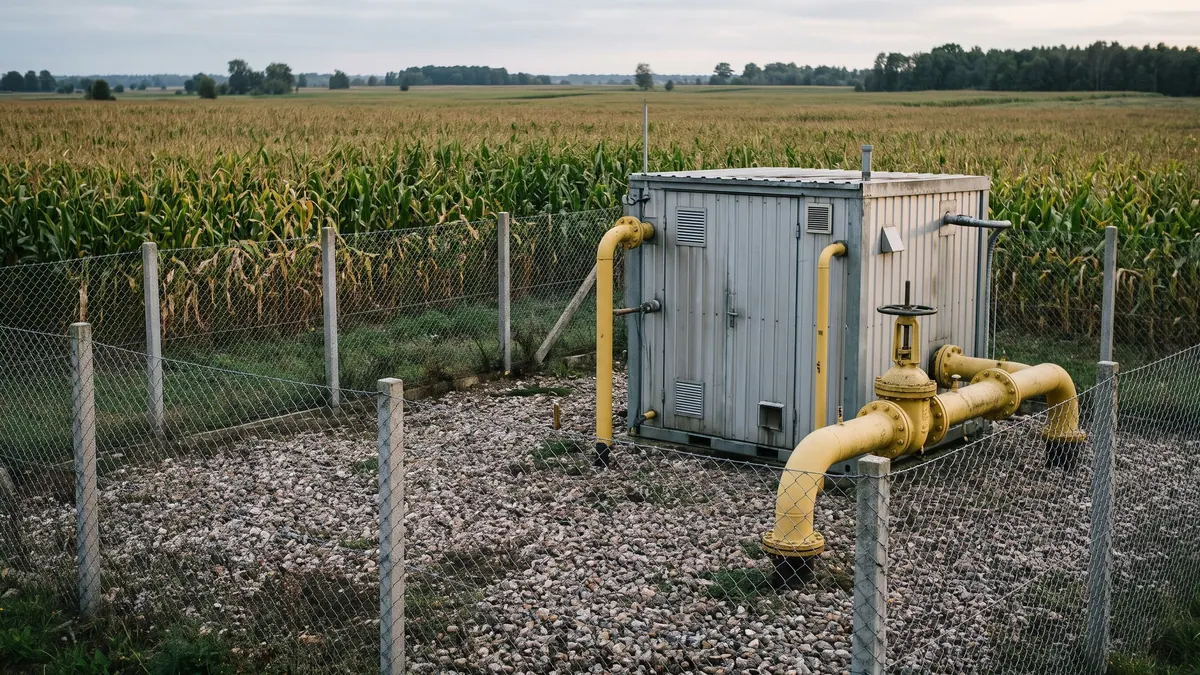
- At the customer: a decompression station reduces the pressure, heats the gas (expansion causes cooling – the Joule–Thomson effect), measures it and directs it to the installation.
- Logistics: usually two or three trailers in circulation – one being filled, one on the road, one being unloaded – so that deliveries are continuous.
How much gas a trailer carries
By way of illustration: a trailer with gas at a pressure of 200 bar. If the water volume of all the cylinders is 20 m³, then at a compression of 200 bar about 20 × 200 ≈ 4000 m³ of gas fits (methane at 200 bar has a compressibility factor Z ≈ 0.8, so in reality more of it fits than in a calculation for an ideal gas: about 4500–4700 m³ converted to normal conditions). Not all the gas can be unloaded, because the cylinders remain at residual pressure (several dozen bar), so the practical net quantity is lower, e.g. 2800–3200 m³. The values are a calculation example and depend on the trailer design; the manufacturer's data decide.
Transport cost example
Assumptions: the customer consumes 100 m³/h of gas (2400 m³/day). A trailer carries 3000 m³ net, so 0.8 deliveries a day are needed, which gives about 292 trips a year. One-way distance 60 km, i.e. 120 km per trip; at an assumed cost of PLN 6/km (an illustrative assumption, including fuel, driver and depreciation) this is PLN 720 per trip plus the costs of standing time and loading. Annual cost: 292 × 720 ≈ PLN 210 thousand, i.e. about PLN 0.24/m³ (volume 876 thousand m³). On top of this come the costs of compression (energy, compressor wear) and of the decompression station. In total, logistics can add from a dozen or so to several dozen groszy per m³ to the price of gas, which should be compared with the cost of a grid connection.
Compression energy
Compression from grid pressure or lower to 200–250 bar consumes energy; for biomethane from upgrading at low pressure it is of the order of 0.2–0.3 kWh/m³, and when compressing from a few bar – less. This cost is included alongside transport.
Advantages
- no costs of building a gas pipeline and connection,
- the possibility of quick start-up and of changing the customer,
- flexibility: gas can go to several customers,
- it enables refuelling a vehicle fleet at locations without a grid.
Limitations
- cost rises with distance and volume; for large customers road transport can be unprofitable;
- constant logistics and the availability of drivers and equipment are required;
- transport regulations (ADR) and safety rules;
- emissions from road transport (although usually small relative to the avoided emissions);
- inability to use the full capacity because of residual pressure.
Safety and regulations
The carriage of compressed gas is regulated by regulations on dangerous goods (ADR). Cylinders and valves are subject to periodic testing, and drivers must hold appropriate qualifications. Compression and decompression stations require fire protection, explosion hazard zones and emergency procedures. The zones around trailers during unloading must be marked.
When a virtual pipeline makes sense
- A customer with steady consumption (e.g. an industrial plant with a continuous process) at a distance of up to several dozen km.
- A transitional period – until a connection to the grid is built.
- Supplying a bioCNG refuelling station when the biogas plant has no grid nearby.
- Projects with strong demand for bioCNG and a premium for renewable fuel.
Comparison with a grid connection
The decision is worth basing on a simple cost comparison: the annual cost of logistics and compression (PLN/year) against the annual capital instalment of the connection and injection station. If the customer is close and the volume large, the gas pipeline usually wins; with a long distance and small volume – road transport. Remember that road transport can be scaled up and down without large outlay, so it reduces investment risk in the initial period of the project.
Summary
A virtual pipeline extends the reach of biomethane beyond the gas network. The economics depend on distance, volume and the organisation of logistics; in many cases it is a complementary solution or a transitional stage, not a substitute for a gas pipeline.
Sources
Related articles