BMP testingGuide
Gas measurement in the BMP test: manometric, volumetric and GC methods
How biogas and methane production is measured in BMP bottles, what errors are made when converting to standard conditions and how to avoid overstating the result.
Other language versions: polski.
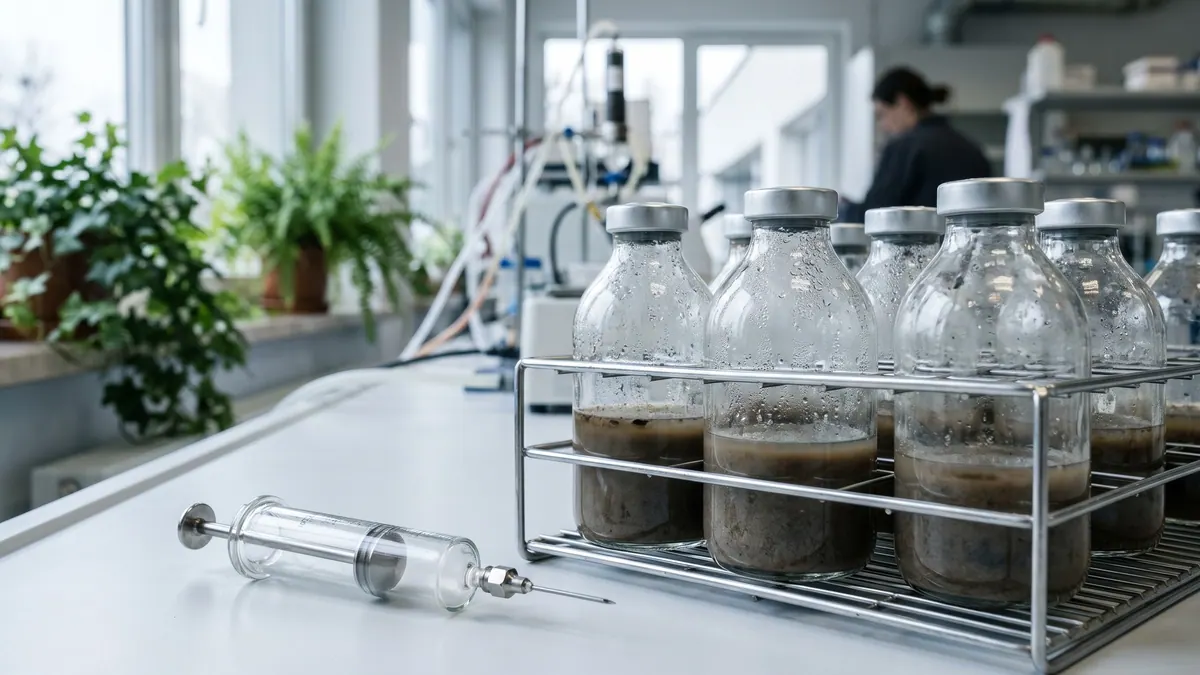
In the BMP test, biogas production is measured with three main techniques: manometrically (pressure increase in a closed bottle), volumetrically (volume of displaced liquid or a gas meter) and in systems with automatic gas meters; the gas composition is determined with a gas chromatograph (GC) or sensors. All methods require conversion to standard conditions (0 °C, 101.325 kPa, dry gas), and a result without this correction is unreliable.
Manometric method
A bottle of known working volume is closed, and the pressure increase is measured with a manometer or sensor. Excess gas is released periodically (at a pressure not exceeding the value resulting from the strength of the bottles and from the solubility of CO₂). The gas volume is calculated from the ideal gas law: n = pV/(RT), and then converted to standard conditions. Advantage: cheap and simple. Disadvantages: the effect of CO₂ solubility grows with pressure; at high pressure part of the CO₂ remains in the liquid, which understates the gas volume, but this does not apply to methane, which dissolves poorly.
Volumetric method
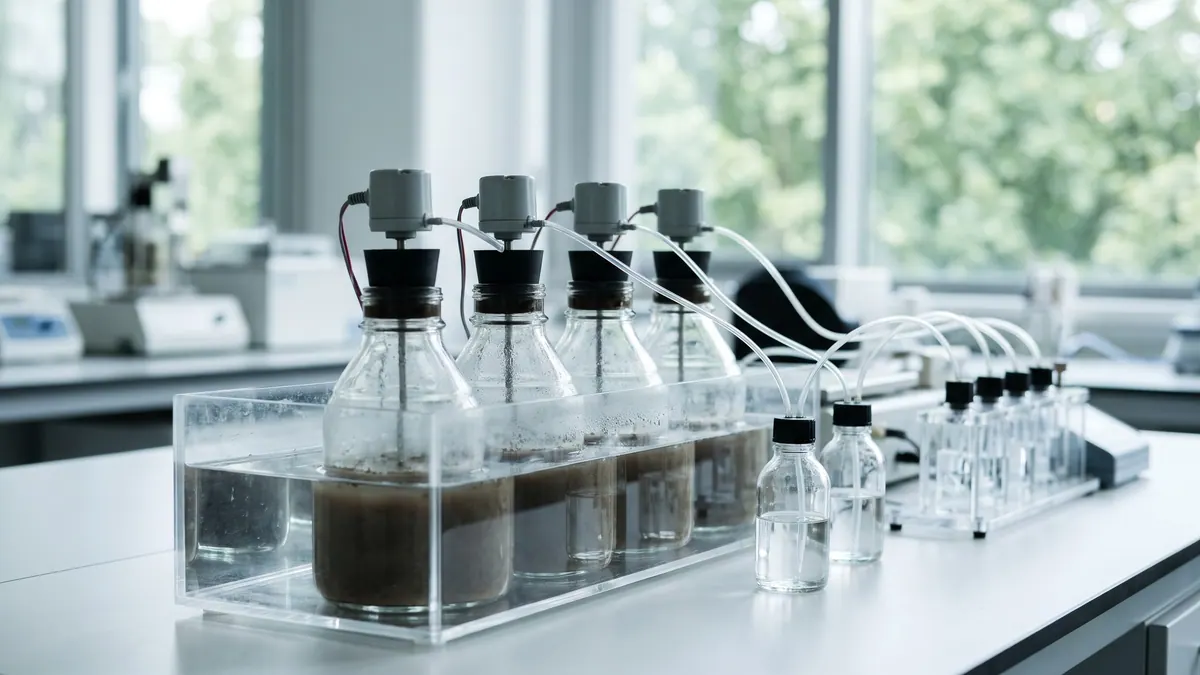
Gas from the bottle flows into a measuring cylinder with a barrier liquid (e.g. acidified water with limited CO₂ solubility) or into a gas meter. The displacement of the liquid indicates the volume. Advantage: direct reading in millilitres. Disadvantages: the effect of CO₂ solubility in the barrier liquid, readings dependent on barometric pressure, labour intensity.
Automatic gas meters
Systems with bubble-counting cells (tipping cell) or flow sensors record gas in real time, often after passing it through a hydroxide solution that binds CO₂ (CH₄ is then measured directly). These methods give good time resolution and make it possible to build a kinetic curve, but they require calibration and leak checks, and the alkaline solution must be replaced.
Gas composition analysis
| Method | Notes |
|---|---|
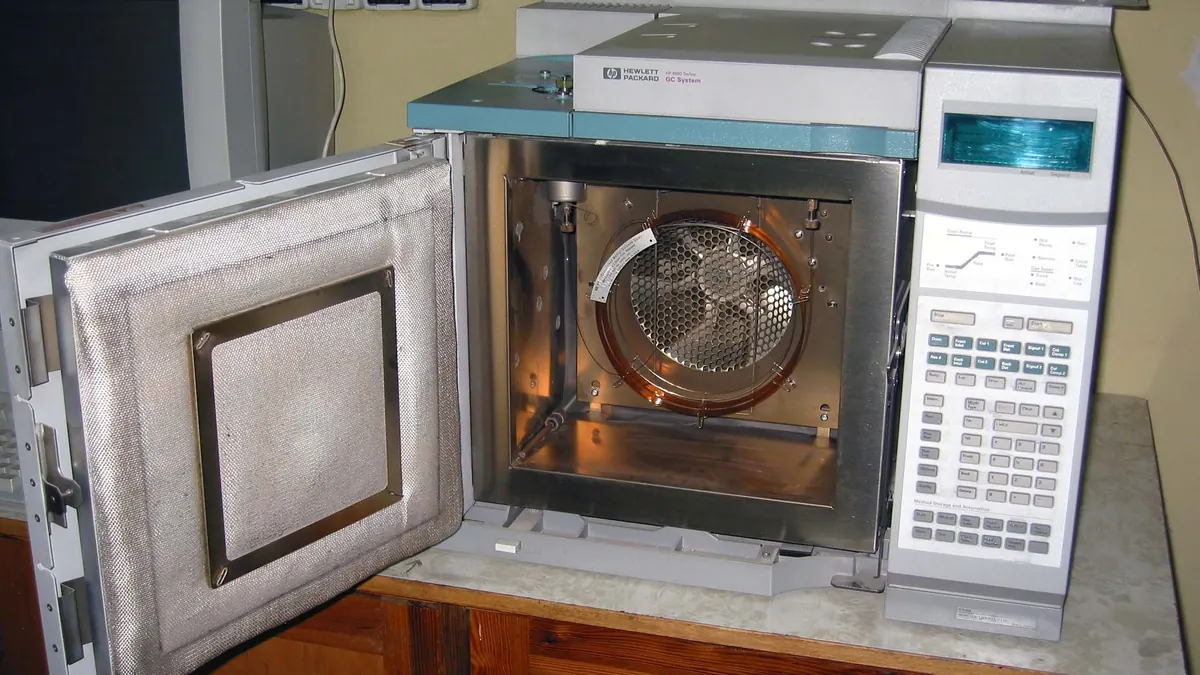
| GC with a TCD detector | standard: CH₄, CO₂, N₂, H₂, O₂; requires calibration with reference gases |
| NDIR sensors | fast for CH₄ and CO₂, require calibration, sensitive to moisture |
| CO₂ binding in NaOH | indirect method: the loss of volume is CO₂ |
Gas samples are taken with a gas-tight syringe with a septum. Each series should be preceded by calibration standards.
Conversion to standard conditions
V₀ = V × (p − p_H₂O) / 101.325 × 273.15 / T, where V — the measured volume, p — pressure (kPa), p_H₂O — water vapour pressure at the measurement temperature, T — temperature (K).
Example: 120 mL of gas saturated with vapour at 38 °C and p = 101.3 kPa was read. The water vapour pressure at 38 °C ≈ 6.6 kPa. V₀ = 120 × (101.3 − 6.6)/101.325 × 273.15/311.15 ≈ 120 × 0.9347 × 0.8779 ≈ 98.5 mL. Omitting the correction for water vapour and temperature would have given a result overstated by about 20%.
Standardised calculation methods
The open "Standard BMP Methods" collection (DBFZ), maintained by the group of authors of the BMP guidelines, contains separate descriptions of calculations for the volumetric, manometric, gravimetric and gas density-based methods. They take into account the composition of the gas in the space above the liquid, changes in volume when gas is released, and the amount of gas removed from the bottle. An approach based on a gas balance is more accurate than simply multiplying the volume by the CH₄ fraction from a single GC measurement, especially when the composition changes over time. The study by Hafner et al. (2020), in turn, shows how important correct data processing and entry are for the repeatability of results.
Most common errors
- Leaking closures (septum, stoppers) — gas escapes, result understated.
- Omitting water vapour — result overstated.
- No correction for the blank (production from the inoculum alone).
- Wrong reference temperature (e.g. room temperature instead of incubation).
- Different standard conditions (0 °C vs. 20 °C vs. 15 °C) in the compilation of results — always check in the report.
- Measuring in the bottle while it is being shaken.
Laboratory checklist
- leak test of the bottles before starting,
- calibration of manometers/gas meters and GC,
- recording of atmospheric pressure and temperature at each reading,
- documenting the frequency of gas release,
- explicit statement of the formulas in the report.
Gas measurement is simple in idea, but it is precisely the conversions and gas-tightness that account for a large part of the scatter of results between laboratories.
Example of calculating methane from GC
Let us assume that 60 mL of gas at standard conditions (after correction) was released from the bottle, and the GC analysis showed 62% CH₄ in the dry gas. The methane is 60 × 0.62 = 37.2 mL. If the bottle contained 1.00 g VS of substrate and the blank (for the same amount of inoculum) gave 8.0 mL CH₄, the net result is 29.2 NmL CH₄/g VS for this reading, and the cumulative result is obtained by summing successive readings. Standardised methods also take into account the methane remaining in the space above the liquid and its change between measurements.
Practical tips
Do not measure gas directly after taking the bottles out of the incubator — cooling changes the pressure. Use the same order of measurements and record the time. With large readings release gas more often to avoid high pressure and increased CO₂ solubility.
Choosing a method for the purpose
For routine testing of substrates a well-run manometric method with periodic gas release and GC analysis is sufficient. For kinetic studies, where time resolution matters, automatic systems are better. For research work with trace gases (H₂S, H₂) a GC with appropriate detectors is essential. Whatever the choice, the laboratory should demonstrate repeatability on the cellulose control and document calibrations.
Sources
Questions and answers
Which is more accurate: pressure or volume measurement?
Either method can be reliable if it is properly calibrated and the conversions are taken into account. What matters is avoiding leaks, controlling the temperature and correctly converting to dry gas at normal conditions.