BiomethaneExplainer
E-methane in Japan: a target of 1% in city gas by 2030 and 90% by 2050
Japanese gas companies intend to replace part of city gas with e-methane – synthetic methane from hydrogen and CO₂. The targets (1% in 2030, about 90% in 2050 according to METI), projects and limitations of this decarbonisation route.
Other language versions: polski.

Japanese gas companies are betting on e-methane – synthetic methane produced from green hydrogen and carbon dioxide – as the main route to decarbonising city gas. The Japan Gas Association (JGA) action plan, adopted in June 2021, sets two targets: in 2030, building a value chain with imports of e-methane and 1% e-methane in city gas supplies, and in 2050 carbon-neutral city gas in which e-methane is the main feedstock and the remainder is covered by direct use of hydrogen, biogas and other measures. Argus reported in May 2024 that the industry ministry is aiming for e-methane to make up 1% of city gas in 2030 and 90% in 2050.
Why e-methane
The partners in the UAE project stress (LNG Prime) that e-methane is compatible with existing LNG infrastructure – tankers and terminals – and with city gas infrastructure, including pipelines and customers' appliances. It therefore does not require rebuilding installations, unlike pure hydrogen. According to the JGA, the price of e-methane is determined mainly by the cost of electricity, which is why feasibility studies are carried out in regions with abundant renewable energy and near existing LNG terminals.
Key projects (as of August 2024)
- Cameron LNG (USA, Louisiana). Mitsubishi Corporation, Tokyo Gas, Osaka Gas, Toho Gas and Sempra Infrastructure Partners plan to produce e-methane in the USA and liquefy it at the existing Cameron LNG terminal. Target production is 130,000 t CH₄ a year (about 180 million Nm³ CH₄), i.e. about 1% of the three companies' combined demand in 2030. According to the JGA, a final investment decision (FID) is needed in 2025 for the 1% target for 2030 to be realistic; production is planned to start from fiscal year 2030.
- US Midwest. Osaka Gas, Tallgrass and Green Plains are studying a project with a capacity of up to 200,000 t CH₄ a year using blue hydrogen and biogenic CO₂.
- UAE. Tokyo Gas, Osaka Gas, Inpex and Masdar signed an agreement for a joint feasibility study of e-methane production in Abu Dhabi (23 January 2024); Masdar and Inpex had been conducting a similar study since July 2023. Tokyo Gas and Osaka Gas intend to take e-methane in an amount equivalent to 1% of each company's annual demand.
- Australia. Santos, Tokyo Gas, Osaka Gas and Toho Gas are conducting a pre-FEED study in the Cooper Basin.
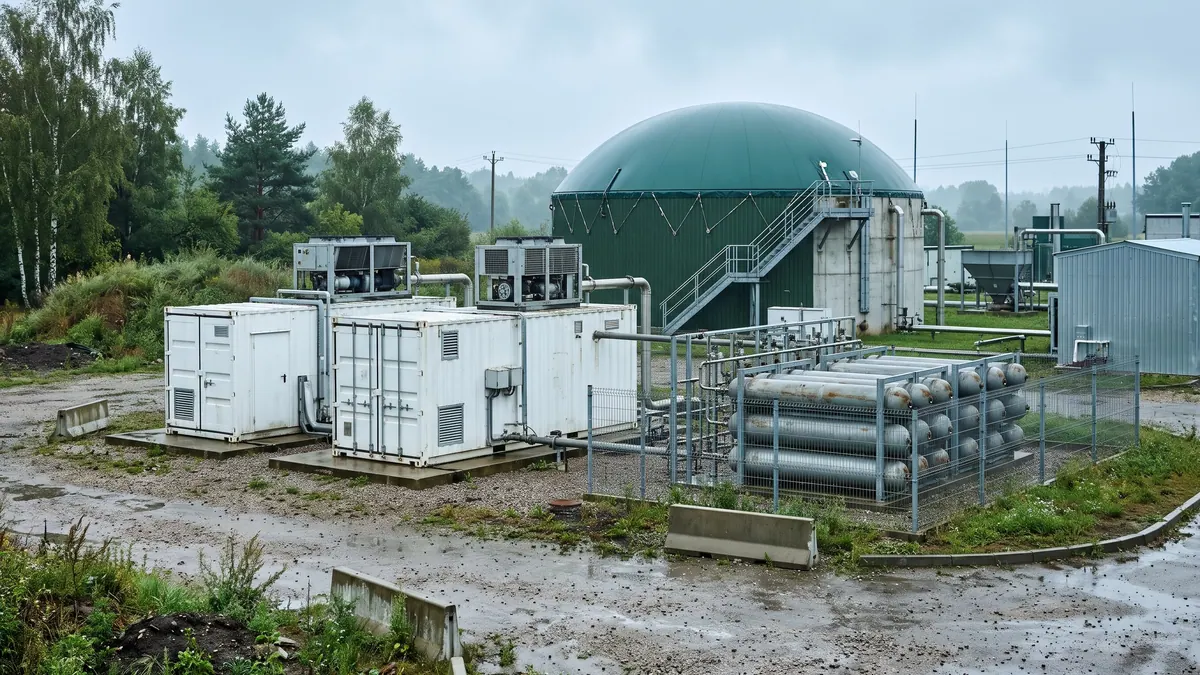
- Japan. In Nagaoka, main construction of a methanation test plant began in October 2023 (about 400 Nm³/h, injection into pipelines from fiscal year 2025); Hitachi Zosen tested production of 125 Nm³/h with the city of Odawara in 2022; JFE Steel and IHI are to build a 500 Nm³/h plant by the end of fiscal year 2024; in May 2024 research began on domestic production at the Oji Paper mill in Tomakomai; a scale of 10,000 Nm³/h in the Osaka port area was also studied.
Scaling up the technology
The JGA presents a pathway for scaling up production plants from 400 Nm³/h through 10,000 Nm³/h to 60,000 Nm³/h, with the cost depending on the cost of electricity, CO₂ sourcing and the cost of methanation equipment; in Chita, biological methanation at a scale of 5 Nm³/h began in 2024 in cooperation with the local authority, which shows the link between this technology and biogas.
Barriers
- Cost. The JGA points to electricity (dependent on hydrogen production), CO₂ sourcing and the cost of methanation equipment as the main cost components.
- CO₂ source. Projects consider biogenic CO₂ (Midwest and the feasibility study on biogenic e-methane by Osaka Gas, IHI and Petronas).
- Scale. The 90% target for 2050 is a policy scenario, not a market forecast – it requires building a global supply chain.
The role of biogas
In the JGA strategy biogas remains a complement: in 2050, together with direct use of hydrogen, it is to cover the part of city gas that does not come from e-methane. For Poland, with its large agricultural potential, the biomethane route remains more important in the medium term, but Japan's experience with e-methane shows how to make use of existing gas infrastructure.
Sources
Questions and answers
How does e-methane differ from biomethane?
Biomethane is produced from biogas (fermentation of organic waste), and e-methane from the reaction of hydrogen with CO₂ (methanation). Chemically it is the same CH₄, but e-methane requires large amounts of cheap electricity and a source of CO₂.
Related articles